
Do guardianship papers need to be notarized?
Some of them, yes — and the ones that do are never the ones people expect. Guardianship papers, meaning the filings in an adult guardianship or conservatorship case, split into two groups. Several supporting documents are sworn or notarized: New York requires the petition “verified under oath,” Texas and Florida require a guardian’s oath, and oaths are exactly what notaries administer. But the document that actually creates the guardianship — the court order appointing the guardian — is signed by a judge, and no notarization is required or even possible as a substitute for it.
That split is where families get burned. A “guardianship letter” signed at a notary’s desk feels official: seal, certificate, signature. It creates nothing. The notary’s certificate proves who signed the paper; it does not give one adult authority over another adult’s medical care, housing, or money. Only a court order does that, in every state this article checked against current statute text.
This guide covers adult guardianship and conservatorship — the court process that starts when someone, often a nursing-home or assisted-living resident, can no longer manage personal or financial affairs and no power of attorney exists. The paperwork for minors runs on different rails; there’s a short section on that near the end.
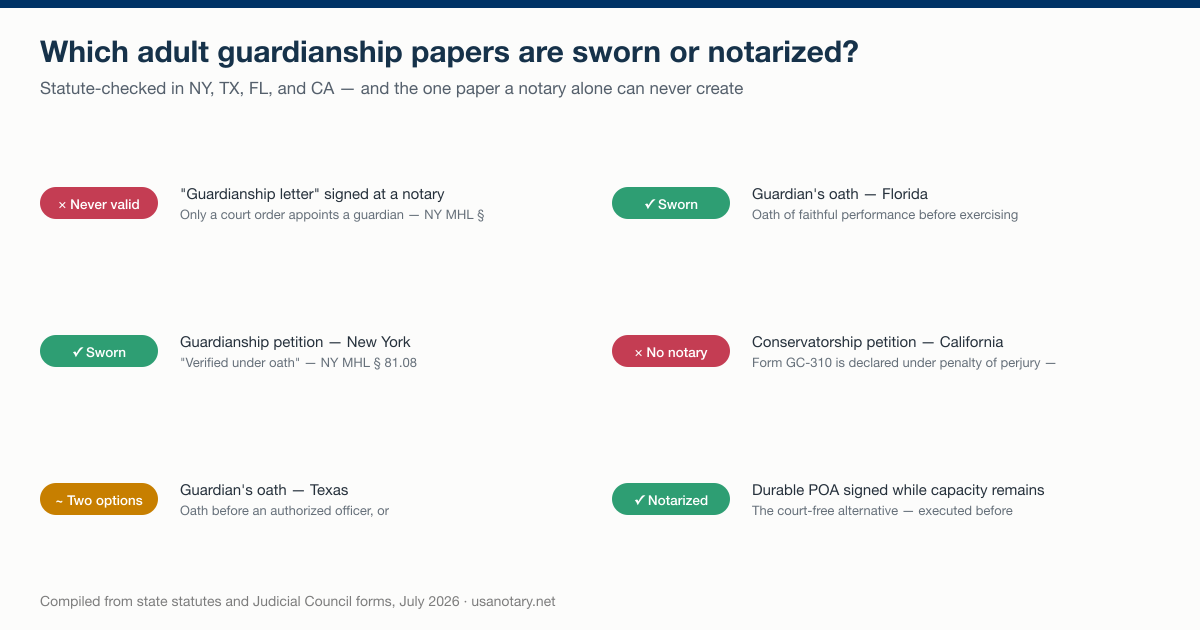
The statute-checked verdicts from this article — and the one paper a notary alone can never create, July 2026.
Why a notarized letter is not guardianship
A notarized letter creates no guardianship anywhere, because state law places the appointment power with a court, not with a notary. New York’s Mental Hygiene Law § 81.02 states it directly: “The court may appoint a guardian for a person if the court determines” that the appointment is necessary to provide for the person’s needs — food, clothing, shelter, health care, safety — or to manage the person’s property, and that the person either agrees or is incapacitated. Incapacity must be proven by clear and convincing evidence. California routes the same decision through a petition to the superior court on Judicial Council form GC-310, and the conservator’s authority begins only when the court grants it — the form’s own language is that “Letters issue upon qualification.”
The reason is the stakes. Guardianship strips an adult of decision-making rights and hands them to someone else; the National Council on Disability estimates 1.3 million people are subject to guardianship in America. Every one of those arrangements began with a petition, notice to the person and their relatives, and a judicial determination. Notice and a hearing are the protections; a notarized letter has neither.
What notarization actually contributes is narrower and still essential. A notary verifies the signer’s identity and, on sworn documents, administers the oath — the same oath that makes a New York petition verification or a Texas guardian’s oath legally meaningful. The seal authenticates execution. It never adjudicates capacity, and it never confers authority.
So when a bank, hospital, or skilled-nursing facility refuses a notarized “guardianship letter,” the refusal is correct. The document they can accept is the court’s order and the letters of guardianship or conservatorship issued under it.
Which guardianship papers are sworn or notarized, state by state
Notarization is required on specific documents inside the packet — and which documents depends on the state. Here is the picture across four major states, checked against current statute text and the official court form:
| State | Document | Sworn or notarized? | What the law says |
|---|---|---|---|
| New York | Article 81 guardianship petition | Yes — verified under oath | MHL § 81.08(a): “The petition shall be verified under oath” |
| Texas | Guardian’s oath or declaration | Sworn oath — or unsworn declaration | Est. Code § 1105.051: the guardian shall “take an oath to discharge faithfully the duties of guardian for the person or estate, or both, of a ward” or make a declaration under penalty of perjury |
| Florida | Oath of guardian | Yes — sworn | Fla. Stat. § 744.347: “every guardian shall take an oath that he or she will faithfully perform his or her duties as guardian” |
| California | Conservatorship petition (GC-310) | No notary | Signed “under penalty of perjury under the laws of the State of California”; CCP § 2015.5 lets declarations replace sworn affidavits |
Two caveats before relying on the table. First, it covers four states where the notarization question turns most clearly — it is not a 50-state survey, and guardianship statutes get amended. Second, individual county courts publish their own packets, and a local packet can add execution formalities the statute doesn’t mention. The court clerk’s checklist controls the paperwork you actually file.
Petition verifications are jurats, not acknowledgments
A verification is a sworn statement that the petition’s contents are true — which puts it in jurat territory, not acknowledgment territory. When New York says the petition “shall be verified under oath,” the petitioner swears before an officer authorized to administer oaths, and a notary public is the officer most families can actually reach. The notary administers the oath and completes the certificate; the petitioner risks perjury if the contents are false. That risk is the point — a guardianship petition asks a court to strip someone’s rights, and the verification puts the petitioner’s own credibility behind every factual allegation in it.
The guardian’s oath comes after the court says yes
The oath is a qualification step, not a filing step. Texas Estates Code § 1105.051 prescribes the wording — “I … do solemnly swear that I will discharge faithfully the duties of guardian” — and § 1105.052 says the oath “may be taken before any person authorized to administer oaths under the laws of this state,” a group that includes notaries public. Texas also offers an escape hatch: instead of the oath, the appointee may sign a written declaration that begins “I declare under penalty of perjury that the information in this declaration is true and correct.” Florida keeps the oath mandatory — a guardian takes it before exercising any authority — while the statute adds that “this oath is not jurisdictional,” meaning a missing oath is a defect to cure, not a void appointment.
California’s no-notary model
California solved the notarization question by legislating around it. Code of Civil Procedure § 2015.5 provides that whenever California law calls for a sworn statement, an unsworn declaration under penalty of perjury carries “like force and effect” — with narrow exceptions such as oaths of office and oaths required before a specified official other than a notary. The GC-310 conservatorship petition shows the result: eight pages, a penalty-of-perjury declaration above the petitioner’s signature, and no notary block anywhere on the form. A California family can complete the entire petition without a notary — and still cannot skip the courtroom.
Guardianship vs. conservatorship: which label your state uses
The process is the same court appointment everywhere; the labels change at the state line, and the label determines what your papers are called. California appoints a probate conservator of the person, the estate, or both, for an adult called the conservatee — form GC-310’s own subtitle reads “Probate—Guardianships and Conservatorships.” Texas appoints a guardian for a ward, and the oath language splits the role the same way: guardian of “the person,” “the estate,” or “the person and estate.” New York’s Article 81 guardian may be appointed for personal needs, property management, or both, per § 81.02.
The boundary that matters more than the label is the one between court-appointed authority and chosen authority. A guardian or conservator is appointed by a judge after capacity is already in question. An agent under a power of attorney is chosen by the person, in writing, while capacity remains. Where exactly that line falls — and why a dementia diagnosis alone doesn’t automatically end signing capacity — is covered in our guide to signing a power of attorney after a dementia diagnosis. If the document can still be signed, the courtroom can often be avoided entirely.
How the paperwork unfolds for a nursing-home resident
Adult guardianship follows the same arc in most states, and the sworn or notarized documents cluster at predictable points. Using California’s GC-310 packet as the concrete example — it is the most detailed official form this article reviewed — the sequence runs:
- Someone with standing files the petition. The GC-310 contemplates petitions from the spouse or domestic partner, relatives, an “interested person or friend,” a state or local public entity, a bank or trust company, or a licensed professional fiduciary. In New York, this is the document that is verified under oath; in California it is declared under penalty of perjury.
- Relatives get notice. The California form requires listing the spouse or registered domestic partner and all second-degree relatives — parents, grandparents, children, grandchildren, brothers and sisters — with residence addresses, so the court can notify them. Guardianship is never a private arrangement between two family members.
- Capacity evidence goes on the record. For orders involving a major neurocognitive disorder such as dementia, the GC-310 packet requires a Capacity Declaration (form GC-335) executed by a licensed physician, or by a licensed psychologist with at least two years of experience diagnosing major neurocognitive disorders. A doctor’s evaluation — not a notary’s certificate, not a family vote — is what the court weighs.
- The court holds a hearing and decides. New York’s standard is explicit in § 81.02: appointment must be necessary, and incapacity must be shown by clear and convincing evidence.
- The appointee qualifies: oath or declaration, and often a bond. Texas and Florida require the guardian’s oath at this stage. California’s form asks the court to fix a bond from an authorized surety company or to order funds into a blocked account. Letters issue upon qualification — and those letters, not any notarized page, are what banks and facilities accept.
- Reporting continues for the life of the case. Inventories, accountings, and status reports keep the court involved after appointment. Guardianship is not one filing; it is an ongoing court relationship.
For a facility, the practical takeaway sits in step 1 and step 5. Admissions teams and social workers meet families mid-crisis — a resident declining, no power of attorney on file, decisions stalled. The facility cannot create authority for anyone, but it can point families to the real process early and can make the sworn paperwork logistics — verifications, oaths, consents from out-of-state relatives where a state’s packet requires them notarized — fast instead of another month of delay. One more California detail worth knowing at the front desk: the GC-310 warns in bold, “Do NOT use this form for a temporary conservatorship” — emergency appointments run on a separate form (GC-111), because even the urgent version of guardianship stays inside the court.
The cheaper path: a durable POA signed while capacity remains
Guardianship is the fallback, not the plan — and the notarized document that prevents it costs a fraction of a court case. A durable power of attorney, signed while the parent can still understand what they’re signing, appoints an agent with no petition, no relative-notice list, no physician’s capacity declaration, no hearing, no surety bond, and no annual accountings. The entire court apparatus described above exists because no one signed that one document in time.
The sequencing is unforgiving. A power of attorney requires a principal with capacity; once capacity is lost, the signing window is closed and the court route is what remains. Families with a parent in assisted living or early-stage decline should treat the POA as urgent paperwork, not someday paperwork — our walkthrough on getting a power of attorney for an elderly parent covers agent selection and the family conversation, and the mechanics of how a power of attorney is notarized cover execution state by state.
One honest boundary: if capacity is genuinely gone, no notary can fix it. A notary who cannot confirm the signer understands the document is required to decline the notarization — and should. At that point the guardianship petition, with its physician evidence and judicial findings, is the legitimate tool. The two paths are not competitors; they are the before and after of the same deadline.
Can guardianship papers be notarized online?
The sworn pieces can be — where state law and the document’s rules permit. The National Association of Secretaries of State reports that 47 states and the District of Columbia have a law that allows for remote e-notarization, and the notarial acts inside a guardianship packet are ordinary ones: a jurat on a petition verification, an oath a notary is authorized to administer, an acknowledgment on a consent form. Texas’s own oath statute — “before any person authorized to administer oaths” — is indifferent to whether that person is across a desk or across a screen, so long as the notarization itself is lawful in the notary’s state.
Two qualifiers belong in writing before any session. First, confirm the court clerk’s rules: guardianship filings are court documents, and individual courts set their own e-filing and original-signature requirements. Second, where a form calls for witnesses, remote witnesses are supported where state law and the document’s rules permit — verify both before the hearing date, not after.
The logistics are where online notarization earns its place in this vertical. The petitioner is often an adult child in another state; the proposed guardian may live three time zones from the courthouse; the deadline is a hearing date that doesn’t move. A remote session runs over live video, takes 15–30 minutes, and is available 24/7 — including the evening hours when working family members can actually sit down together. Multi-signer sessions handle a co-petitioning sibling in another state in the same appointment. Identity is verified before the notary appears, through credential analysis of a government ID plus knowledge-based authentication run by a third-party identity service — a sturdier check than a glance at a driver’s license. The finished document is a tamper-evident PDF with a complete audit trail, and the session’s audio-video recording and electronic journal entry are retained for ten years or longer where state law requires — a record that exists precisely for proceedings where someone might later contest a signature.
Pricing is $25 per document, with volume pricing for teams that handle this paperwork weekly. Nursing homes, assisted-living communities, and elder-law practices that shepherd families through guardianship filings — plus the POAs that prevent them — can set up staff-initiated sessions through our online notarization service for healthcare and senior care teams, so the sworn paperwork happens at the bedside or the business office instead of a parking-lot notary hunt.
What about guardianship papers for a minor?
Minor guardianship is a different lane, and this guide doesn’t cover it. Court-appointed guardianship of a child runs through its own petitions and its own state forms. The documents most people actually mean when they search this — a grandparent enrolling a grandchild in school, a caregiver authorizing medical care during a parent’s deployment — are typically caregiver authorization and consent forms rather than court filings, and they follow school-district and state-form rules of their own. Those documents and their notarization requirements are covered through our education document notarization page.
The seal proves who signed; the order creates the guardian
That’s the whole rule. Notarization is required on real pieces of the guardianship packet — New York’s verified petition, the Texas and Florida oaths, notarized consents where a local packet demands them — and online sessions handle those in minutes. But no seal substitutes for the judge’s signature, and anyone offering a “notarized guardianship” without a courtroom is selling paper, not authority. Handle the sworn documents efficiently, get the POA signed while it still can be, and leave the appointment itself to the court, where it belongs.
Questions about a resident’s paperwork or a recurring facility workflow? Call 804-767-7500 or reach us through the contact page.