
Do nursing homes have notaries on staff?
Usually not. Nursing homes and assisted-living communities — even large campuses with hundreds of residents — typically do not keep a notary on staff. The question comes up constantly because the paperwork of later life concentrates inside these buildings: powers of attorney, advance directives, Medicaid paperwork, deeds, and affidavits all need a notary at exactly the moment the signer can no longer drive to a bank branch.
Two facts frame the answer. First, no federal rule requires a facility to provide notarial services: 42 CFR § 483.10, the resident-rights regulation for Medicare- and Medicaid-certified facilities, requires facilities to honor a resident’s designated representative and to inform residents of the right to formulate an advance directive — it never mentions a notary. Second, families confirm the staffing gap from experience. When a caregiver asked on AgingCare’s forum whether nursing homes have a notary available, respondents answered that facilities “most always do not” — and pointed instead to the social worker, volunteer notaries who visit facilities, mobile notaries who “do charge extra,” and one elder-law attorney who offered remote notarization by video.
So the real question behind “do nursing homes have notaries” is what a family — or an admissions coordinator staring at an unsigned power of attorney — does next. This guide answers the staffing question first, then compares the four routes that actually exist, with the state witness rules and cost mechanics that decide between them. The hands-on logistics of the signing itself — ID rules, what happens when the signer can’t hold a pen — live in our separate guide to getting a notary to a homebound or hospitalized signer; this page stays on the availability question.
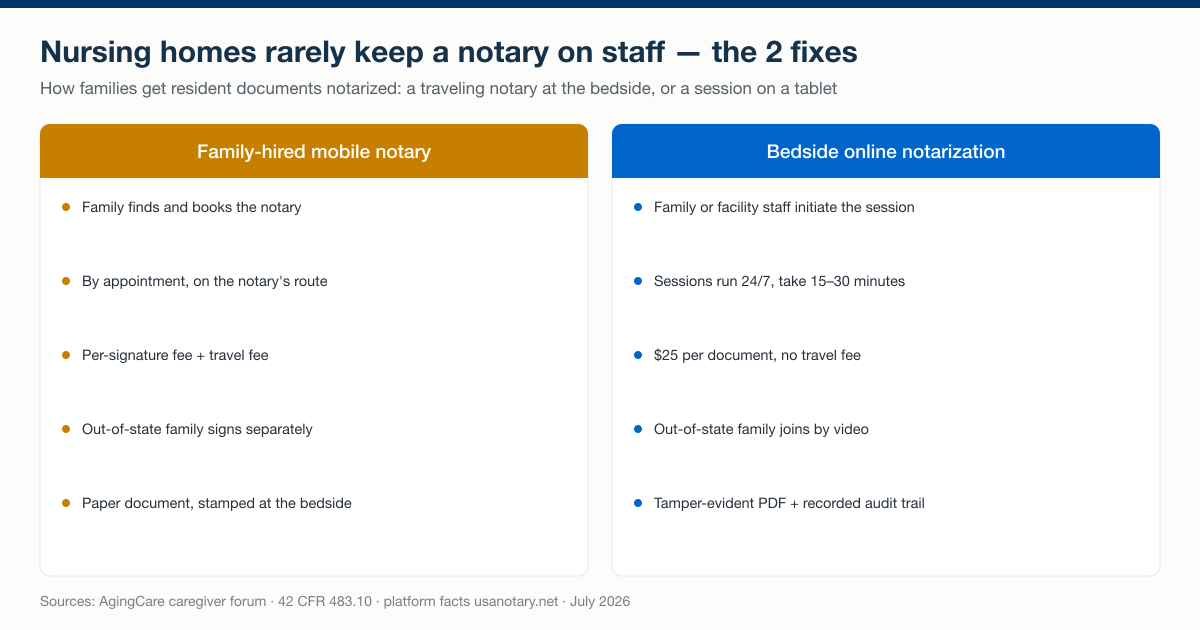
The two working routes when a nursing home resident needs a notary — most facilities don’t keep one on staff, so the notary either travels in or appears on a screen.
Why don’t nursing homes keep a notary on staff?
Nursing homes avoid in-house notaries because state law makes an employee notary least useful on exactly the documents residents need most. The gap isn’t indifference — it’s two legal problems stacked on top of a practical one.
The disqualifying-interest problem
A notary is disqualified from notarizing documents the notary is connected to. Virginia’s rule is a clear example: Va. Code § 47.1-30 provides that no notary shall perform a notarial act on a document “to which the notary or his spouse is a party, or in which either of them has a direct beneficial interest,” or where the notary “is a signatory or is named in the document.” Virginia treats a violation as official misconduct and makes the resulting notarization voidable.
Map that onto a facility employee’s actual workday. The admission agreement names the facility. The payment authorization names the facility. The personal-funds paperwork names the facility. The documents an employee notary could safely handle are precisely the ones the facility has no role in — and the ones crossing the business office’s desk every day are the ones the disqualification reaches. An employee’s notarization on facility-interested paperwork is the detail a lawyer attacks first when a transfer or agreement is later contested, because the neutrality a notarization is supposed to add came from someone on the facility’s payroll.
The witness bars: staff often can’t even sign as witnesses
Separate from notarization, state law disqualifies facility staff from the witness seats on the health care and estate documents residents sign most. Three fetched-and-checked examples show how consistently legislatures wrote facility employees out of the room:
| State | Document | How it’s executed | Who at the facility is disqualified |
|---|---|---|---|
| California | Advance health care directive | Acknowledged before a notary or signed by two qualified witnesses (Prob. Code § 4673) | Employees of the patient’s health care provider, and operators or employees of community care facilities and residential care facilities for the elderly, cannot witness (§ 4674). In a skilled nursing facility, a patient advocate or ombudsman must additionally sign “either as one of two witnesses or in addition to notarization” (§ 4675) |
| Texas | Medical power of attorney | Signed before two qualified witnesses or acknowledged before a notary public (HSC § 166.154) | At least one witness may not be an employee of the attending physician, a facility employee providing direct patient care, or an officer, director, partner, or business-office employee of the facility or its parent organization (§ 166.003) |
| North Carolina | Living will (declaration of a desire for a natural death) | Signed before two qualified witnesses and proved before a clerk of court or notary public (G.S. § 90-321) | Paid employees of the health facility in which the declarant is a patient — nursing homes named explicitly — cannot witness (§ 90-321) |
| Virginia | Any notarized document | Standard notarization | The notary is disqualified from any document to which the notary is a party, a signatory, named in, or holds a direct beneficial interest (§ 47.1-30) |
Three details in that table decide real signings. California’s skilled-nursing rule is the strictest: even a notarized advance directive is not effective for an SNF resident unless a long-term-care patient advocate or ombudsman also signs as a witness — notarization alone does not cure it. Texas runs the other direction: notarization replaces the witness requirement on a medical power of attorney entirely, which is why a notary at the bedside — physical or on video — often solves the witness problem in one move. North Carolina stacks both: a living will needs two qualified witnesses and a notary or clerk. Which seat a state lets the notary fill is covered in more depth in our guide to when you need a witness for a notarization.
”Can’t we just get an employee commissioned?”
Administrators ask this after the third scramble for an outside notary in a month, and the honest answer is: you can, and it will help less than you expect. Nothing in state notary law forbids a facility from sponsoring a business-office employee’s commission — the process is inexpensive, and becoming a notary takes weeks, not months in most states. But the commission does not erase the two problems above. The employee notary is still disqualified from facility-interested paperwork, still barred from the witness seats statutes reserve for outsiders, and still leaves the facility explaining — in any later dispute over a resident’s power of attorney — why the impartial officer at the signing drew a facility paycheck. Staff turnover then resets the whole investment. Facilities that do the math usually conclude the notary should not work for them at all; the workable version of “in-house” is an outside notary the facility can summon on demand, which is what a staff-initiated online session is.
What do families actually do when a resident needs a notary?
Families use one of four routes, and most learn them in this order — usually while a durable power of attorney for an elderly parent sits unsigned:
- Ask the facility for a referral. The social worker or business office is the right first stop — the AgingCare thread’s own consensus. Some facilities keep relationships with notaries who visit as volunteers; availability is real but unscheduled, and it evaporates on weekends and evenings.
- Hire a mobile notary. A commissioned notary drives to the facility, checks ID at the bedside, and completes the notarization on paper. This is the traditional workhorse: reliable when booked ahead, dependent on the notary’s route and hours, and priced as a per-signature fee plus a travel fee.
- Transport the resident to a notary. A bank branch or shipping store notarizes for customers during business hours. For a resident who still travels comfortably this works; for most nursing-home residents, arranging wheelchair transport and a lobby wait for a five-minute stamp is the option families try exactly once.
- Run a remote online notarization at the bedside. The resident signs on a tablet or laptop over live video with a commissioned online notary. The National Association of Secretaries of State reports that 47 states and the District of Columbia have a law allowing remote e-notarization — this is the route that removes both the travel and the scheduling constraint, and the one facilities can initiate themselves.
Side by side:
| Facility referral / volunteer | Mobile notary visit | Transporting the resident | Bedside online notarization | |
|---|---|---|---|---|
| Who arranges it | Family, via the social worker | Family finds and books | Family handles transport | Family — or facility staff initiate the session |
| When it can happen | When a volunteer is available | By appointment, on the notary’s route | Branch business hours | Sessions run 24/7 |
| Cost structure | Varies by arrangement | Per-signature fee + travel fee | Transport + standard notary fees | $25 per document, no travel fee |
| Out-of-state family co-signing | Separate signing later | Separate signing later | Separate signing later | Joins the same multi-signer session by video |
| Record produced | Paper document | Paper document | Paper document | Tamper-evident PDF + complete audit trail, with audio-video recording and an electronic journal retained 10 years or longer where state law requires |
The fourth column’s last two rows are the quiet differentiators. Senior-care documents are exactly the ones challenged years later — by a sibling contesting a power of attorney, by a Medicaid caseworker questioning a transfer — and a recorded session with a retained journal is a stronger evidentiary record than a stamp recalled from memory. And because so many adult children live out of state, a multi-signer session that puts the Ohio daughter and the Florida resident in front of the same notary at the same time replaces two separate signings with one.
How does a bedside online notarization session work in a nursing home?
A bedside session needs three things the facility already has — a tablet or laptop, a connection, and a quiet room — and it runs the same way whether a family member or the facility initiates it:
- Prepare the document as a PDF. The attorney or family uploads the power of attorney, directive, affidavit, or Medicaid form. The notary notarizes what’s presented — drafting stays with the attorney.
- Start or schedule the session. Family can begin immediately; facilities that handle signings regularly use staff-initiated workflows, where an admissions coordinator or social worker sends the session link to the resident’s tablet and the family’s phones.
- The resident verifies identity. A third-party identity-verification service runs credential analysis on the resident’s ID and a knowledge-based-authentication quiz. Signers can complete this in all 50 states.
- The notary meets the resident on live video. The notary confirms identity, confirms the resident understands and wants to sign, and watches the signature happen. Sessions take 15–30 minutes; out-of-state relatives join the same session as co-signers, and remote witnesses are supported where state law and the document’s rules permit.
- The completed document returns as a tamper-evident PDF. The audio-video recording and electronic journal entry are retained for 10 years or longer where state law requires — the audit trail a contested document needs.
One requirement does not relax on video, and families should plan around it: capacity. A notary refuses the act when not satisfied that the signer “is competent or has the capacity to execute the record” and that the signature “is knowingly and voluntarily made” — the standard as Oregon’s ORS 194.245 words it, and the judgment every state expects its notaries to make. A diagnosis alone doesn’t bar signing; lucidity at the moment of signing is what the notary evaluates. Schedule the session at the resident’s clearest hour, clear the room of anyone who might be pressuring the signature, and read our guide on how dementia changes who can sign before the window narrows. A refused session is not a failure — it’s the system working — and rescheduling for a better hour is routine.
What does getting a notary to a nursing home cost?
Online notarization is priced per document: $25, with volume pricing for facilities and families with stacks of paperwork — and no travel component, because nobody travels. A mobile notary’s bill has two parts: the notarial fee itself, which states cap per signature, and the travel fee, which most markets price by distance and urgency — the “extra” the AgingCare respondents flagged.
The multiplier that decides the comparison is document count. A typical move-in generates several notarizations in the first month — the durable power of attorney, an advance directive where the state’s form uses a notary, Medicaid-related affidavits, sometimes a deed or trust certification. Per-visit pricing charges the travel premium every trip; per-document pricing doesn’t care whether the paperwork arrives in one urgent bundle or spread over a year. For a facility whose residents need notarizations weekly, the difference compounds — which is why the cost conversation belongs to the business office, not just to families.
What can facility staff set up before the need is urgent?
Admissions coordinators and social workers can remove almost all of the scramble by treating notary access as an admission-planning item instead of an emergency:
- Ask the notary question at admission. “Does anyone need to sign a power of attorney, directive, or Medicaid paperwork in the next 90 days?” catches the documents while the resident’s capacity and ID are strongest.
- Check the ID early. Identity verification — bedside or online — starts with a current government ID. Flag expired licenses at intake and start the state-ID replacement before any signing deadline appears.
- Keep a session-ready tablet. One charged tablet with a camera and a quiet room is the whole hardware requirement for a bedside session.
- Set up a staff-initiated workflow. Facilities that route signings through our online notarization service for healthcare and senior-care teams let staff open sessions on demand — the on-call notary the facility never has to employ, with none of the disqualification problems an employee notary carries.
- Schedule around the resident. Book sessions at the resident’s most lucid hour and note it in the care plan; the capacity standard above is easier to meet at 10 a.m. than at dusk.
The short answer, and the workaround
Do nursing homes have notaries? Almost never on staff — and the statutes above explain why the ones that tried found an employee notary useless on the documents that matter. The workaround used to be a traveling notary’s schedule. Now the notary appears on a tablet: 24/7, $25 per document, out-of-state family in the same session, and a recorded audit trail attached to the exact documents most likely to be questioned later.
Setting this up for one parent or a 200-bed facility takes about the same effort. Call 804-767-7500 or reach us through the contact page — and if the signer is at a hospital rather than a long-term-care facility, the bedside guide linked above walks through that setting step by step.