
Does a mechanics lien need to be notarized?
In most states, yes. A mechanics lien — the claim a contractor, subcontractor, or supplier records against real property to secure payment for work on a construction project — must be sworn, verified, or acknowledged before it is recorded in the majority of states, and in the sworn-claim states that oath is administered by a notary. That real-estate construction lien is what this guide covers. The “mechanic’s lien” a repair shop asserts against a car title is a different instrument under motor-vehicle law, handled through our vehicle and title notarization services.
The lien claim also gets confused with its opposite number. A mechanics lien asserts a payment claim against the property; a lien waiver gives up lien rights in exchange for payment — and the notarization rules run in opposite directions. Most states require the claim to be sworn, while almost no state requires a notarized waiver. The waiver side lives in our separate guide to whether a lien waiver needs to be notarized; everything below is about the claim.
The two most-read state surveys disagree on the exact count — 29 states plus D.C. in one, 36 states in the other — but they agree on the direction: notarization is required for the lien claim in most of the country, and the requirement sits in each state’s lien statute, not in any federal rule. Nine of those statutes, checked against current text in July 2026, follow.
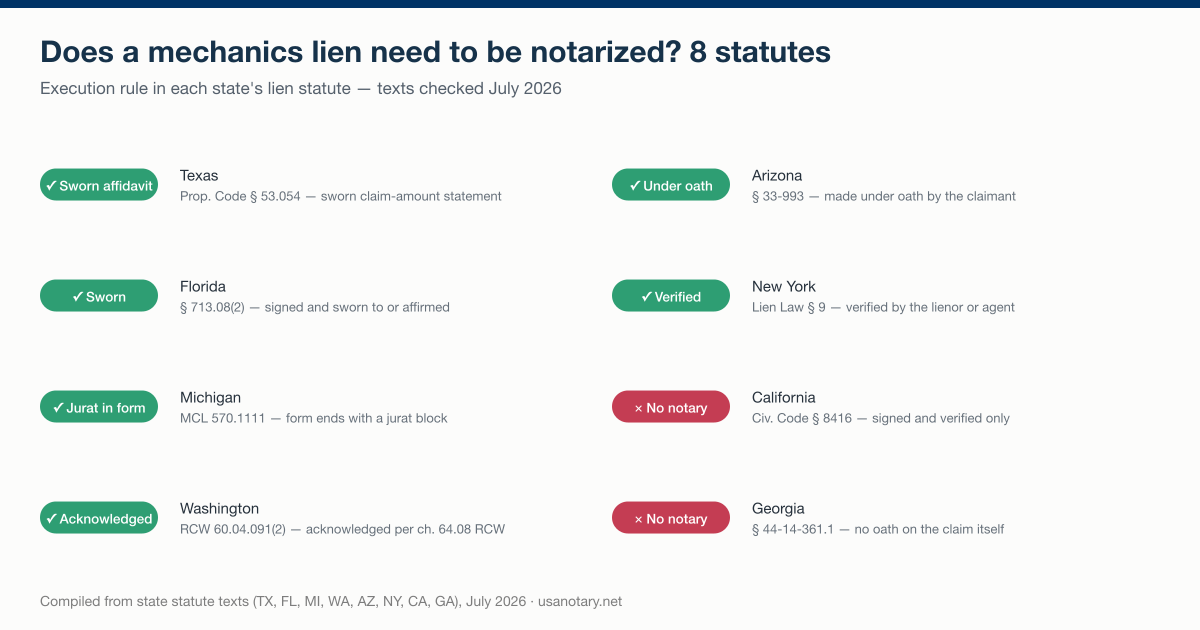
What each state’s lien statute requires on the claim’s signature line — statute texts checked July 2026.
Which states require a mechanics lien to be notarized?
Seven of the nine lien statutes reviewed for this article require the claim to be sworn, verified, or acknowledged — California and Georgia are the clear exceptions. Here is what each statute’s own text says, with the general filing deadline from the same chapter:
| State | Notarization required? | What the statute says | General filing deadline |
|---|---|---|---|
| Texas | Yes — sworn affidavit | Tex. Prop. Code § 53.054 requires the lien affidavit to contain “a sworn statement of the amount of the claim” and to be “signed by the person claiming the lien or by another person on the claimant’s behalf” | 15th day of the fourth month after last work — third month on residential projects (§ 53.052) |
| Florida | Yes — sworn | Fla. Stat. § 713.08(2): the claim of lien “shall be signed and sworn to or affirmed by the lienor or the lienor’s agent acquainted with the facts”; the statutory form ends “Sworn to (or affirmed) and subscribed before me” | Not later than 90 days after final furnishing |
| Michigan | Yes — jurat in the form | The statutory claim-of-lien form in MCL 570.1111 closes with “Subscribed and sworn to before me” over notary public signature and commission lines | Within 90 days after last furnishing |
| Washington | Yes — acknowledged | RCW 60.04.091(2): the claim shall be signed by the claimant, state it is “true and correct under penalty of perjury,” and “shall be acknowledged pursuant to chapter 64.08 RCW” | Not later than 90 days after ceasing to furnish |
| Arizona | Yes — under oath | A.R.S. § 33-993: “The notice and claim of lien shall be made under oath by the claimant or someone with knowledge of the facts” | Within 120 days after completion — 60 days if a notice of completion is recorded |
| New York | Yes — verified | N.Y. Lien Law § 9: the notice “must be verified by the lienor or his agent, to the effect that the statements therein contained are true to his knowledge” | — |
| Illinois | Yes — verified by affidavit | 770 ILCS 60/7: the contractor files “a claim for lien, verified by the affidavit of himself or herself, or his or her agent or employee” | 4 months after completion; up to 2 years as against the owner |
| California | No | Cal. Civ. Code § 8416 requires “a written statement, signed and verified by the claimant” — the section contains no notarization or acknowledgment requirement | — |
| Georgia | No | O.C.G.A. § 44-14-361.1 imposes no oath on the claim of lien itself; only the later notice filed in a lien action is “executed, under oath,” and even that omission “shall be an amendable defect” | Within 90 days after completion of the work |
The ”—” deadline cells mean the deadline section of that state’s statute was outside this article’s review, not that no deadline exists — every lien statute runs on a clock.
Texas deserves its own paragraph, because the statute builds the oath into the document’s name. Chapter 53 calls the recorded claim a lien affidavit, and § 53.054 never uses the word “notary” — it doesn’t have to. An affidavit is a written statement sworn before an officer authorized to administer oaths, and the section’s required “sworn statement of the amount of the claim” is exactly what a notary’s jurat certifies on the finished document. Miss the oath and the document stops being an affidavit at all. The deadline runs on the calendar rather than a day count: the affidavit must be filed by the 15th day of the fourth month after the month the claimant last provided labor or materials — the third month on residential projects — which is why Texas lien teams live and die by the 15th.
Two caveats on the table. First, this is a nine-state review checked against current statute text, not a 50-state survey — lien statutes get amended, and the right state page or construction counsel should confirm before a filing rides on it. Second, the deadlines shown are the general rules from the cited sections; several states run alternate clocks alongside them, like Arizona’s 120-day window collapsing to 60 days once a notice of completion is recorded.
Why do the popular state-by-state lists disagree?
Because “notarized” is doing three different jobs in fifty different statutes. The two most-cited surveys illustrate it: Levelset’s guide (updated May 19, 2025) names 29 states plus Washington D.C. where a lien claimant needs “the name of a good notary,” files 12 states — California, Georgia, and Illinois among them — under no notarization or attestation requirement, and classifies Texas separately as requiring attestation but not a notary. Siteline’s guide (updated June 25, 2026) counts 36 states plus D.C. and puts it flatly: “More states than not require mechanics’ liens to be notarized.” Same country, same statutes, seven states apart.
The gap is classification, not sloppy research. State lien statutes use at least four different execution verbs — sworn to (Florida), under oath (Arizona), verified (New York, Illinois, California), acknowledged (Washington) — and each surveyor decides which verbs count as notarization. “Verified” is the troublemaker. Illinois shows the problem in a single section: Levelset files Illinois under “no attestation,” yet 770 ILCS 60/7 requires the contractor’s recorded claim to be “verified by the affidavit of himself or herself, or his or her agent or employee” — and an affidavit is by definition a sworn document. California shows the mirror image: Civil Code § 8416 also uses “verified” — a claim “signed and verified by the claimant” — but the section contains no notarization or acknowledgment requirement anywhere, so the no-notary classification holds. Identical verb, opposite outcomes.
Texas is the third trap: Levelset classifies it as attestation-without-notarization, while the statute’s own document is an affidavit containing “a sworn statement of the amount of the claim.” However a survey files it, an unsworn Texas lien affidavit is a contradiction in terms.
The practical rule that falls out of all this: read the execution sentence of your project state’s lien statute — or have counsel read it — before trusting any survey’s column, including the table above. The statute’s verb, not the survey’s checkbox, decides what the notary has to certify.
Jurat or acknowledgment: which notarial act does the statute require?
When notarization is required, the statute usually tells you which notarial act — and the two acts are not interchangeable. Florida’s statutory claim-of-lien form closes with “Sworn to (or affirmed) and subscribed before me” — that is a jurat, meaning the signer swears in the notary’s presence that the claim’s contents are true. Michigan’s form ends the same way: “Subscribed and sworn to before me,” over the notary’s signature and commission lines. Washington took the other fork: RCW 60.04.091(2) has the claimant sign a penalty-of-perjury statement and then requires the claim to be “acknowledged pursuant to chapter 64.08 RCW” — an acknowledgment, where the notary certifies the signer’s identity and that the signature was voluntary, without administering an oath.
The distinction decides what happens inside the notary session. Under a jurat, the notary administers a verbal oath or affirmation and watches the signature happen; under an acknowledgment, the signer declares an existing or new signature to be theirs. A notary cannot choose the certificate for you — selecting the notarial act on an uninstructed document is legal advice a notary is not allowed to give — so the statutory form or your attorney’s instruction has to name the act before the session starts. Our breakdown of how a jurat and an acknowledgment differ covers both certificates in detail, and the oath-and-signature walkthrough for affidavits shows the jurat side in practice, since most lien claims sit on that side of the line.
One more sense-check while you’re reading your form: “verification” on a lien claim means the sworn-truth statement discussed above, not the identity checks a notary or platform performs. A New York notice of lien is “verified” when the lienor swears its statements are true — the word describes the document’s oath, not the signer’s ID.
How do you notarize a mechanics lien affidavit online before the filing deadline?
Lien deadlines are statutory and unforgiving, and the oath is usually the last step standing between a finished claim and the recorder. Texas gives most claimants until the 15th day of the fourth month after their last work; Florida, Michigan, Washington, and Georgia run 90-day windows; Arizona allows 120 days at most. The traditional bottleneck is appearance: the affiant — typically an owner, officer, or credit manager with personal knowledge of the claim amount — has to get in front of a notary with the document, on a business day, before the clock runs out.
Remote online notarization removes the appearance problem where notarization is required. The National Association of Secretaries of State reports that 47 states and the District of Columbia have a law allowing remote e-notarization, so the oath can be sworn over live video instead of across a counter. The sequence for a lien affidavit:
- Prepare the claim for your project state. Use the statutory form or counsel’s draft. The notary administers the oath and completes the certificate — a notary does not draft the claim, verify the amounts, or pick the certificate for an uninstructed document.
- Upload the PDF and verify identity. Identity verification runs before the session through credential analysis of a government ID plus knowledge-based authentication, handled by a third-party identity service.
- Join the video session. A commissioned notary meets the affiant on live audio-video. Sessions run 24/7 and take 15–30 minutes — deadline-week filings don’t wait for business hours, and signers can connect from any of the 50 states.
- Swear the oath on camera. For jurat states like Florida and Michigan, the notary administers the oath and watches the signature; for an acknowledgment state like Washington, the signer acknowledges the signature instead. If company practice puts two names on the claim — an officer plus a witness where the document’s rules permit — a multi-signer session handles both in one sitting.
- Receive the sealed document. The session produces a tamper-evident notarized PDF with a complete audit trail, and the audio-video recording and electronic journal entry are retained for 10 years or longer where state law requires — a durable record if the lien’s execution is ever challenged in a payment dispute.
One wrinkle worth settling in advance: if the affiant is in a different state than the project — a superintendent filing on an out-of-state job, say — the notarization’s validity is governed by the notary’s commission state, and notarial acts are recognized across state lines. Our guide to remote notarization’s validity across state lines covers the recognition rules.
The cost side is flat: $25 per document, with volume pricing for teams that file monthly. Construction back offices that handle lien affidavits, sworn statements, and closeout paperwork on a draw cycle can set up staff-initiated sessions through our online notarization workflows for construction teams — the office prepares the document and the affiant just joins and swears.
Will the county recorder accept a remotely notarized lien?
Recording is a separate, county-level step — and it is the question to settle before the session, not after. A remote session produces an electronically signed and notarized PDF, but a mechanics lien only does its job once it is recorded: Florida’s claim is “recorded” in the clerk’s office, the Texas affidavit is “filed” with the county clerk, Washington’s claim is recorded within its 90-day window. The notarization can be flawless and the filing still fails if the recorder’s intake can’t take the format.
Practical questions for the recorder’s office in the project county, asked while there is still deadline slack:
- Does the county accept e-recording for construction lien documents, and through which e-recording channels?
- Will it accept an electronically notarized PDF as submitted, or does it apply different requirements to electronic notarizations?
- If the county requires paper, what procedure does it accept for producing a recordable paper version of an electronically notarized document?
- How long does intake take at the deadline — same-day e-recording versus mail or counter processing?
Build the answer into the deadline math. A claimant with ten days of slack can afford a county that processes paper by mail; a claimant swearing the affidavit on the 13th for a 15th-of-the-month Texas deadline needs e-recording or a counter run. When the answer is unclear, the safe sequence is to notarize early and leave recording days in reserve — the session itself takes minutes, and the recorded date, not the notarization date, is what perfects the claim.
Get the lien affidavit sworn before the deadline
The rule to remember: the lien claim is sworn in most states; the lien waiver almost never is. Read the execution sentence in your state’s statute, match the notarial certificate to its verb, and leave recording time inside the deadline. When the statute requires notarization and the deadline is close, a 15–30 minute video session gets the oath done the same day the claim is finalized — from the office, the truck, or the jobsite trailer.
Questions about a lien affidavit filing or a recurring draw-cycle workflow? Call 804-767-7500 or reach us through the contact page.