
What is a mechanic’s lien on a car?
A mechanic’s lien on a car is a possessory lien: the repair shop, tow company, or storage yard holding the vehicle keeps it until the bill for repair, towing, or storage charges is paid, and state law lets the business sell the vehicle at a public lien sale if the bill stays unpaid. This is not the construction mechanic’s lien that contractors record against buildings and land — that lien attaches to real property, and its paperwork lives with our online notarization service for construction teams. This guide is written for the vehicle side of the phrase: the shop with a finished repair nobody claimed, the wrecker with a car aging in the yard, the storage lot watching charges accrue on a title that isn’t theirs.
The two liens share a name for a historical reason, and an official Massachusetts source spells it out. The Massachusetts Trial Court Law Libraries — who field this exact confusion constantly — write that a mechanic’s lien “has nothing to do with auto mechanics”: it is “a lien on real property that may secure payment for labor or materials furnished for construction projects.” The “mechanic” in the name is an old English word for a tradesperson who works with their hands. Thomas Jefferson lobbied for the first mechanic’s lien laws in 1791 to protect the builders constructing the new national capital; when the automobile arrived, “mechanic” migrated to car repair, and the two-liens-one-name confusion was born.
The vehicle version goes by cleaner names in most statutes: a garage keeper’s lien in Massachusetts, a possessory lien in Oklahoma’s Title 42, a worker’s lien in Texas, a lien “dependent upon possession” in California. Whatever the label, the machinery is the same everywhere: the lien arises from unpaid vehicle charges, it generally survives only while you hold the vehicle, and it converts into a transferable title through the notice-and-sale process this guide walks through, statute by statute. (Landed here looking for construction payment paperwork instead? Our state-by-state guide to whether lien waivers need notarization covers that world.)
Who can claim a mechanic’s lien on a car?
Any business that repairs, tows, or stores a vehicle at the owner’s request can claim a mechanic’s lien on a car under the statutes we checked — but each statute defines the covered services precisely, and the differences decide whether your charges are lienable at all.
California casts the widest net. Civil Code § 3068 gives “every person” a “lien dependent upon possession” for compensation owed for “making repairs or performing labor upon, and furnishing supplies or materials for, and for the storage, repair, or safekeeping of, and for the rental of parking space for, any vehicle.” Repair, parts, storage, safekeeping, even parking-space rental — one section covers them all.
Maryland attaches two conditions that do real work. Commercial Law § 16-202 gives the lien to “any person who, with the consent of the owner, has custody of a motor vehicle and who, at the request of the owner, provides a service to or materials for the motor vehicle” — covering charges for “repair or rebuilding,” “storage,” and “tires or other parts or accessories.” Custody with consent, service at the owner’s request: a yard holding a car the owner never authorized has a weaker claim than a shop with a signed repair order.
Texas splits the lien by trade. Property Code § 70.001 — the worker’s lien — lets a worker who repairs a motor vehicle retain possession until the contract amount is paid, “or if no amount is specified by contract, the reasonable and usual compensation.” The lien is possessory in the strictest sense: it ends when the shop is paid or gives the vehicle back, whichever comes first.
Oklahoma bundles the trades into one “special lien.” Under 42 O.S. § 91(A), any person lawfully in possession who furnishes “storage, rental space, material, labor or skill for the protection, improvement, safekeeping, towing, right to occupy space, storage or carriage” of the vehicle holds a lien dependent on possession — the section tow operators and storage yards run their Title 42 filings under.
When the lien arises
The lien arises on a statutory trigger, not when you decide to enforce it. California’s § 3068 sets the trigger at the earlier of two events: “at the time a written statement of charges for completed work or services is presented to the registered owner or 15 days after the work or services are completed, whichever occurs first.” Maryland’s § 16-202 is simpler — the lien “is created… when any charges… giving rise to the lien are incurred.” The date matters because every downstream clock in the process counts from it.
The dollar guardrails
California shows how tightly some legislatures cap the lien before a lender’s consent enters the picture. Under § 3068, the storage or safekeeping portion of the lien cannot exceed $1,025 without the legal owner’s advance written consent — rising to $1,250 if a lien-sale application is filed within 30 days. Charges for work or services above $1,500 are likewise invalid against the lien without prior written notice to and consent from the legal owner. And the lien itself is perishable: where the work was done with the registered owner’s consent, the lien is extinguished unless the lienholder acts within 30 days after it arises — the statute’s first listed path is applying for authorization to conduct a lien sale within that window.
How does the lien-sale process work, step by step?
The lien-sale process runs on the same skeleton in every state we checked: hold the vehicle, identify everyone with an interest, mail notice, wait out the statutory clock, publicize the sale, sell at public sale, and finish the title packet. The day counts and form names change at each state line.
- Keep possession. The lien depends on it. Texas releases the worker’s lien when the shop is paid or relinquishes the vehicle; Oklahoma will not even accept a Title 42 filing unless the vehicle has been in the filer’s possession “a full 30 days” and sits physically in Oklahoma.
- Pull the ownership record. Virginia’s § 46.2-644.03 has the DMV search “its own records, the records of a nationally recognized crime database, and records of a nationally recognized motor vehicle title database” before anything else happens. Oklahoma routes the same lookup through a Vehicle Information Request (Form 769, $1.00 plus mail fee). Indiana front-loads it: a business storing or repairing vehicles “shall obtain the name and address of the owner” at the time the vehicle is left.
- Mail the notice by certified mail. Texas requires notice to the owner and each lienholder of record no later than the 30th day after charges accrue, by certified mail with return receipt requested. Oklahoma’s Notice of Possessory Lien is mailed no later than 60 days after the first services, by first-class and certified mail. Maryland’s pre-sale notice is mailed by registered or certified mail at least 10 days before the sale — to the owner, every holder of a perfected security interest, and the Motor Vehicle Administration.
- Wait out the clock. Texas blocks the public sale until the 31st day after a copy of the notice is filed with the county tax assessor-collector (a $25 administrative fee applies). Maryland requires the charges to sit due and unpaid for 30 days. Oklahoma’s foreclosure proceedings commence “no sooner than 10 days and no later than 30 days” after the notice is mailed. Virginia gives the owner 15 days from the certified-mail notice to reclaim the vehicle, and the sale date must fall at least 21 days after notification.
- Advertise and post the sale. Maryland requires publication once a week for the two weeks immediately preceding the sale in a newspaper of general circulation. Indiana wants a newspaper ad carrying the vehicle description, the unpaid charges, and the time, place, and date of sale — plus proof the ad ran. Oklahoma posts the Notice of Sale in two public places in the county at least 10 days before the sale.
- Sell at public sale, then finish the paperwork. Maryland’s auction must run in a publicly accessible place between 10 a.m. and 6 p.m. Oklahoma bars Sunday sales, requires the sale within 60 days of the Notice of Sale, and wants the complete packet at Service Oklahoma within 30 days after the hammer falls. Texas sends excess proceeds to the person entitled to them. Then the title office judges the file: Indiana’s BMV issues a title only if “sufficient credible evidence exists to substantiate the applicant’s claim of ownership” — and returns the entire application if anything is missing.
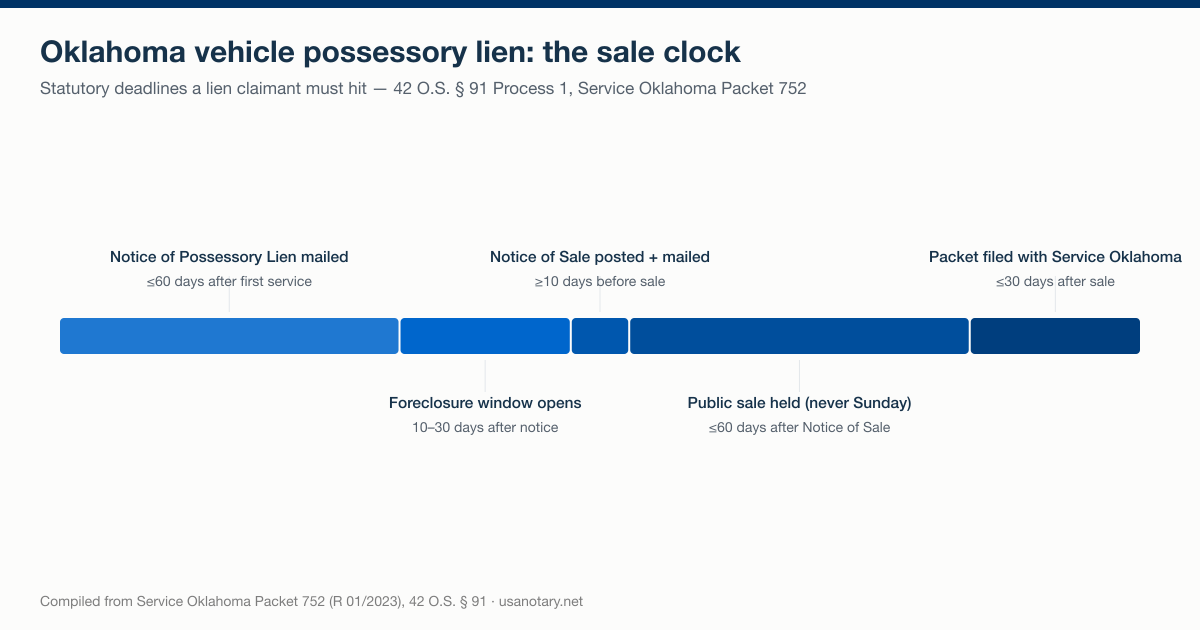
Oklahoma’s Title 42 clock, compiled from Service Oklahoma Packet 752 — miss a window and the title application comes back.
Which lien-sale documents are notarized, state by state?
Notarization is required in some lien-sale packets and entirely absent from others — the split runs state by state, and the table below reflects only what each statute or agency packet we fetched actually says.
| State | Who blesses the title step | Clock highlights | Notarization in the packet |
|---|---|---|---|
| Oklahoma | Service Oklahoma reviews the Title 42 packet | Notice ≤60 days after first service; foreclosure 10–30 days after notice; packet due ≤30 days post-sale | Yes — twice. Claimant’s signature on the Notice of Possessory Lien “shall be notarized,” and the Notice of Sale carries “a notarized statement” of the work performed (42 O.S. § 91) |
| California | DMV authorizes the lien sale (§ 3072 ≤ $4,000; § 3071 above or self-storage) | Lien-sale application within 30 days or the lien is extinguished | Process runs on DMV forms and declarations — the owner fights back with a Declaration of Opposition, not an affidavit |
| Texas | County tax assessor-collector filing, then public sale | Notice ≤30 days after charges accrue; no sale before the 31st day after filing | § 70.006 runs on certified mail and the county filing — no notary requirement in the section |
| Maryland | Lienor sells at public auction under § 16-207 | 30 days unpaid; 10-day mailed notice; two weeks of newspaper ads | The sale statute relies on certified mail and publication; it prescribes no notary block |
| Virginia | Bailee auctions under $12,500; general district court to $25,000; circuit court above (§ 46.2-644.03) | 15-day reclaim window; sale ≥21 days after notification | Below $12,500 the statute runs on DMV records and certified mail; above it, the courtroom takes over |
| Indiana | BMV Central Office issues the title | Certified letter + newspaper ad, both with proof | The BMV checklist demands certified-mail proof, an auctioneer’s signature, and a law-enforcement inspection — no notary block on the checklist |
| Massachusetts | Superior or District Court orders the sale | Demand letter, then a lawsuit | Judicial route: the garage “can send a demand letter and then sue the owner… to obtain a court order to have the vehicle sold” (Mass.gov) |
Oklahoma: the notarized-affidavit blueprint
Oklahoma writes notarization into the statute itself, which makes it the clearest working example of sworn paperwork inside a vehicle lien sale. Under 42 O.S. § 91(A)(4), the Notice of Possessory Lien must contain “the signature of the claimant which shall be notarized.” Under § 91(A)(6), the Notice of Sale must contain “a notarized statement of the nature of the work, labor or service performed, material furnished, or storage or rental of space” — plus the date, the name of the person who authorized the work, and written proof of authority. After the sale, “properly completed and notarized (if applicable)” copies of Forms 752-A through 752-D go to Service Oklahoma with the postmarked certified-mail receipts, and the packet even ships with its own Form 752-E Affidavit of Publication.
The stakes on those sworn statements are not theoretical. Section 91(E) makes knowingly false statements in a possessory-lien proceeding a felony, the packet warns that “alterations of any kind are not acceptable” — no erasures, no white-out — and a rejected filer gets exactly one resubmission within 15 business days of the denial.
Indiana: the certified-mail blueprint
Indiana shows the opposite design philosophy: evidence by paper trail rather than by oath. The BMV’s mechanic’s lien checklist assembles State Form 205 (title application), State Form 23104 (Mechanic’s Lien Bill of Sale, carrying the auction company’s name, signature, and license number), the certified letter to every owner and lienholder of record with proof of delivery, proof the newspaper ad ran, and a Physical Inspection of a Vehicle or Watercraft completed by an Indiana law enforcement officer. Even the odometer reading gets special treatment — mileage on a lien-sale title is branded “Not Actual” on the State Form 43230 disclosure, a wrinkle our odometer disclosure statement guide covers in detail. The application fee is $15, and a packet arriving more than 45 days after the sale date picks up a $30 penalty.
California: declarations, not notary blocks
California’s process splits on vehicle value — § 3072 for vehicles at $4,000 or less, § 3071 above $4,000 or from a self-storage facility — and both paths run through DMV authorization on DMV forms. The registered or legal owner contests by filing a Declaration of Opposition, which forces the lienholder toward court instead of a sale. Where notarization does enter California vehicle paperwork is the title side generally, and requirements shift again at every border; our state-by-state rules for notarizing a vehicle title map that terrain.
What happens when the car has a loan on it?
A mechanic’s lien on a financed car sits behind the lender’s perfected security interest unless the statute is followed to the letter — and Oklahoma says so in exactly those terms: “This special lien shall be subordinate to any perfected security interest unless the claimant complies with the requirements of this section.” The statute then lists what “failure to comply” means — missing return receipts, the claimant not being in possession, the notice of lien not properly filed, foreclosure run outside the window — and any one of them both sinks the title application and drops the shop’s lien behind the bank’s.
Every state process we checked puts the recorded lienholder on the required notice list. Texas § 70.006 sends the certified-mail notice to “each holder of a lien recorded on the certificate of title.” Maryland § 16-207 mails notice to every “holder of a perfected security interest.” Virginia’s DMV records search exists precisely to surface the lender before a sale is scheduled. Oklahoma defines “interested parties” to include any lienholder noted on the face of the title — and then gives the lender an exit ramp: a lienholder may retrieve the vehicle without retitling it by proving its lienholder status and paying the claimant’s lawful charges.
The practical read for a shop or yard: run the record search first, budget for the possibility that the payoff conversation ends with the lender collecting the car and paying your bill, and treat the lender’s green return-receipt card as the single most load-bearing page in the packet. A lien sale that skips the bank does not transfer clean title — it manufactures a lawsuit.
How do shops and yards notarize lien paperwork without leaving the lot?
Lien-sale affidavits can be notarized online in most of the country. The National Association of Secretaries of State reports that 47 states and the District of Columbia have a law allowing remote e-notarization, and Oklahoma’s possessory-lien statute anticipates it directly: “In place of an original signature and notary seal, a digital or electronic signature or seal shall be accepted.”
For an operation filing these packets every month, the workflow looks like this: the office manager uploads the Notice of Possessory Lien or the sworn sale statement, the signer’s identity is verified through credential analysis and knowledge-based authentication run by a third-party identity service, and a commissioned notary completes the notarization on live video. Sessions run 24/7 and take 15–30 minutes, multiple signers can join one session when the manager and the tow operator both sign, and the result is a tamper-evident PDF with a complete audit trail — with the audio-video recording and electronic journal entry retained for 10 years or longer where state law requires. That evidentiary layer matters in a process where a false statement is a felony and the reviewing agency rejects packets over white-out.
Notarization costs $25 per document, with volume pricing for recurring filers, and tow, salvage, and repair operations can set up staff-initiated workflows through our online notarization service for automotive businesses so every lien packet, every month, follows the same checklist. The sworn-statement mechanics are the same as for any affidavit — our walkthrough on how to notarize an affidavit covers what the signer should have ready before the session starts.
Turn the unpaid bill into a title without leaving the lot
The pattern across every statute we fetched: the lien arises from the unpaid charges automatically, the notice is mailed by certified mail everywhere, the vehicle is sold at public sale only after the statutory clock runs — and notarization is required only where the statute says so. Oklahoma builds it into two documents; Indiana builds none into its checklist; Massachusetts routes the whole question through a courtroom. Know which blueprint your state follows before the storage charges start accruing, because the title office rejects packets, not excuses.
Questions about a recurring lien-sale workflow — or a stack of notices that needs sworn signatures this week? Call 804-767-7500 or reach the team and we’ll map your state’s packet to a repeatable process.