
Does a HIPAA authorization need to be notarized?
No — federal law is unambiguous on this one. A HIPAA authorization — the form a patient signs so a hospital, clinic, or health plan can release protected health information to a third party — is valid without a notary and without a witness. The Department of Health and Human Services answers the exact question in its FAQ 478: “The Privacy Rule does not require that a document be notarized or witnessed.” That guidance sits directly on top of the regulation, which lists the elements of a valid authorization and stops there.
The regulation behind the FAQ says the same thing by omission. 45 CFR § 164.508 lists every element a valid authorization must contain — six core elements plus three required statements — and a notary’s certificate appears nowhere in the list. The signature requirement in § 164.508(c)(1)(vi) asks for exactly two things: “Signature of the individual and date.”
So why does this question keep coming up? Because the form’s legal floor and an institution’s paperwork demands are two different things. A records department, a life insurer, or an attorney assembling an estate plan can layer its own identity checks on top of HIPAA — and some of them request notarization. The rest of this guide covers what the law requires, why some offices demand more, who is permitted to sign for a patient who can’t, and how to complete a notarized release from a facility bedside when someone insists on it.
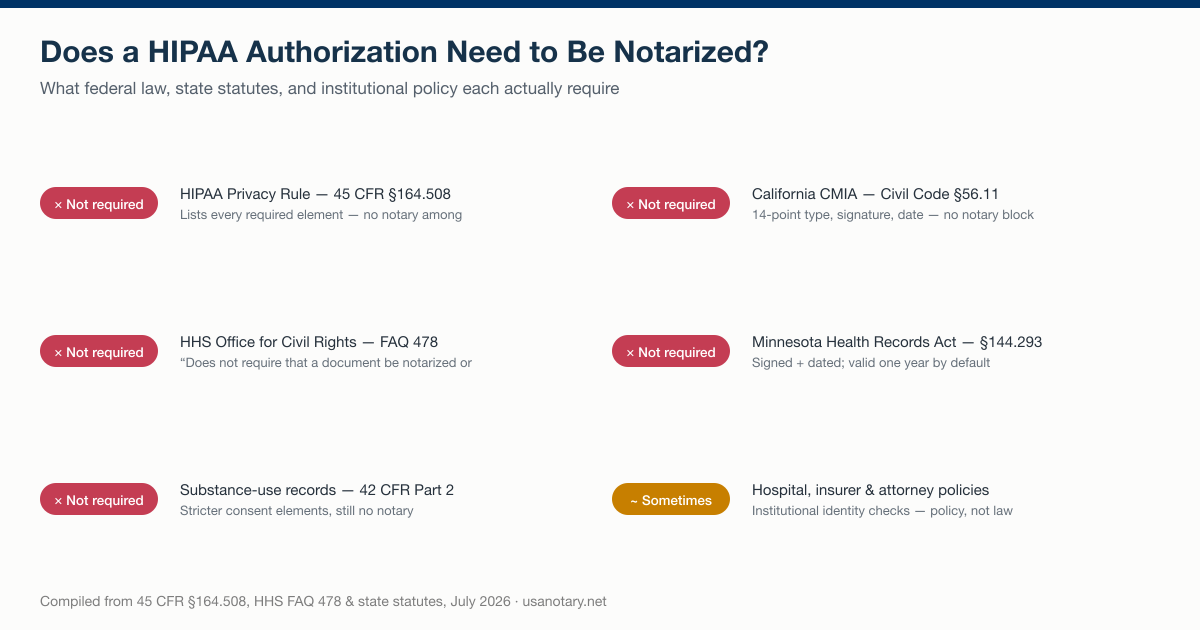
Every rule checked for this guide — federal HIPAA, substance-use records, and the state statutes reviewed — requires a signature, not a seal. Only institutional policies sometimes ask for more.
What does federal law require on a HIPAA authorization instead?
A valid HIPAA authorization is required to contain specific content, not a specific execution ceremony. Under § 164.508(c)(1), the six core elements are:
| # | Core element (45 CFR § 164.508(c)(1)) | What it means on the form |
|---|---|---|
| 1 | Description of the information | What records are being released — specific enough to be meaningful |
| 2 | Who may disclose | The person or class of persons authorized to make the disclosure |
| 3 | Who receives it | The person or class of persons the records go to |
| 4 | Purpose | Why the disclosure is being made (“at the request of the individual” suffices when the patient initiates) |
| 5 | Expiration | An expiration date or an expiration event |
| 6 | Signature and date | ”Signature of the individual and date” — plus a description of authority if a personal representative signs |
Section 164.508(c)(2) then requires three statements putting the signer on notice: the right to revoke the authorization in writing, whether treatment or payment can be conditioned on signing, and the potential for the recipient to redisclose the information outside HIPAA’s protection. The revocation right matters in practice for families managing a resident’s records — a signed release is not permanent, and a written revocation ends it prospectively.
That is the complete federal checklist. An authorization fails under § 164.508(b)(2) when it is expired, incomplete on the required elements, known to be revoked, tied to prohibited conditioning, or contains material information known to be false. Notice what is not on the failure list: an un-notarized signature. A release form signed at a kitchen table with a ballpoint pen satisfies federal law as fully as one stamped and sealed.
What “signature and date” covers when someone else signs
The one place execution gets more involved is the personal-representative scenario. Section 164.508(c)(1)(vi) adds: “If the authorization is signed by a personal representative of the individual, a description of such representative’s authority to act for the individual must also be provided.” The form itself still needs no notary — but the authority document behind the signature usually got one, which is where notarization genuinely enters this picture (more on that two sections down).
Why do some offices demand a notarized HIPAA release anyway?
Institutional caution, not law, drives the notarization demand — and there is a real regulatory hook behind the caution. 45 CFR § 164.514(h) requires a covered entity to verify “the identity of a person requesting protected health information and the authority of any such person to have access” when that identity or authority isn’t already known. The regulation deliberately leaves the method open: it permits reliance on documentation that is reasonable on its face and on professional judgment, and it prescribes no particular formality.
An open-ended verification duty invites conservative policies. A records department that receives a release form by mail from an address it doesn’t recognize, signed by a name it can’t match to a face, has to verify somehow — and a notarized signature is an easy institutional answer. The same logic shows up in a few recurring places:
- Mailed and out-of-state requests. A release arriving without the patient present gives the records office nothing to verify against, so some offices request notarization as their identity check.
- Deceased-patient records. When an executor requests a decedent’s file, the office is verifying estate authority on top of identity — and estate paperwork culture leans notarial.
- Life insurers and attorneys. Underwriting files and estate-planning packages often route every signature through one execution standard, and that standard sometimes includes a notary.
One important boundary keeps this from going too far. When a patient requests their own records — the right of access under § 164.524, a different pathway from a third-party authorization — HHS’s access guidance states that a covered entity “may not impose unreasonable measures on an individual requesting access that serve as barriers to or unreasonably delay the individual from obtaining access.” A provider that piles friction onto a patient’s own access request is on thin regulatory ice. The third-party authorization pathway carries no equivalent anti-barrier language, which is why the notarization request survives there as a policy choice.
The practical takeaway for families and facility staff: arguing the law with a records clerk rarely moves the file. If the requesting institution’s policy says notarized, the fastest path is usually to get the signature notarized and keep the request moving.
Who can sign for a resident who can’t — the personal-representative rules
A personal representative signs when the patient can’t, and HIPAA defines who qualifies by pointing at state law. Under 45 CFR § 164.502(g), a covered entity must treat as a personal representative any person who has authority under applicable law to make health care decisions for the individual. In a nursing home or assisted-living context, that is typically one of three people:
- An agent under a health care power of attorney — the most common case. The POA document names the agent and defines the authority; our guide to how to notarize a power of attorney covers why that underlying document is usually the one that actually gets notarized.
- A court-appointed guardian or conservator — where no POA was signed while the resident had capacity, a court order establishes the authority.
- For a deceased resident, the executor or administrator — § 164.502(g)(4) extends personal-representative status to the person with authority to act for the deceased individual or the estate.
Whoever signs, § 164.508(c)(1)(vi) requires the form to carry a description of that authority — which in practice means the records office will ask to see the POA, the letters of guardianship, or the letters testamentary alongside the signed release. The abuse-and-neglect exception in § 164.502(g)(5) also lets a covered entity refuse to recognize a representative it reasonably believes has abused or endangered the patient, so representative status is not absolute.
The notarization question hiding inside this one
Families searching for whether the HIPAA form needs a notary are often one document away from the question that actually matters: whether the power of attorney behind the signature was properly executed. Many states require notarization or witnesses on the POA itself, and a facility admission is exactly when the gap surfaces. Adult children coordinating records for a parent should start with our walkthrough on getting power of attorney for an elderly parent — the HIPAA release is the easy signature; the authority document is the one with execution rules.
Do any state laws require a notarized medical-records release?
None of the statutes reviewed for this guide require notarization — and that includes the strict ones. State law can lawfully demand more than HIPAA: under 45 CFR § 160.203, a state privacy law that “is more stringent” than the federal standard survives preemption. States have used that room to add formatting rules, shorter validity windows, and special regimes for sensitive records. What no reviewed statute added is a notary:
| Rule | What it adds beyond HIPAA | Notary required? |
|---|---|---|
| Federal baseline — 45 CFR § 164.508 | Six core elements + three required statements | No — HHS FAQ 478: “does not require that a document be notarized or witnessed” |
| Substance-use records — 42 CFR § 2.31 | Separate, stricter consent for substance use disorder treatment records, ten required elements | No — patient signature and date; electronic signatures permitted unless prohibited by other law |
| California — Civil Code § 56.11 (CMIA) | Authorization must be “handwritten … or in a typeface no smaller than 14-point type,” clearly separate from other text, signed and dated | No — handwritten or electronic signature; no notary block |
| Minnesota — Minn. Stat. § 144.293 | Signed and dated consent required; consent “is valid for one year” unless the consent or another Minnesota law specifies a different period | No — signed and dated only |
The pattern is worth stating plainly: legislatures that cared enough to regulate the typeface of a release form still declined to require a notary on it. Where a notarization demand appears, it is coming from the requesting institution’s policy, not from a records-release statute.
Two honest caveats. First, this table is a checked sample, not a 50-state survey — sensitive-records regimes (mental health, HIV, genetic information) vary widely, and statutes get amended. Second, the preemption rule cuts in the patient’s favor: when a state form demands more content than HIPAA, the stricter form governs, so always complete the specific form the institution or state agency hands you rather than a generic template.
How to notarize a HIPAA authorization online from a facility bedside
When a records office, insurer, or attorney requests a notarized release, remote online notarization completes it without anyone leaving the building. The National Association of Secretaries of State reports that 47 states and the District of Columbia have a law allowing remote e-notarization, and the signer can be in any of the 50 states. For a nursing home or assisted-living resident, that turns a days-long mobile-notary scheduling problem into a same-day session:
- Upload the release form. Use the exact form the requesting institution supplied — the notary notarizes the signature on it and does not draft or alter the document.
- Verify identity on camera. The platform verifies the signer’s identity through credential analysis of a government ID plus knowledge-based authentication, run by a third-party identity-verification service before the notary appears.
- Join the video session. A commissioned notary meets the signer on live video — sessions run 24/7 and take 15–30 minutes, and multi-signer sessions let an out-of-state adult child sign the same packet in one sitting. Remote witnesses are supported where state law and the document’s rules permit.
- Send the completed document. The session produces a tamper-evident notarized PDF with a complete audit trail, and the audio-video recording and electronic journal entry are retained for the period the notary’s commissioning state requires — a stronger provenance record than an ink stamp for any records office that later questions the signature.
Sessions cost $25 per document, with volume pricing for organizations. Facilities that handle these requests weekly — admissions packets where residents authorize adult children, records releases for care transitions, releases attached to insurance claims — can set up staff-initiated workflows through our online notarization service for healthcare and senior care teams, so a social worker or admissions coordinator starts the session and the resident just signs. For signers stuck at home rather than in a facility, the same process works anywhere — see our guide to getting documents notarized for homebound or hospitalized signers.
HIPAA authorization vs. medical power of attorney vs. advance directive
A HIPAA authorization releases information; it does not delegate decisions. Families completing senior-care paperwork routinely conflate the three documents in this table — often because admission packets present all three for signature in the same sitting — and the notarization answer is different for each:
| Document | What it does | Who signs | Typical notarization |
|---|---|---|---|
| HIPAA authorization | Permits a provider or plan to release records to a named recipient | The patient, or a personal representative with described authority | Not required by the Privacy Rule; sometimes requested by institutional policy |
| Medical (health care) power of attorney | Appoints an agent to make health care decisions when the patient cannot | The principal, while they have capacity | Varies by state — many states require a notary and/or witnesses on the POA itself |
| Advance directive / living will | States the patient’s own treatment wishes (life support, end-of-life care) | The patient | Varies by state — witness and notary rules are set by each state’s directive statute |
The execution stakes run in ascending order. A defective HIPAA release costs you a re-signed form; a defectively executed POA or directive can cost a family the ability to act at all, forcing a guardianship proceeding. State-by-state execution rules for the second and third documents are covered in our guides to notarizing a living will or advance directive and notarizing a power of attorney — and both are documents to complete while the signer clearly has capacity, not after questions arise.
Get the release signed without the notary hunt
The rule to remember: a HIPAA authorization is valid signed and dated — the notary only enters when a specific institution’s policy asks for one. Federal law lists the required contents and stops there; the state statutes reviewed here add formatting and validity rules but no seal; and the verification duty in § 164.514(h) explains why a cautious records office sometimes wants more than the law demands.
When that demand lands — a mailed records request, an insurer’s packet, an estate attorney’s checklist — a video session completes the notarization the same day, from the resident’s bedside, with family joining from anywhere. Questions about a one-off release or a recurring facility workflow? Call 804-767-7500 or reach out through our contact page.