
Does a homeschool affidavit need to be notarized?
In two of the best-known filing states, yes — in most of the rest, no. A homeschool affidavit needs to be notarized in Pennsylvania, where 24 P.S. § 13-1327.1 requires a notarized affidavit filed with the district superintendent (with a notary-free unsworn declaration as the alternative), and in Arizona, where the county school superintendents who receive the Affidavit of Intent require the notarized form. California sits at the opposite pole: its Private School Affidavit is an affidavit in name only, filed electronically under penalty of perjury with no notary anywhere in the process.
The confusion is baked into the vocabulary. An affidavit, in the ordinary legal sense, is a written statement sworn before an officer authorized to administer oaths — the person swearing it is the affiant, and the oath is what the notary is there for. State education codes, however, attach the word “affidavit” to filings that range from a true sworn document (Pennsylvania) to an online form submitted under penalty of perjury (California). Whether a homeschool affidavit needs to be notarized therefore depends entirely on which state’s filing you mean — and this guide walks the answer state by state, against the statutes.
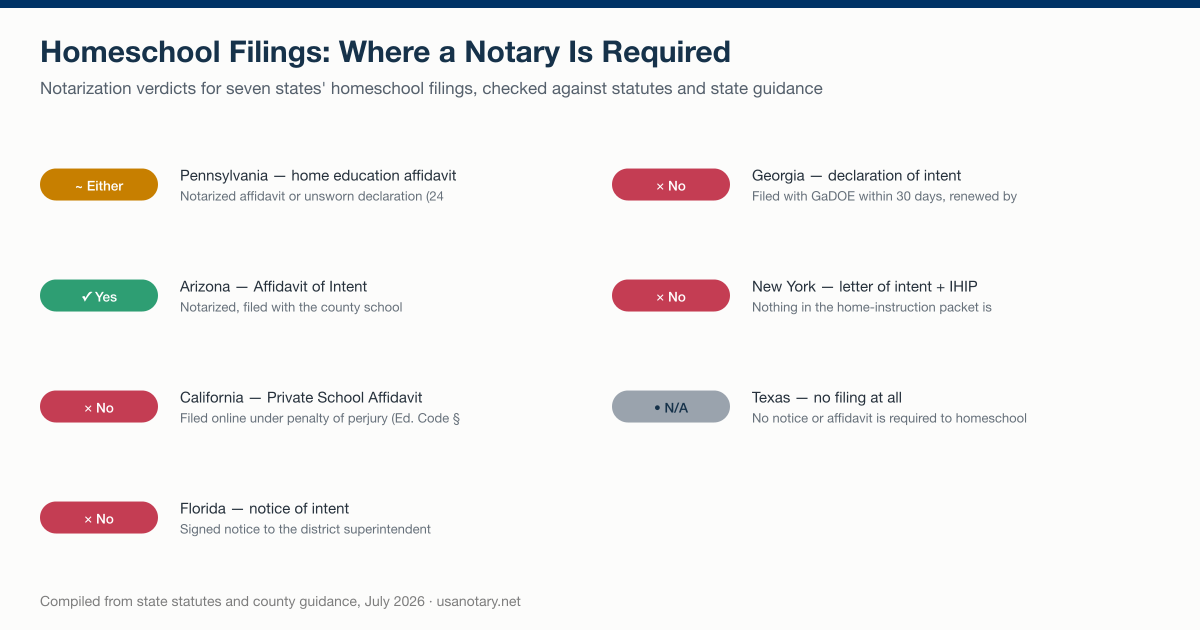
Notarization verdicts for seven states’ homeschool filings, checked against statutes and state guidance, July 2026.
Which states require a notarized homeschool affidavit?
Pennsylvania and Arizona are the two states where notarization is required on the standard homeschool filing — and Pennsylvania is the only one of the two that writes the word “notarized” into the statute itself. Here is how the most-searched states compare, each verdict checked against the statute or the state’s own guidance:
| State | Filing | Notarization required? | What the source says |
|---|---|---|---|
| Pennsylvania | Home education affidavit | Yes — or file an unsworn declaration instead | 24 P.S. § 13-1327.1 requires a notarized affidavit filed with the superintendent “prior to the commencement of the home education program and annually thereafter on August 1”; homeschool organizations publish an unsworn-declaration alternative that needs no notary |
| Arizona | Affidavit of Intent | Yes, in practice | A.R.S. § 15-802 requires the affidavit “within thirty days”; Maricopa County states the affidavit “must be notarized,” and AFHE instructs parents to file “a notarized Affidavit of Intent” |
| California | Private School Affidavit (PSA) | No | Ed. Code § 33190 is executed “under penalty of perjury” — the words “notary” and “notarized” never appear; filed electronically per the HomeSchool Association of California |
| Florida | Notice of intent | No | HSLDA’s Florida guide: a notice with students’ full legal names, addresses, and birthdates, filed within 30 days — no notarization mentioned |
| Georgia | Declaration of intent | No | HSLDA’s Georgia guide: submitted to the Georgia Department of Education within 30 days and by September 1 annually, with online versions available — no notarization mentioned |
| New York | Letter of intent + IHIP | No | NYSED’s home instruction Q&A covers the letter of intent and the Individualized Home Instruction Plan; nothing in it is notarized |
| Texas | None | N/A — no filing at all | HSLDA’s Texas page lists “Notification Required: No” |
Two caveats before the deep dives. First, this table covers the states where the notarization question actually gets asked — it is not a 50-state survey, and a state not listed may have its own notice-of-intent rule. Second, the “in practice” note on Arizona matters and is explained below: the statute’s text and the county’s form say slightly different things, and the county’s form is the one you have to satisfy.
Pennsylvania: notarized affidavit or unsworn declaration — pick one
Pennsylvania requires a notarized affidavit as the default homeschool filing, and it is the most demanding filing in the country. Under 24 P.S. § 13-1327.1, the affidavit is filed with the superintendent of the school district of residence “prior to the commencement of the home education program and annually thereafter on August 1.” The person who files is the statute’s “supervisor” — the parent, guardian, or person having legal custody who is responsible for the instruction and holds a high school diploma or its equivalent.
What the Pennsylvania affidavit must include
The affidavit is not a one-line pledge. The statute requires it to carry, at minimum:
- The supervisor’s name and the name and age of each child in the program
- The program’s address and telephone number
- Assurance that the required subjects are taught in English, with “an outline of proposed education objectives by subject area”
- Evidence of immunization (or the applicable exemption) and evidence of the health and medical services required by law
- A certification that the program will comply with the home education statute
- A criminal-history certification — signed by the supervisor — that the supervisor, all adults living in the home, and persons having legal custody of the children have not been convicted of the enumerated criminal offenses within the past five years
That last item is the reason the notarization carries weight in Pennsylvania: the affidavit puts the supervisor under oath about the criminal history of every adult in the household, not just about curriculum plans. HSLDA’s Pennsylvania guidance keeps the mechanics blunt: “Fill out this affidavit, get it notarized, and mail it Certified Mail/Return Receipt Requested to the superintendent.”
The unsworn declaration: the notary-free alternative
Pennsylvania filers who skip the notary do not skip the filing — they swap its format. Both HSLDA and Homeschool Pennsylvania publish an unsworn declaration as an alternative to the notarized affidavit, resting on Pennsylvania’s Uniform Unsworn Declarations Act in Title 42 of the consolidated statutes. Homeschool Pennsylvania states the trade plainly: “The affidavit must be notarized. The unsworn declaration does not need to be notarized, but requires a specific statement and signature.” The declaration carries the same content on the same schedule — HSLDA notes it is “due no later than August 1” each year — and substitutes a statutory penalty-of-perjury statement for the notary’s certificate.
Which route should you take? The unsworn declaration is free and instant, which is why the homeschool organizations promote it. The notarized affidavit is the format the School Code itself names, and some filers prefer to match the statute’s own words — particularly in districts that have questioned paperwork before. Since a remote notarization takes 15–30 minutes from a couch, the cost of choosing the statute’s format is smaller than it used to be.
Filing mechanics and deadlines
The filing is submitted by the parent, guardian, or person having legal custody to the superintendent of the district of residence — Homeschool Pennsylvania summarizes the timing as “prior to commencing homeschooling and each following year by August 1.” Two practical notes follow from that calendar. First, a family starting mid-year files before day one of instruction, not on the following August 1. Second, the annual August 1 renewal lands in the middle of summer, when school offices run reduced hours — which is exactly when a mailed, certified-return-receipt package (HSLDA’s recommendation) plus a notarization you can complete any evening keeps the deadline boring instead of frantic.
Arizona: the notarized Affidavit of Intent and the 30-day clock
Arizona requires an Affidavit of Intent filed with the county school superintendent — not the school district — “within thirty days from the time the child begins to attend a private school or homeschool,” under A.R.S. § 15-802. The statute lists the contents: the child’s name, the child’s date of birth, the current address of the school the child is attending, and the names, telephone numbers, and addresses of the persons who currently have custody of the child.
Where the notarization requirement actually comes from
Here is the detail no forum thread gets right: the text of § 15-802 never uses the word “notarized.” The notarization requirement lives in the form itself. An affidavit is, by definition, a sworn statement — and the county school superintendents who prescribe and receive Arizona’s form require it notarized. Maricopa County’s homeschool page refers to “the affidavit, which must be notarized,” and adds that “notary services are available by appointment only at our office and at no additional charge.” Arizona Families for Home Education, the statewide homeschool organization, instructs parents to file “a notarized Affidavit of Intent to Homeschool with the County School Superintendent” by mail, and notes the 30-day window also runs “within 30 days following the child’s 6th birthday for children who’ve been homeschooled prior to age 6.”
Unlike Pennsylvania’s annual renewal, Arizona’s affidavit is filed once per child — though AFHE notes a family that moves to a new county files a fresh affidavit there, and § 15-802 requires notifying the county superintendent within 30 days when homeschooling ends.
The birth certificate and the paperwork that rides along
The affidavit does not travel alone. Under A.R.S. § 15-828, the filing must be accompanied by a certified copy of the pupil’s birth certificate — AFHE emphasizes “a certified copy of the birth certificate must be submitted (not a photocopy)” — or, failing that, other reliable proof of identity and age together with “an affidavit explaining the inability to provide a copy of the birth certificate.” Maricopa County accepts filings three ways: by mail, in person by appointment, or online through its Homeschool Connect portal, where filers “upload your notarized documents.” A remote notarization fits that last channel neatly, because its output is exactly what the portal asks for: a notarized PDF. Confirm the upload option with your own county superintendent’s office, since each of Arizona’s 15 counties runs its own intake.
California: the Private School Affidavit needs no notary
California’s Private School Affidavit is filed online, and no notary touches it. Most California homeschools operate as home-based private schools, and Education Code § 33190 requires every person or firm “offering or conducting private school instruction on the elementary or high school level” to file the affidavit “between the first and 15th day of October of each year.” The statute’s execution language is “under penalty of perjury” — the words “notary” and “notarized” appear nowhere in it.
The HomeSchool Association of California confirms the mechanics: “The PSA is filed electronically on the California Department of Education website,” and the electronic submission itself constitutes the legal signature under penalty of perjury. A family that starts homeschooling outside the October 1–15 window files the PSA when the school begins operating. So when a Californian asks whether the homeschool affidavit needs to be notarized, the honest answer is that California’s filing borrowed the word “affidavit” without borrowing the oath — it is a statistical registration of a private school, not a sworn statement before an officer.
What do the no-notary states require instead?
Most filing states replaced the oath with a simple signed notice — the enforcement teeth sit in the follow-up requirements, not the execution formality. The table above gives the verdicts; here is what the filing actually looks like in the other states parents ask about:
- Florida — a written notice of intent filed with the county superintendent within 30 days of beginning the program, carrying “the full legal names, addresses, and birthdates” of the homeschool students, per HSLDA’s Florida guide. No notarization is mentioned anywhere in the requirement.
- Georgia — a declaration of intent submitted to the Georgia Department of Education “within 30 days after you begin homeschooling, and every year thereafter by September 1,” listing students’ names and ages, the program’s location, the local school system, and the program’s 12-month school year, per HSLDA’s Georgia guide. Online and printable versions exist; none is notarized.
- New York — the most paperwork of the no-notary states: a letter of intent (filed within 14 days of beginning home instruction for families starting mid-year or moving into a district) followed by an Individualized Home Instruction Plan listing “syllabi, curriculum materials and textbooks to be used or a plan of instruction to be followed” plus quarterly instruction hours, per NYSED’s Q&A. A search of the state’s guidance for anything notarized comes up empty.
- Texas — nothing to file. HSLDA’s Texas summary lists “Notification Required: No” — there is no notice, no affidavit, and therefore no notarization question at all.
The pattern is worth naming: states that demand a sworn filing (Pennsylvania, Arizona) put the parent under oath once and largely leave the program alone; states with unsworn notices often attach ongoing obligations — Florida’s annual evaluations, New York’s quarterly reports — instead. The notary is one compliance model among several, not a proxy for how strict a state is.
How to notarize a homeschool affidavit online
A homeschool affidavit can be notarized online in the states where notarization is required, because both of those states authorize remote notarization. The National Association of Secretaries of State reports that 47 states and the District of Columbia have a law allowing remote e-notarization. Pennsylvania made remote online notarization “a permanent part of Pennsylvania law” with Act 97 of 2020, effective October 29, 2020 — the Pennsylvania Department of State confirms a Pennsylvania notary “may also perform a notarial act facilitated by communication technology for a remotely located individual.” Arizona’s authorization sits in A.R.S. § 41-263, which lets a remotely located individual appear before a notary “using communication technology,” with an audiovisual recording of the act.
For a parent staring down an August 1 renewal or a 30-day clock, the session looks like this:
- Complete the affidavit first. Use your district’s or county’s current form — the notary notarizes your signature on the document; the notary does not draft it or check its contents against the education code.
- Verify your identity. Before the video session starts, the platform verifies identity through credential analysis of your government ID plus knowledge-based authentication questions, run by a third-party identity-verification service.
- Swear and sign on camera. A homeschool affidavit takes an oath, which makes it a jurat rather than an acknowledgment — the notary administers the oath over live video, watches you sign, and completes the certificate. Sessions run 24/7 and take 15–30 minutes.
- File the notarized PDF. You receive a tamper-evident notarized PDF with a complete audit trail — ready to print and mail certified to a Pennsylvania superintendent, or to upload where a county intake portal accepts documents electronically.
The full document workflow is covered in our walkthrough of how to notarize an affidavit online, and if you’re weighing whether a notarization performed by an out-of-state commissioned notary holds up for your filing, our guide to remote notarization validity across state lines explains the recognition rules — Pennsylvania’s own county offices are a fine belt-and-suspenders check for a document this cheap to redo. At $25 per document, the notarization costs less than the round trip to find a walk-in notary in July — and umbrella schools, co-ops, and district offices that field stacks of sworn enrollment paperwork every August can set up staff-initiated sessions through our online notarization service for schools and education programs.
What happens if you file without notarization where it’s required?
An unnotarized filing in a notarization state is a defective filing, and each state handles the defect differently. In Pennsylvania, a submission that is neither notarized nor executed as an unsworn declaration matches neither format the law recognizes — and 24 P.S. § 13-1327.1 gives districts a formal track for programs deemed out of compliance: a hearing before an impartial examiner within 30 days, and, if appropriate education is found lacking, prompt enrollment of the student in the public school district of residence, a nonpublic school, or a licensed private academic school. No family wants a paperwork format question to be the thing that opens that door.
Arizona writes the consequence directly into the statute. Under A.R.S. § 15-802, “a parent who fails to comply with the duty to file an affidavit of intent to provide instruction in a homeschool is guilty of a petty offense” — a lesser violation than the class 3 misdemeanor the same statute attaches to failing to enroll or ensure school attendance altogether. A rejected, unnotarized affidavit that never gets cured drifts toward exactly that exposure, which is why Maricopa County both offers free notary appointments and accepts uploaded notarized documents: the county wants the filing perfected, not punished.
The cure, in either state, is the same fifteen-minute fix described above — re-execute the affidavit before a notary and refile it.
File once, homeschool all year
The rule to remember: the word “affidavit” doesn’t decide the answer — the state does. Pennsylvania’s affidavit is required to be notarized (or swapped for an unsworn declaration), Arizona’s Affidavit of Intent is required to be notarized by the county offices that receive it, and California’s Private School Affidavit never meets a notary at all. Check your state’s row in the table, pull the current form from your district or county, and give yourself more runway than the deadline demands.
Homeschooling families often face this alongside other district paperwork — if you’re also proving where you live for enrollment purposes, a school residency affidavit is the companion document. Questions about a homeschool affidavit or a recurring notarization workflow for your co-op or umbrella school? Call 804-767-7500 or reach out through our contact page.