
What is a letter of guarantee in a total-loss claim?
A letter of guarantee is the lienholder’s written statement of the exact payoff on your car loan, paired with its commitment to hand the insurance company a lien-free title once that payoff is paid. Carrier claims guidance describes the trigger directly: Central Insurance’s total-loss guide states that “once your lienholder is notified that the vehicle is a total loss, they must provide a ‘Letter of Guarantee’ stating the current payoff for the loan.” The claims-industry template version of the document — the Guarantee of Title letter used for financed vehicles and boats — spells out the promise half: the lienholder commits to “provide a lien free Certificate of Title to the insurance company upon receipt of a claim payment.”
The letter of guarantee exists because of a simple ownership problem. When a carrier totals a financed car, it pays the claim and takes the vehicle — which means it needs the title. But it cannot take clean title while a lender’s lien is recorded against the vehicle, and as FindLaw’s total-loss guide explains, to dispose of the car the insurer “must have legal ownership of the vehicle and permission from the original owner to transfer title.” The letter of guarantee is the lender’s half of that equation: it names the number that makes the lien go away and guarantees the title will follow the money.
If you own the car outright, no letter of guarantee is issued — there is no lien to clear, so the settlement runs on the owner’s documents alone. The letter of guarantee only enters the picture when a bank, credit union, or finance company still holds an interest in the vehicle, which is exactly when total-loss settlements slow down.
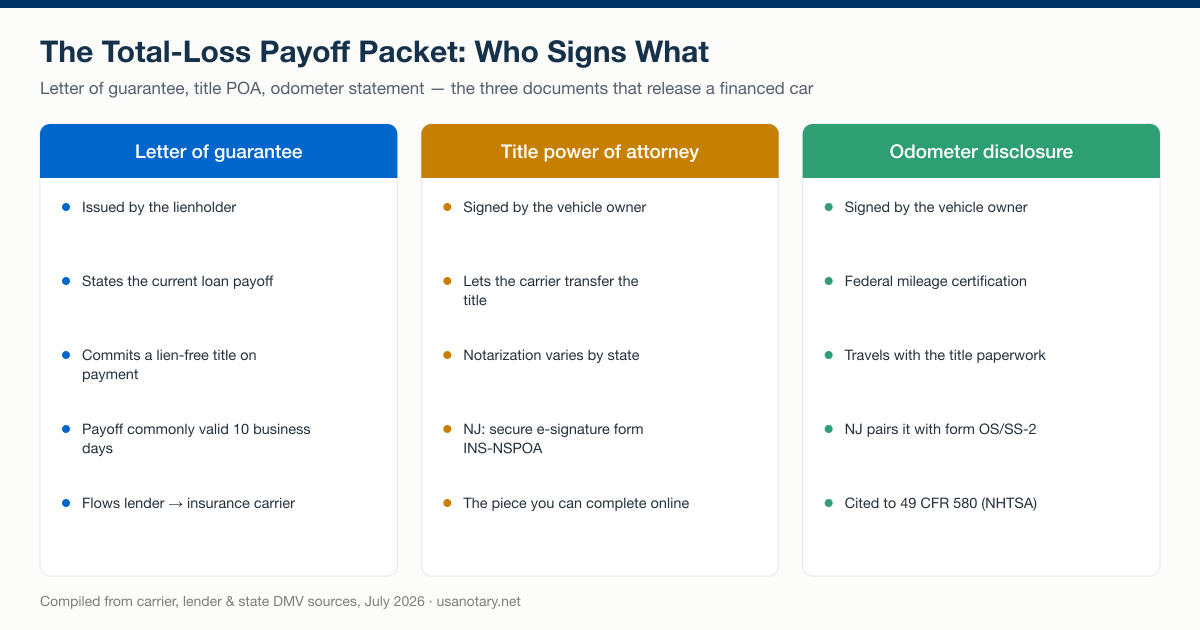
The three documents that release a financed car’s settlement — the lender signs one, the owner signs two.
What a letter of guarantee is not
The name collides with several unrelated documents, so it’s worth pinning down the sense. A letter of guarantee in a total-loss claim is not a lien release — the release comes after the payoff is paid, while the letter of guarantee is issued before payment as the promise that a release will follow. It is not a medallion signature guarantee, the bank-issued stamp used for securities transfers — a distinct instrument that certifies the authority to transfer securities, not a promise of payment. It is not a construction lien waiver, the payment document contractors sign — covered separately in our article on whether lien waivers need to be notarized. And it is not the owner’s power of attorney: the letter of guarantee is the lender’s document, while the POA is the owner’s — our companion guide to the total-loss power of attorney covers that piece of the packet in full.
Who issues the letter of guarantee, and what does it promise?
The lienholder issues the letter of guarantee — the bank, credit union, or captive finance company named on the title — and it flows in one direction: from lender to insurance carrier. The owner never drafts or signs it. The carrier’s total-loss team typically requests it as soon as the vehicle is declared a total loss, because per Central Insurance’s guidance the lienholder is expected to provide it once notified of the total loss.
The letter of guarantee makes two statements, and both matter:
- The payoff figure. The letter states the current amount required to satisfy the loan in full — not the monthly balance on your statement, but the lump-sum figure that clears the lien on the day it’s paid.
- The title commitment. The lender guarantees that, upon receipt of the claim payment, it will release its interest and deliver a lien-free certificate of title to the insurance company. That guarantee is what lets the carrier cut a check before it physically holds the title.
The payoff figure comes with a short shelf life. One Inc, a claims-payments provider, reports that the payoff amount in a letter of guarantee “is only good for 10 business days.” A loan payoff is a moving number — it changes as the loan continues to sit open — so the lender stamps an expiration on the quote. Miss the window and the whole exchange restarts with a fresh letter.
Which documents travel with the letter of guarantee?
The letter of guarantee never travels alone. A financed-vehicle settlement closes only when the lender’s letter meets the owner’s title paperwork, and the carrier can’t pay anyone until both sides of the packet are in hand. Here is the full paper chain and who owns each piece:
| Document | Signed by | Notarization | What it does |
|---|---|---|---|
| Letter of guarantee | Lienholder (lender) | None appears in the carrier, lender, or DMV procedures reviewed here — it is a lender-signed business letter | States the current payoff and commits a lien-free title to the insurer upon payment |
| Title power of attorney | Vehicle owner | Varies — FindLaw notes some states may require notarization, and California and Nevada require wet-ink signatures; New Jersey instead uses a secure e-signature form | Authorizes the carrier to apply for and transfer the title on the owner’s behalf |
| Odometer disclosure statement | Vehicle owner | Federal mileage certification that travels with the title paperwork | Records the mileage at transfer; New Jersey requires it alongside the total-loss POA |
| Certificate of title | Released by whoever holds it | — | The document everything above exists to move — from owner and lienholder to carrier |
New Jersey shows how tightly the packet is bound together. The state’s INS-NSPOA form — “Power of Attorney for Total Loss Vehicle” — appoints the insurance company’s representative as the owner’s attorney-in-fact “to apply for a duplicate certificate of title, and to perform on my/our behalf any necessary act concerning the transfer of such motor vehicle.” The form is designated for electronic signature only, must be submitted with a certificate of completion for each digital signature, and states on its face: “This form must accompany an Odometer Statement, Form OS/SS-2.” It also requires the electronic signature to comply with NHTSA’s minimum security requirements under 49 CFR 580.1 et seq. — the federal odometer-disclosure regulations. One state form, three documents chained to each other by rule.
Two of those documents are the owner’s to sign, and they are the only part of the chain the owner controls. The POA question — which states require it to be notarized, what the form looks like, and how to complete it remotely — is the subject of our dedicated guide to the total-loss power of attorney. The mileage certification has its own rules, covered in our walkthrough of the federal odometer disclosure statement. And note the boundary: this packet is the insurance settlement path. Selling a car yourself moves title through different paperwork — see how to sign over a car title in a private sale for that route.
How long does a letter of guarantee take — and why does your settlement wait on it?
A letter of guarantee moves on the lender’s clock, and the deadline that actually bites is the one inside the letter: the payoff figure is commonly valid for only 10 business days. One Inc’s claims-payment analysis lays out why that window creates a trap — “the actual processing, mailing and delivery of paper checks can take up to 10 business days on average,” which means a mailed payoff check can consume the entire life of the quote in transit. When the payment lands after the quote expires, a new payoff amount must be requested, and the settlement loops back to the start.
That loop is the reason a total-loss payout can stall for weeks even when nobody disputes the claim. The sequence has three hand-offs, and each one waits on the previous:
- The carrier declares the total loss and requests the letter of guarantee from the lienholder.
- The letter of guarantee is issued with a payoff good for a limited window, while the owner’s notarized POA and odometer statement are collected in parallel.
- The payoff is paid to the lender, the lien is released, the title is released to the carrier, and any remaining settlement money goes to the owner.
Slow motion at step 1 or step 3 is the lender’s; slow motion at step 2 is often the owner’s — and step 2 is the only one you can compress yourself.
What state law says about releasing the lien after the payoff is paid
State statutes put hard deadlines on the back half of the exchange — what the lienholder must do once the payoff is paid. Three fetched examples:
| State | Deadline after payoff | Statute |
|---|---|---|
| California | Within 15 business days of receiving payment in full (plus the required written instrument), the legal owner shall release its security interest and mail, transmit, or deliver the certificate of ownership to the transferee | Cal. Veh. Code § 5753(c)(1) |
| Texas | The lien must be released “not later than the 10th day” after the payoff amount is tendered under Fin. Code § 348.408; Transp. Code § 501.115 requires the discharge to be executed and delivered within that Finance Code window | Tex. Fin. Code § 348.408; Tex. Transp. Code § 501.115 |
| Virginia | A lienholder holding the certificate of title must mark it satisfied and surrender it to the person legally entitled to it within 10 days after the security interest is satisfied — failure is a Class 3 misdemeanor | Va. Code § 46.2-643 |
Notice what these statutes do and don’t cover: they discipline the lien release after money moves, not the issuance of the letter of guarantee before it. The front half of the exchange runs on carrier pressure and lender processing queues rather than statutory clocks.
If the lender drags its feet
Escalate through the carrier first — the total-loss adjuster requests the letter of guarantee and chases it, and carriers have standing lender contacts that an individual borrower doesn’t. Some settlements sidestep the letter entirely: Oregon’s Division of Financial Regulation notes that when there is a lienholder, “the check will probably be made out to you and the lienholder” — a joint check puts the payoff obligation in both names instead of routing a separate payment on a guarantee. And the state stays in the loop either way: Oregon requires the insurance company to notify the DMV when it totals a vehicle, and Washington’s insurance commissioner notes the insurer will report a totaled car to the state Department of Licensing. If a paid-off lien still isn’t released on your state’s statutory deadline, the statutes in the table above are the lever — Virginia attaches criminal liability to sitting on a satisfied title.
What happens when the loan is bigger than the settlement?
The lienholder is paid first — that ordering doesn’t change based on how much is left over. Central Insurance’s guidance describes the split when the numbers are favorable: “if the valuation for your vehicle is above the payoff amount, your insurance company will pay the lienholder first and any left over money would go directly to the named person(s) on the title.” FindLaw compresses the same rule into four words: “the bank gets paid first.” What the owner receives is the actual cash value minus the deductible and the loan payoff.
When the payoff exceeds the settlement, the letter of guarantee still does its job — the lien is cleared up to the settlement amount only if the lender agrees, and the borrower remains responsible for the shortfall. The product built for that scenario is gap coverage, which Washington’s insurance commissioner defines as “coverage you can buy that covers the difference between what you owe on your vehicle or motorhome and what it’s worth.” Without gap coverage, an underwater total loss leaves you making payments on a car that no longer exists — a reason to check the payoff figure in the letter of guarantee against the settlement offer the moment both numbers are on the table.
How do you speed up your side of the payoff chain?
The owner controls exactly one segment of the total-loss timeline: how fast the signed, notarized title paperwork gets back to the carrier. The lender’s letter and the carrier’s check move on institutional clocks — but a POA that sits unsigned on a kitchen counter for a week adds a week to the settlement, and if the delay pushes the payoff past its 10-business-day validity, it can add a full re-quote cycle on top. Here’s how to keep your segment tight:
- Give the carrier your lienholder’s details on day one. The adjuster can’t request the letter of guarantee until the lender is identified — have the loan account number ready when you report the claim.
- Ask the adjuster exactly which documents you owe. The packet varies by state: a title power of attorney, an odometer disclosure, sometimes the physical title if you hold it.
- Sign and notarize the same day the packet arrives. Where the title POA is notarized, this is the step that usually waits for a weekday errand — and it doesn’t have to. A remote online session runs 24/7, takes 15–30 minutes, and works for signers in all 50 states, so the POA can be notarized the evening the carrier emails it.
- Return everything in one upload. The session produces a tamper-evident PDF with a complete audit trail, backed by an audio-video recording and electronic journal retained for 10 years or longer where state law requires — a stronger record than a stamped form in an envelope, and one the carrier receives the same day.
- Confirm the payoff clock. Ask the adjuster when the letter of guarantee was issued and when its payoff expires, so your documents never become the reason the window closes.
Remote online notarization has the legal footing to carry that step: the National Association of Secretaries of State reports that 47 states and the District of Columbia have a law allowing remote e-notarization. At $25 per document — with volume pricing for teams that handle title work daily — the notarized POA costs less than the drive it replaces. For carriers and TPAs, the same math scales: total-loss units that collect notarized POAs from claimants across state lines can run business-initiated sessions through our online notarization service for insurance teams, sending the signer a link instead of sending them to find a notary. Multi-signer sessions cover co-titled vehicles, and remote witnesses are supported where state law and the document’s rules permit.
The paper chain, in one sentence
The letter of guarantee is issued by the lender to name the payoff, the owner’s POA is notarized to move the title, and the settlement is paid only when both documents sit in the carrier’s file — so the fastest total-loss payout belongs to the claimant whose paperwork never waits on a business day. The lender’s letter isn’t yours to speed up; the notarized POA is. When the packet lands, our guide to the total-loss power of attorney covers exactly what you’ll sign.
Handling total-loss paperwork for a claims team, or just trying to get one settlement unstuck? Call 804-767-7500 or reach us here.