
Medallion signature guarantee vs notary: which stamp does your document need?
A medallion signature guarantee is required when you transfer securities — endorsing a stock certificate, signing a stock power, or sending a transfer agent an instruction to move shares — and only a participating financial institution can issue one. A notarization verifies your identity on nearly everything else a bank or broker puts in front of you: affidavits, powers of attorney, trust certifications, beneficiary paperwork, account forms. The medallion signature guarantee vs notary question has a clean answer once you know which regime your document lives in, because the two stamps certify different facts, answer to different rules, and come from different places.
The confusion is easy to explain. Both are stamps a third party applies next to your signature, both exist to stop forgery, and both get called “getting something stamped” at a branch counter. Tellers routinely send medallion requests to the notary desk, and signers routinely book a notary for a transfer-agent form that will bounce without a medallion. The mix-up costs real time: a rejected securities transfer restarts the whole paperwork cycle.
This guide draws the line with the actual rule text — SEC Rule 17Ad-15, FINRA Rule 11550, and the requirements transfer agents like Computershare publish — then routes the common documents to the right stamp and shows where to get each one.
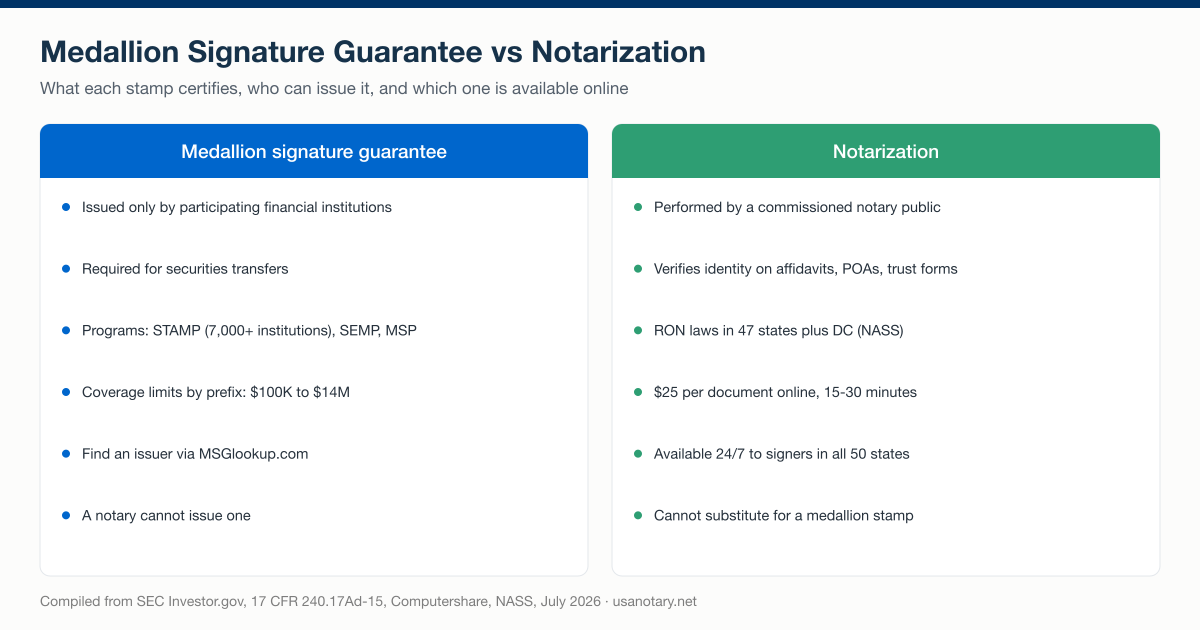
The two stamps side by side — what each certifies, who issues it, and which one is available online, compiled from SEC, FINRA, Computershare, and NASS sources, July 2026.
What does a medallion signature guarantee actually certify?
A medallion signature guarantee certifies three facts at once — the signature is genuine, the signer has legal capacity, and the signer has authority to sign — and the issuing institution puts its own name behind that certification. Computershare, one of the largest U.S. transfer agents, defines it this way: “A Medallion Guarantee is a special stamp that’s used when you sell or transfer US securities. It confirms that the signature authorizing the sale or transfer is genuine and that the signer has the legal capacity and authority to sign the document.”
The federal frame sits in SEC Rule 17Ad-15, which defines the guarantee as “a guarantee of the signature of the person endorsing a certificated security, or originating an instruction to transfer ownership of a security.” The same rule tells transfer agents — the companies that maintain a security’s ownership records — to adopt written standards for which guarantees they accept, and to treat every category of eligible guarantor institution equitably under those standards.
The SEC’s investor education page states the program’s purpose plainly: it protects investors by making it harder for someone to steal securities by forging a signature on the certificates and related transfer documents. That anti-theft mission is why the stamp exists at all — a forged endorsement on a stock certificate can move someone’s life savings, so the securities industry built a guarantee regime with institutional money standing behind every stamp.
The STAMP, SEMP, and MSP programs
Three medallion programs issue the stamps, and the SEC’s investor page names each one’s membership:
- STAMP — the Securities Transfer Agents Medallion Program, whose participants include more than 7,000 U.S. and Canadian financial institutions. This is the program most bank and credit-union medallion desks belong to.
- SEMP — the Stock Exchanges Medallion Program, whose participants include regional stock exchange member firms plus clearing and trust companies.
- MSP — the New York Stock Exchange Medallion Signature Program, whose participants are NYSE member firms.
Every medallion stamp also carries a coverage ceiling. Computershare’s shareholder help page explains that each stamp’s alpha prefix corresponds to a transaction limit — the limits range from $100,000 up to $14,000,000 — and “if the value of the transaction exceeds the limit, the MSG will be rejected.” A stamp with a low prefix on a high-value transfer fails even though the stamp itself is genuine, which is one of the most common reasons transfer paperwork comes back.
Why transfer agents insist on the medallion
Liability drives the requirement. The SEC’s page is direct about the mechanism: “Transfer agents insist on medallion signature guarantees because they limit their liability and losses if a signature turns out to be forged.” The transfer agent processes an irreversible change of ownership; the medallion shifts the forgery question onto an institution that verified the signer and is answerable for the guarantee.
FINRA’s rulebook applies the same logic to brokered transfers. FINRA Rule 11550 requires that “each assignment, endorsement, alteration and erasure shall bear a guarantee acceptable to the transfer agent or registrar.” The rule adds a detail worth knowing before you sign anything: the signature on an assignment must correspond with the name as written on the certificate in every particular, without alteration or enlargement. A married name, a dropped middle initial, or “Bob” for “Robert” can sink a transfer no matter which stamp sits beside it.
What does a notarization certify — and where do its limits sit?
A notarization verifies identity: a commissioned notary public confirms who the signer is, watches or takes the acknowledgment of the signature, and completes a notarial certificate — but the notary certifies nothing about what the signer owns or has authority to transfer. Our plain-English guide to what “notarized” actually means walks through the mechanics; the short version is that the notarial act attaches a state-commissioned officer’s identity verification to a signature.
The certificate the notary completes comes in two main forms, and the document’s own wording chooses between them. An acknowledgment records that the signer appeared and confirmed the signature as their own free act; a jurat records that the signer swore or affirmed the document’s contents are true, under oath administered by the notary. The distinction matters for bank paperwork — affidavits take jurats, deeds and POAs typically take acknowledgments.
What a notary never certifies
A notary never certifies ownership, authority, or value. The notarial certificate says nothing about whether the signer actually owns the 400 shares being transferred, whether a trustee has power under the trust instrument, or whether the transaction makes sense. That silence is the whole reason the securities industry built the medallion programs: identity verification alone does not answer the question a transfer agent needs answered — is this endorsement good, and who pays if it isn’t?
The liability shape differs accordingly. A medallion stamp is a guarantee with an institution behind it and a dollar-denominated coverage prefix. A notarization is an official act of a state-commissioned individual; a notary who performs the act properly has no stake in the transaction’s value at all. One stamp prices risk; the other verifies a person.
Medallion signature guarantee vs notary: the differences that matter
The medallion signature guarantee and the notarization diverge on every practical dimension — what is certified, who issues it, which rules govern it, and where you can get it:
| Dimension | Medallion signature guarantee | Notarization |
|---|---|---|
| What it certifies | Signature is genuine and the signer has legal capacity and authority to sign the transfer (Computershare) | Signer’s identity — plus acknowledgment of the signature or an oath to the contents, per the certificate |
| Who issues it | Participating banks, savings banks, credit unions, and broker-dealers in the STAMP, SEMP, or MSP programs (SEC) | A state-commissioned notary public |
| Governing rules | SEC Rule 17Ad-15; FINRA Rule 11550 for assignments of registered securities | State notary statutes and the state’s certificate forms |
| Risk it addresses | Forged endorsements on securities; the stamp limits the transfer agent’s liability (SEC) | False identity on signed documents |
| Coverage limit | Alpha-prefix transaction limits from $100,000 to $14,000,000 (Computershare) | No transaction cap — the notarial act does not insure value |
| Where and when | In person at a participating financial institution, during business hours | Online over live video, 24/7 — 47 states and DC have remote e-notarization laws (NASS) |
Two of those rows do most of the work in practice. The issuer row explains why a notary appointment can never satisfy a medallion requirement: the stamp is a membership credential of a guarantee program, not a notarial tool. The coverage limit row explains why even a correct medallion sometimes fails — a transfer agent checks the stamp’s prefix against the transaction value, and Computershare warns that a transaction above the stamp’s limit is rejected outright.
The governing-rules row also settles a question signers ask constantly: no state notary statute anywhere authorizes a notary to issue a signature guarantee, because the guarantee is a creature of SEC rule and private program membership, not of notarial law. The two regimes simply do not overlap.
Which stamp does your document need?
The document type decides, and the split follows one rule: instruments that transfer ownership of securities are required to carry a medallion, while sworn or acknowledged documents are notarized. Here is the router for the documents banks and brokerages see most:
| Document | Which stamp | Why |
|---|---|---|
| Stock power / assignment of a certificated security | Medallion | FINRA Rule 11550: each assignment or endorsement must bear a guarantee acceptable to the transfer agent |
| Transfer-agent instruction to sell or transfer shares (Computershare, EQ, and similar) | Medallion | Computershare: the stamp “is used when you sell or transfer US securities” |
| Account transfer forms moving securities between institutions | Medallion (when the receiving form requires it) | SEC Rule 17Ad-15 covers instructions “to transfer ownership of a security” |
| Affidavit of domicile in an estate transfer package | Notarization | It is a sworn affidavit — the notary administers the oath; see our affidavit of domicile guide |
| Power of attorney presented to a bank | Notarization | Execution is governed by state POA law — our guide to notarizing a power of attorney online covers the steps |
| Certification of trust for account opening | Notarization | Required where state law or the institution’s own form calls for an acknowledged certification |
| Beneficiary and account-maintenance forms | Check the form | Custodians print the execution requirement in the signature block — some demand a guarantee, some a notary, many neither |
Estate transfers show why the two stamps travel together rather than compete. A decedent’s shares held at a transfer agent typically move only with a medallion-stamped transfer form — and the supporting affidavits in the same envelope are notarized, because they are sworn statements rather than ownership transfers. One package, both stamps, each doing the only job it can legally do.
When the form itself decides
Custodian paperwork settles most edge cases for you: the signature block states what the institution will accept. Read that block before booking either service. If it prints a medallion box, a notary seal will not save the submission — SEC Rule 17Ad-15 lets a transfer agent reject any transfer whose guarantee fails its written standards, and an absent guarantee fails by definition. If it prints a notary block, the document needs a notarial certificate, and a medallion desk cannot produce one. When the block offers either option, the notarization is almost always the faster path, because it does not require a branch visit at all.
Can a notary do a medallion signature guarantee?
No — a notary cannot issue a medallion signature guarantee, and the prohibition is structural rather than a matter of bank policy. SEC Rule 17Ad-15 defines the “eligible guarantor institution” whose guarantees transfer agents accept, and the definition names banks, brokers, dealers, municipal securities dealers, credit unions, national securities exchanges, registered securities associations, clearing agencies, and savings associations. Notaries public appear nowhere in that definition. The SEC’s investor page closes the loop from the other direction: an investor obtains the stamp “from a financial institution — such as a commercial bank, savings bank, credit union, or broker dealer — that participates in one of the Medallion Signature Guarantee Programs.”
A notary commission and a medallion stamp are different species of authority. The commission is a state appointment to verify identity, administer oaths, and complete notarial certificates. The medallion is a program credential an institution holds — backed by the institution’s own participation in STAMP, SEMP, or MSP — that lets specific authorized employees guarantee signatures on securities transfers. The same bank employee can hold both: a branch officer may be a commissioned notary and an authorized medallion signer. Even then, each stamp works only for its own purpose, because each certifies a different fact under a different regime.
Why the reverse substitution fails too
A medallion cannot replace a notarization either. When a statute or a document requires an acknowledged or sworn signature — a POA that state law says must be acknowledged, an affidavit that must be sworn — only a notarial certificate satisfies it, and a medallion stamp is not a notarial act. Signers occasionally present a medallion-stamped affidavit to a court clerk or county recorder and discover the document is unusable; the guarantee regime carries zero weight outside securities transfers. The substitution fails in both directions because neither officer is performing the other’s act, no matter how similar the ink looks.
Where do you get each one — and which can you do online today?
The medallion comes from a participating financial institution in person; the notarization comes from any commissioned notary, and in most of the country that now includes a notary on live video.
Getting a medallion signature guarantee. Start with your own bank, credit union, or broker-dealer — the SEC’s guidance is to obtain the stamp from a participating financial institution, and institutions generally serve their own account holders first. Computershare’s shareholder help page adds three practical routes: a searchable directory of participating institutions at MSGlookup.com; eSignature Guarantee, an online provider it lists for shareholders; and Computershare’s own Medallion Waiver Program, an alternative for U.S. residents with holdings under $10,000. Shareholders outside the U.S. have the hardest path — Computershare notes that “some financial institutions outside the United States offer a medallion signature guarantee to existing customers if the financial institution has a corresponding relationship with a United States bank.”
Getting a notarization. The National Association of Secretaries of State reports that 47 states and the District of Columbia have a law allowing remote e-notarization, which means the notarized documents in a transfer package no longer require a branch visit at all. The legal grounding — commissions, state statutes, interstate recognition — is covered in our guide to whether online notarization is legitimate. Here is how the online session works:
- Upload the document. The custodian’s own form, the affidavit, or the POA — the notary notarizes the signature on it and does not alter the form.
- Verify your identity. Identity verification runs before the session through credential analysis and knowledge-based authentication handled by a third-party identity-verification service.
- Join the video session. A commissioned notary meets you on live video — sessions run 24/7, take 15–30 minutes, and support multiple signers when an estate package needs two executors on the same affidavit. Remote witnesses can join where state law and the document’s rules permit.
- Receive the completed document. The session produces a tamper-evident notarized PDF with a complete audit trail, and the audio-video recording and electronic journal entry are retained for 10 years or longer where state law requires.
Notarization costs $25 per document, with volume pricing for institutions that send recurring paperwork. The medallion side has no equivalent published price — cost and availability are set institution by institution, which is why the router table above is worth checking first.
What should banks and credit unions tell customers who ask for “the stamp”?
Triage the request by document, because the customer asking for “a signature guarantee stamp” usually needs one of two very different services. A two-question script sorts nearly every case:
- Is the document transferring ownership of securities? Stock power, transfer-agent form, certificate endorsement — route the customer to the institution’s medallion desk if it participates in STAMP, SEMP, or MSP, or to MSGlookup.com if it does not. A notary appointment cannot help them, and sending them to one wastes their day.
- Is the document sworn or acknowledged? Affidavit, POA, trust certification, consent form — the customer needs a notarization, and the branch does not need an on-site notary to deliver it. A staff-initiated remote session connects the customer to a commissioned notary over live video while they are still at the desk or after they get home.
The staff-initiated workflow is where the split turns into an operational advantage. Front-line employees at banks and credit unions field both requests all day; the medallion side must stay in-house by federal rule, but the notarization side can be handed to a remote notary in minutes — 24/7, for signers in all 50 states, with the tamper-evident record an examiner expects. Our online notarization service for banks and credit unions covers how business-initiated sessions work, and the acceptance question is addressed in our guide to whether banks accept online notarization.
The rule to leave with: the medallion is required for securities transfers and only a participating financial institution can issue it; the notarization verifies identity on everything else and no longer requires a branch at all. Questions about a recurring document workflow? Call 804-767-7500 or reach out through our contact page.