
Does an LLC operating agreement need to be notarized?
No — an LLC operating agreement does not need to be notarized to be legally binding. The agreement becomes binding when the members sign it, and in some states it needs even less than that: Delaware’s LLC Act defines the operating agreement as “any agreement (whether referred to as a limited liability company agreement, operating agreement or otherwise), written, oral or implied, of the member or members,” and a contract that can exist as an oral understanding cannot carry a notarization prerequisite. Thomson Reuters’ guidance for business owners states the general rule plainly: “In most jurisdictions, it is not a legal requirement that an operating agreement be notarized.”
The operating agreement is also not filed anywhere. The Small Business Administration puts it in one line: operating agreements “are not required to be filed, nor will they be accepted by your state.” The articles of organization are filed with the state; the operating agreement stays with the company’s internal records. No filing clerk reviews it, no state seal lands on it, and no notary certificate stands between the signed document and a court enforcing it.
So why does the question keep coming up? Because an LLC’s formation stack does contain documents where notarization is required — and non-resident founders hit those documents more often than anyone else. The first half of this guide covers what actually makes the agreement binding and when adding a notary is still the smart move. The second half maps the steps where a notary genuinely belongs to the rule: the USPS form behind a US mailing address, the bank’s verification file, and the apostille chain for documents traveling back across a border.
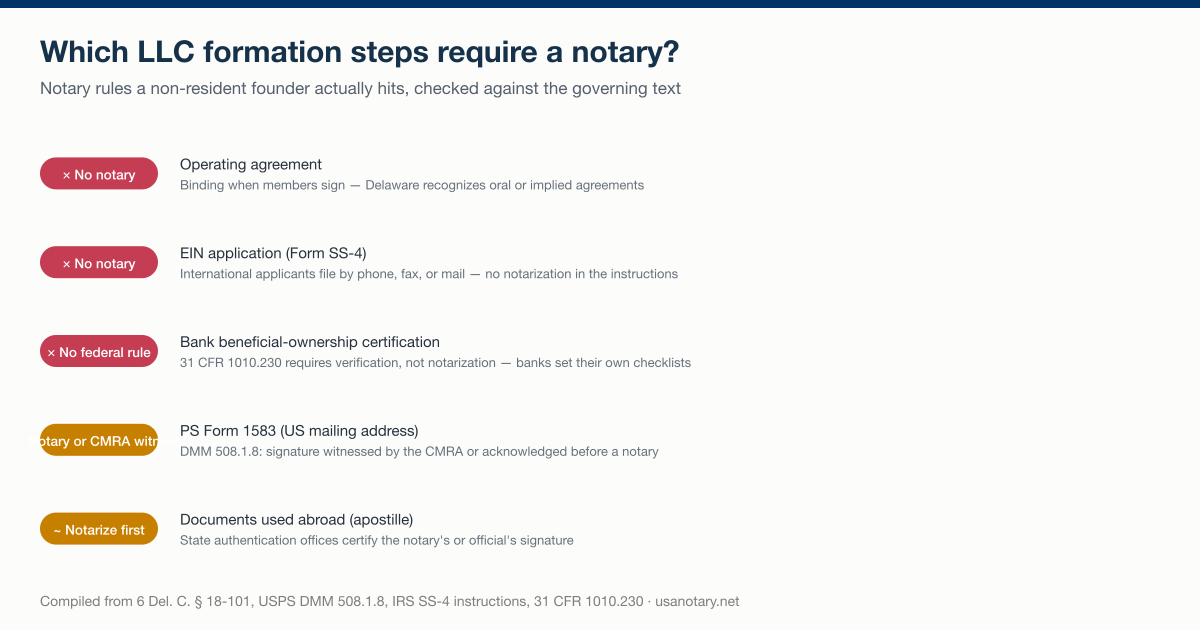
Where a notary actually appears in an LLC formation stack — each verdict checked against the governing text cited in this article, July 2026.
What makes an operating agreement legally binding?
Contract law makes an operating agreement binding — the members’ assent, usually shown by signatures, not a notary’s certificate and not a state stamp. An operating agreement is a private contract among the members of the LLC governing ownership percentages, voting, distributions, and what happens when a member leaves. The LLC statutes define it deliberately loosely, because legislatures wanted the members’ actual arrangement to control even when the paperwork is thin:
- Delaware — 6 Del. C. § 18-101 defines the limited liability company agreement as “written, oral or implied,” and adds that it “is not subject to any statute of frauds.” An agreement the statute enforces without any writing at all plainly does not require a notary certificate.
- California — Corporations Code § 17701.02 defines the operating agreement as the members’ agreement “whether oral, in a record, implied, or in any combination thereof.”
- Most states — the SBA notes that “the requirement of an operating agreement depends on the state in which it was formed. Many states do not require operating agreements” at all.
Put those together and the pattern is clear: the states regulate whether an agreement must exist and sometimes what form it takes — never whether a notary watched the signing.
States that require a written operating agreement
New York is the standing example that “no notarization” does not mean “no formality.” LLC Law § 417 directs that members “shall adopt a written operating agreement,” and the agreement “may be entered into before, at the time of or within ninety days after the filing of the articles of organization.” Written adoption is the entire requirement — the section imposes no notarization and no filing of the agreement itself. A New York LLC that operates on a handshake understanding is out of step with § 417; a New York LLC whose written agreement was never notarized is fully compliant.
That is the practical hierarchy to remember. A written, signed operating agreement satisfies every state’s formality rules that this guide’s sources address; notarization sits above every statutory requirement as a purely optional layer.
When should you notarize an operating agreement anyway?
Notarize the operating agreement when a third party might later question who signed it. The notarial act at issue here is an acknowledgment — the notary verifies the signer’s identity and certifies that the signature is genuinely theirs — and that certificate is evidence about execution, not an upgrade to the contract’s terms. Three situations make that evidence worth having:
- A dispute among members is foreseeable. In a fight over whether a member actually agreed to a buyout clause or a capital-call provision, an acknowledgment puts the signer’s verified identity and the date of the notarial act into the record. The agreement was already binding; the acknowledgment makes the execution hard to deny.
- A bank, lender, or investor will scrutinize the document. Federal banking rules require institutions to verify who stands behind an entity customer (covered in detail below), and institutions translate that duty into their own document checklists. A notarized execution page answers signature-authenticity questions before they are asked.
- The document is leaving the country. A foreign bank, registry, or government office has no way to evaluate a bare US signature. Virginia’s authentication office describes exactly what the receiving side wants instead: a chain in which a state office verifies “that the Virginia Notary, Virginia Clerk of Court or Virginia Deputy State Registrar is listed in our system, and they have notarized or issued your document correctly.” Without notarization there is nothing for that chain to attach to.
Thomson Reuters’ guidance lands in the same place: notarization is not required, but it is inexpensive and can still be prudent. For a single-member LLC whose agreement will only ever sit in a drawer, skip it. For a multi-member company with foreign owners, cross-border banking, or an eventual sale in view, the $25 acknowledgment is cheap execution insurance.
Which formation steps are required to be notarized for a non-resident founder?
For a non-resident founder, notarization is required at exactly one step by a federal rule — PS Form 1583, the form behind a US mailing address — and re-enters through the apostille chain whenever a US document travels abroad. The EIN application and the federal bank rule demand verification, not a notary. Founders forming a US LLC from outside the country tend to assume the operating agreement is the document with the formal execution rule; the real notarization rules sit in the surrounding stack.
PS Form 1583: the US mailing address step
A non-resident founder’s US street address almost always comes from a Commercial Mail Receiving Agency — a virtual mailbox provider — and USPS regulates that relationship directly. Under Domestic Mail Manual 508.1.8.3, the mail addressee “must sign or confirm his or her signature in the physical or virtual (in real-time audio and video) presence of the CMRA owner or manager, or authorized employee, or acknowledge his or her signature in the physical or virtual (in real-time audio and video) presence of a notary public.” Two forms of identification are required with the form, and “the identification presented must be current (not expired).”
Notice what the rule does that no LLC act does: it names the notary public in the regulation itself. Signing Form 1583 casually and emailing it in does not satisfy DMM 508.1.8 — the signature must be witnessed by the operator or acknowledged before a notary, in person or over live audio-video. Our PS Form 1583 notarization walkthrough covers the session itself, and the companion guide to getting a US address as a non-resident covers where the form fits in the larger sequence. Founders signing for a company rather than themselves should check who signs Form 1583 for an LLC — business accounts follow different box-by-box rules than residential ones. Mailbox providers that onboard non-resident founders at volume typically build this verification into signup; that operator-side workflow is what our notarized Form 1583 onboarding service for virtual mailbox operators handles.
The EIN: no notary, but no online application either
An EIN application is never notarized — the Form SS-4 instructions contain no notarization requirement anywhere — but non-resident founders lose the easy path. The IRS states that you cannot use the online EIN tool if “your principal place of business is outside the U.S.” The SS-4 instructions route international applicants three ways instead:
- Phone: call 267-941-1099 (not toll-free), 6:00 a.m. to 11:00 p.m. Eastern time, Monday through Friday.
- Fax: send the completed SS-4 to 304-707-9471 from outside the United States.
- Mail: send it to Internal Revenue Service, Attn: EIN International Operation, Cincinnati, OH 45999.
A responsible party who has no SSN or ITIN and is ineligible to obtain one enters “foreign” or “N/A” on line 7b, per the same instructions. The EIN step costs patience, not notary fees — and any provider or forum post claiming the SS-4 must be notarized is describing a requirement the IRS never wrote.
The bank account: verification, with the bank choosing the proof
Federal law obligates the bank, not the founder, at account opening — and it demands verification rather than notarization. Under 31 CFR 1010.230, covered financial institutions “are required to establish and maintain written procedures that are reasonably designed to identify and verify beneficial owners of legal entity customers.” The rule reaches every individual who “owns 25 percent or more of the equity interests” and at least one individual with “significant responsibility to control, manage, or direct” the company — an executive officer, senior manager, or managing member. The bank may collect this through the certification form in the regulation’s Appendix A, signed by the person opening the account.
Notarization is not mentioned anywhere in 31 CFR 1010.230. But the rule sets a verification floor and leaves the documentary method to each institution — which is exactly where notarized or certified documents enter a bank’s checklist for a founder the branch cannot meet in person. When a specific bank asks for a notarized operating agreement or a notarized signature card, that request comes from the bank’s own procedures, and the fastest way through is usually to complete it rather than argue the federal rule. The same logic applies to certified-copy requests: the authority that holds an original — a state filing office for articles of organization, a notary for qualifying unrecorded documents — is the one that can produce the certified duplicate a bank will accept.
Notarized, apostilled, or certified copy: which one is the request for?
Non-resident founders receive all three requests, often in the same email, and each names a different act by a different authority. The table below separates them:
| The request | What it actually is | Who performs it | Where an LLC founder meets it |
|---|---|---|---|
| Notarization (acknowledgment) | A commissioned notary verifies the signer’s identity and completes a certificate on the document itself | A notary public | PS Form 1583; bank documents when the institution’s checklist asks; any contract whose parties require it |
| Apostille | A state-issued certificate authenticating the notary’s or official’s signature for use abroad | The state’s authentication office — in Virginia, the Secretary of the Commonwealth | US company documents presented to a foreign bank, registry, or government |
| Certified copy | An official duplicate confirmed against the original by the authority that holds the original | The issuing office for filed documents; a notary for qualifying unrecorded documents | Foreign account opening; proving formation documents without surrendering originals |
The apostille deserves the extra sentence because it sits on top of notarization rather than beside it. Virginia’s authentication office issues either a Great Seal certification or an apostille “depending on the destination country,” and describes the apostille as the form “to be used in countries who are signed as a part of the Hague Convention” — a convention the Hague Conference reports now has 130 contracting parties, replacing the older, slower legalisation process with a single certificate. The order of operations for an operating agreement headed to a foreign authority is therefore fixed: the document is notarized first, the state office then authenticates the notary’s commission, and only then does the foreign recipient accept it. Our explainer on what an apostille is walks through that chain state by state.
How do you notarize LLC documents online?
Remote online notarization handles every notarization named in this guide without the founder setting foot in a US notary’s office — NASS reports that 47 states and the District of Columbia have a law that allows for remote e-notarization, and DMM 508.1.8.3 explicitly accepts a signature acknowledged in the “virtual (in real-time audio and video) presence” of a notary public. Here is how a session runs:
- Upload the document. The operating agreement, Form 1583, or bank form goes in as-is — the notary notarizes the signature on it and does not draft or alter the document.
- Verify identity. Before the session starts, identity verification runs credential analysis plus knowledge-based authentication through a third-party IDV service, so the notary knows exactly who is signing.
- Join the video session. A commissioned notary meets the signer on live video — sessions run 24/7 and take 15-30 minutes, and multi-signer sessions cover a multi-member LLC executing one agreement together.
- Receive the completed document. The session produces a tamper-evident PDF with a complete audit trail; the audio-video recording and electronic journal entry are retained for 10 years or longer where state law requires.
Pricing is $25 per document, with volume pricing for companies and providers that generate notarizations at scale. Founders signing from outside the US should read the guide to notarizing documents from overseas first — the mechanics differ enough from a domestic session to be worth five minutes.
Which state rules on operating agreements are worth knowing?
State LLC acts differ on whether an operating agreement must exist and what form it takes — none of the statutes reviewed here touches notarization. The three statutes this guide fetched directly:
| State | Must an operating agreement exist in writing? | Notarization required? |
|---|---|---|
| Delaware | No — 6 Del. C. § 18-101 recognizes “written, oral or implied” agreements, exempt from any statute of frauds | No |
| California | No — Corp. Code § 17701.02 accepts agreements “oral, in a record, implied, or in any combination thereof” | No |
| New York | Yes — LLC Law § 417: members “shall adopt a written operating agreement,” before, at, or within 90 days after the articles are filed | No |
| Most other states | Varies — the SBA notes many states do not require operating agreements at all | Not in any statute reviewed here |
The direction of the differences is the tell. Where states tighten the rule, they tighten it toward written — never toward notarized. A founder who signs a written operating agreement has cleared the strictest formality any of these statutes imposes.
Keep the notary for the documents that need one
The rule to remember: an operating agreement becomes binding when the members sign it, and no statute reviewed in this guide adds a notary to that. The notarization requirements in a non-resident founder’s stack live elsewhere — PS Form 1583 under DMM 508.1.8, the apostille chain for any document headed abroad, and whichever items a specific bank’s checklist adds. Handle those in a 15-30 minute video session, and keep the operating agreement where the statutes put it: signed, stored with the company records, and notarized only when the audience for it makes the $25 worth spending.
Questions about a recurring 1583 workflow or a stack of formation documents? Call 804-767-7500 or contact us.