
Does a loan modification need to be notarized?
A loan modification needs to be notarized when it will be recorded — and usually not otherwise. The modification agreement is the contract that restructures an existing home loan; the California Department of Real Estate’s Loan Modification Self-Help Guide describes it as “a restructuring of your current loan repayment period (term), interest rate, or other provision of your home loan.” Nothing in that definition involves a notary. The notary requirement enters through a different door: the county land records. When the servicer decides the signed agreement must be recorded — filed with the county recorder where the property sits — the agreement has to be executed in recordable form, and recording statutes require a notarial acknowledgment on instruments affecting real property.
That is why there is no single yes-or-no answer taped to the document. Two versions of the same Flex Modification can leave the same servicer’s shop in the same week: one with a plain signature block, one with a notary certificate at the end, depending on whether that particular agreement is headed to the recorder’s office. The DRE guide gives borrowers the operative instruction in one line: have your signature notarized “only if required by your mortgage lender.” The package tells you what it needs — the trap is not reading it, signing in the wrong name, or skipping the notary line that the recorder will later reject the document over.
This guide covers when a modification is recorded and why recording requires a notary, the signing rules that send packages back, what Fannie Mae and Freddie Mac require when the notarization happens remotely, and how servicers and borrowers complete the whole step online. For the origination-side picture — which closing documents carry notary certificates in the first place — see our guide to which mortgage documents need to be notarized.
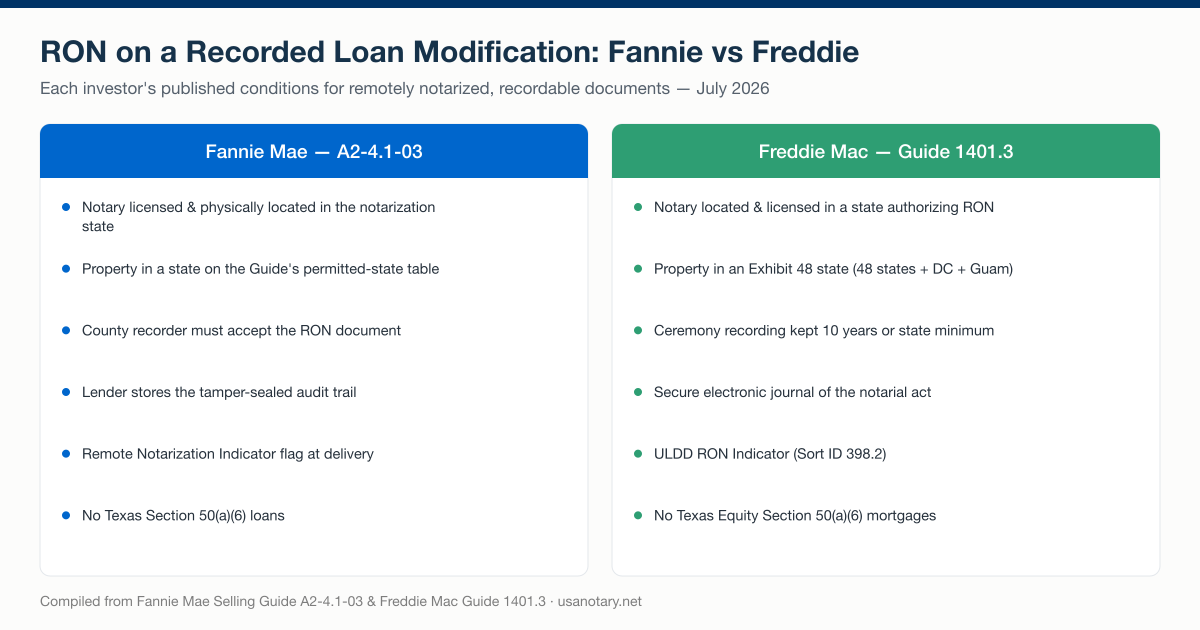
The two investors’ published conditions for remotely notarized, recordable documents — compiled from Fannie Mae Selling Guide A2-4.1-03 and Freddie Mac Guide Section 1401.16, July 2026.
When is a loan modification recorded — and why does recording require a notary?
A loan modification is recorded when the servicer needs the modified lien to hold its place in line. Fannie Mae’s Servicing Guide (F-1-27) states the trigger in priority terms: the servicer must record the executed Loan Modification Agreement if “recordation is necessary to ensure that the modified mortgage loan retains its first lien position and is enforceable in accordance with its terms at the time of the modification, throughout its modified term, and during any bankruptcy or foreclosure proceeding involving the modified mortgage loan.” A second trigger is structural: recording is required whenever the agreement “includes assignment of leases and rents provisions.”
What recording sets in motion at the servicer
Recording is not a filing formality — it pulls a chain of obligations behind it. The same Fannie Mae section requires the servicer to “obtain a title endorsement or similar title insurance product issued by a title insurance company if the Loan Modification Agreement will be recorded,” and it puts the executed paperwork on a clock: when the agreement will be recorded, a certified copy goes to the document custodian within 25 days, with the recorded original following within 5 business days of its return from the recorder. An unrecorded agreement still moves — the original goes to the custodian within 25 days. Here is the decision in table form:
| Question the servicer answers | Rule in Fannie Mae Servicing Guide F-1-27 | Effect on the signing ceremony |
|---|---|---|
| Does the modified loan need recordation to retain its first lien position and stay enforceable? | Executed agreement must be recorded | Agreement must be notarized so the recorder will accept it |
| Does the agreement include assignment of leases and rents provisions? | Executed agreement must be recorded | Agreement must be notarized so the recorder will accept it |
| Will the agreement be recorded? | Title endorsement or similar title insurance product required | Title underwriter reviews the executed, notarized instrument |
| Will the agreement stay unrecorded? | Original still goes to the document custodian within 25 days | Plain signatures generally suffice — follow the package instructions |
Why the county recorder demands a notary
County recorders accept instruments, not promises — and state recording statutes define what an acceptable instrument looks like. Ohio’s is a clean example: Ohio Revised Code § 5301.01 requires a deed, mortgage, land contract, or lease of any interest in real property to be signed and acknowledged before an official — a judge or clerk of a court of record, a county auditor, a county engineer, a notary public, or a mayor — who certifies the acknowledgment on the document. A loan modification headed for the land records is an instrument in that family: it amends a recorded security instrument, so it enters the records the same way, wearing an acknowledgment certificate. The acknowledgment is a specific notarial act — the signer appears before the notary and confirms the signature is theirs — and it differs from the oath-based jurat used on affidavits; our comparison of acknowledgments versus jurats walks through which certificate belongs on which document.
Put the two halves together and the rule that governs this entire topic emerges: the modification must be notarized because it is recorded, and it is recorded to protect lien priority. Servicers that internalize this stop asking “does a loan modification need to be notarized?” in the abstract and start asking “is this one being recorded?”
Which signing mistakes send a modification package back?
Name mismatches and missing signatures kill more modification packages than any legal technicality. A loss-mitigation workout that survived underwriting can still fail at the signature line, and the fix — mailing a corrected package and waiting again — burns weeks a delinquent loan does not have. The California DRE’s self-help guide gives borrowers a checklist for the moment the paperwork arrives, and it doubles as the servicer’s quality-control list:
- Understand all of the terms — the loan type, the new interest rate, and the new payment — before signing anything.
- Review and confirm that all personal information is correct on every page.
- Contact the mortgage lender immediately if there is an error — do not hand-correct a recordable instrument.
- Sign the documents exactly as your name appears on the paperwork. If the agreement prints “Jonathan Q. Public,” the signature line needs “Jonathan Q. Public,” not “Jon Public.”
- Have your signature notarized only if required by your mortgage lender — which, as covered above, generally means the agreement is being recorded.
- Keep copies of all the documents before sending them back.
The exact-name rule earns its bold type. A recorded instrument has to match the chain of title, and the notary’s certificate identifies the person who appeared — a signature that drifts from the printed name invites rejection at two checkpoints, the servicer’s document review and the county recorder’s counter.
Every borrower signs — with narrow exceptions
Fannie Mae instructs servicers to “ensure that the Loan Modification Agreement is executed by the borrower(s)” — plural. Both names on the note means both signatures on the modification, even when the co-borrowers no longer share an address or a marriage. The Servicing Guide recognizes reality’s edge cases: “The servicer may encounter circumstances where a co-borrower signature is not obtainable for the Loan Modification Agreement, for reasons such as mental incapacity or military deployment.” Those are exceptions a servicer documents, not options a household elects. For everyone else, the second signature is a logistics problem — and it is the single best argument for a notarization session both signers can join from different cities, covered below.
FHA workouts raise the stakes on the same rules. An FHA partial claim adds a second recordable instrument to the package — a subordinate mortgage payable to HUD — with its own signing and notarization requirements that a servicer’s closing team confirms against the current HUD handbook.
What do Fannie Mae and Freddie Mac require for remote online notarization?
Both GSEs accept remotely notarized documents — including recordable security-instrument paperwork — and both publish the conditions in their guides. Fannie Mae’s Selling Guide (A2-4.1-03) sets the conditions on the Fannie side and points RON systems to MISMO RON Standards Version 2.0; Freddie Mac’s Seller/Servicer Guide (Section 1401.16) — the section its Exhibit 48 permitted-state list and ceremony-recording rules run under — sets the conditions on the Freddie side and reaches electronic post-closing documents, the category that covers the servicing side where modification agreements live. The operative conditions, side by side:
| Requirement | Fannie Mae (Selling Guide A2-4.1-03) | Freddie Mac (Guide 1401.16 + Exhibit 48) |
|---|---|---|
| Notary location | “Licensed and physically located in the state in which the notarial act is performed” | Located in a state that authorizes RON and licensed in that state to perform it |
| Property location | State on the Guide’s permitted-state table | State listed in Exhibit 48 — 48 states plus DC and Guam |
| Recording | “The county recorder in the state and county where the property is located must accept the remotely notarized document for recording” | Seller must record the remotely notarized closing/post-closing documents in the public land records |
| Audit records | Lender stores the tamper-sealed audit trail produced by the RON system until it passes to the servicer | Secure electronic journal of the notarial act, plus a retained audio-video recording of the ceremony the servicer must be able to produce on request |
| Delivery flag | Remote Notarization Indicator on a remotely notarized “security instrument or amendment to the security instrument” | ULDD Remote Online Notarization Indicator delivered per Freddie Mac’s ULDD requirements |
| Excluded loans | Texas Section 50(a)(6) loans | Confirm any state-specific exclusions in the current Section 1401.16 |
Two details in that table deserve their own paragraphs, because they are the ones that surprise servicing teams.
The three-state question: borrower, property, notary
Freddie Mac addresses the interstate question directly: when the borrower and the mortgaged premises sit in a state different from the one where the notary is licensed and located, the law of the notary’s own commissioning state must authorize that notary to engage in interstate remote online notarization transactions. The notary’s commissioning state is the legal anchor — a principle explored in depth in our guide to whether a remote notarization is valid across state lines. Exhibit 48’s own footnote applies the same logic to California: under the provisions of California Senate Bill 696, a California borrower on a California property may use an out-of-state notary where that notary’s state authorizes interstate RON. Georgia and Mississippi are the two states absent from Freddie Mac’s Exhibit 48 list.
RON is an option the borrower accepts, not a mandate
Freddie Mac’s guide also protects borrower choice: where a borrower requests another notarization option that is permitted by the state where the borrower and the mortgaged premises are located, the Seller may not require remote online notarization. A servicer can build its modification workflow around remote sessions — and should, for the completion-rate reasons below — but the borrower who wants a courtesy closing at a branch or a mobile signing keeps that right. The workflow that wins offers the webcam session first and keeps the paper path open.
Can you notarize a loan modification online?
Yes — a loan modification can be notarized online wherever three layers align: state law authorizes the notarization, the investor’s conditions are met, and the county recorder accepts the output. The legal layer is the widest one: the National Association of Secretaries of State reports that 47 states and the District of Columbia have a law that allows for remote e-notarization. The investor layer is the table above. The recording layer is the narrowest and the one to verify first — Fannie Mae’s condition makes the recorder the gatekeeper, so the pre-session question is always whether the destination county records remotely notarized instruments.
Here is how the session itself runs for a borrower whose modification agreement carries notary provisions:
- The package is uploaded — by the borrower, or by the servicer’s staff through a business-initiated workflow, so the borrower never handles a scanner.
- The borrower’s identity is verified through credential analysis of a government-issued ID plus knowledge-based authentication, run by a third-party identity-verification service before the notary appears.
- The borrower and notary meet on live video. Sessions run 24/7, take 15–30 minutes, and support multiple signers — co-borrowers can join from different locations, which solves the deployed-spouse and divorced-co-borrower problems that stall mailed packages. Signers can appear from all 50 states.
- The notary completes the acknowledgment and the session produces a tamper-evident PDF with a complete audit trail — the artifact the lender must store under Fannie Mae’s audit-trail condition.
- The recording and journal are retained. The audio-video recording and electronic journal entry are retained under the notary’s state-law schedule and kept available to the lender and servicer on request — the records Freddie Mac’s Guide Section 1401.16 requires the servicer to be able to produce.
The economics favor the webcam heavily. A remote session costs $25 per document, with volume pricing for servicing shops — against the cost of printing, overnighting, chasing, and re-mailing a package that came back with the wrong signature, before counting the calendar days lost while a delinquency deepens.
How do servicers stop losing modifications to the mail?
Unreturned and mis-executed packages are a workflow problem, and workflow problems have workflow answers. Every mailed modification package bets the workout on the borrower finding a notary, signing in exactly the right name, and mailing the originals back before the deadline — three failure points the servicer cannot see until the bet is already lost. Moving the execution step to a scheduled video session collapses all three: the notary is present by design, the name-match happens live with the notary reading the printed name off the document, and the executed, notarized PDF exists the moment the session ends — with the 25-day custodial clock barely started.
The staff-initiated model matters more than the technology. A loss-mitigation specialist who sends the borrower a session link the day the modification is approved — rather than a FedEx envelope and a prayer — controls the timeline. Multi-signer sessions bring the co-borrower in from another state instead of routing the package through two households sequentially. And because every session yields a tamper-evident PDF and a complete audit trail, the servicer’s file supports the investor delivery flags and title-endorsement review that a recorded modification demands. That end-to-end pattern — approval, session link, executed recordable instrument, custodian — is what our online notarization service for mortgage lenders is built around, from Flex Modifications to the subordinations and releases that share the same recording logic. (The subordination case has its own guide: subordination agreement notarization rules.)
The rule to remember
A loan modification is notarized because it is recorded, and it is recorded to protect first lien position. Everything else in this topic is implementation detail hanging off that rule: the recorder demands an acknowledgment, the investor demands the audit trail and the delivery flag, and the package demands every borrower’s exact-name signature. When any piece is unclear, the modification package’s own instructions control — and when the package does call for a notary, the session can happen tonight over video instead of next week at a bank branch. The broader legal grounding for that option is covered in our explainer on whether online notarization is legit.
Questions about a recurring modification workflow, or a one-off package that has to record in a specific county? Call 804-767-7500 or reach us through the contact page — sessions run around the clock, and business-initiated workflows let your team send the link.