
Does a Medicaid application need to be notarized?
No. A Medicaid application does not need to be notarized — in any state, for any coverage group. Federal regulation sets the signature standard that every state Medicaid agency follows: under 42 CFR § 435.907, “all initial applications are signed under penalty of perjury,” and agencies must accept electronic signatures, “including telephonically recorded” ones. The same rule requires agencies to take applications online, by telephone, by mail, and in person. A signature framework built around phone calls and web portals has no room for a notary stamp, and the regulation never mentions one.
So why does the question come up constantly in nursing-home business offices and elder-law waiting rooms? Because a long-term-care Medicaid file is much bigger than the application form. The application arrives with a durable power of attorney proving that an adult child may act for the resident, five years of financial records, and — in spend-down cases — caregiver agreements, trust documents, and signed declarations. Some of those supporting documents are notarized, not because Medicaid demands it, but because the state property and agency laws they live under demand it. Families see a notary block on the power of attorney and assume the whole packet works that way.
The cleanest official statement comes from New York. The state’s Medicaid documentation checklist (09 INF-2, Attachment 3) tells applicants directly that “affidavits need not be notarized,” and describes an acceptable affidavit as one that “must be signed under penalty of perjury, but need not be notarized.” Even the sworn-sounding paperwork inside the eligibility file follows the application’s signature standard, not the notary’s.
This guide separates the two layers — the application layer, where notarization is never required, and the document layer behind it, where notarization often is — with the statute or form for each claim.
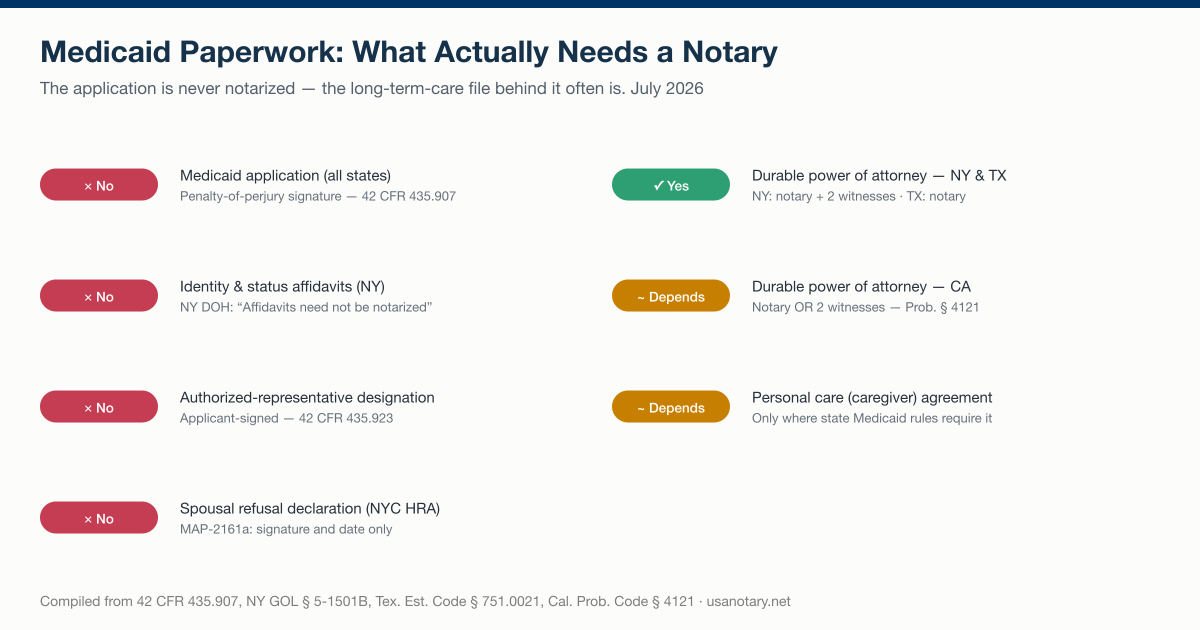
The verdicts from this guide’s document table — the application layer is notarization-free by federal design; the notarized documents sit in the file behind it, July 2026.
Which documents in a long-term-care Medicaid file do need a notary?
The notarized documents in a Medicaid file are the ones governed by state property and agency law — chiefly the durable power of attorney — while everything the Medicaid agency itself created is signed under penalty of perjury instead. Here is the full stack, document by document:
| Document | Needs a notary? | Rule that decides it |
|---|---|---|
| Medicaid application (all states) | No | 42 CFR § 435.907: signed under penalty of perjury; electronic and telephonic signatures accepted |
| Identity and status affidavits (NY) | No | NY DOH 09 INF-2 checklist: “Affidavits need not be notarized” |
| Authorized-representative designation | No | 42 CFR § 435.923: written designation with the applicant’s signature |
| Spousal refusal declaration (NYC forms) | No notary block | NYC HRA MAP-2161a: signature and date only |
| Durable power of attorney | Yes in NY and TX; notary or two witnesses in CA | NY GOL § 5-1501B; Tex. Estates Code § 751.0021; Cal. Prob. Code § 4121 |
| Personal care (caregiver) agreement | Depends on the state | No notary needed “unless the Medicaid rules in your state require it” — MedicaidLongTermCare.org |
The pattern in that table is the answer to remember: notarization is required by the law that governs the document, not by the Medicaid program processing it. A durable power of attorney is an instrument of state property law — New York executes it like a real-estate conveyance, Texas requires a formal acknowledgment — so it carries a notary block into the Medicaid file. An identity affidavit is a creature of the eligibility process itself, so it follows the process’s penalty-of-perjury standard.
For facility business offices, the practical division of labor looks like this: the application, renewal forms, and agency-issued declarations get signed and submitted as-is. The documents that authorize someone else to handle the resident’s affairs — and the spend-down instruments that move or commit the resident’s money — are the ones to route to a notary. Our guide to how affidavits are notarized covers the sworn-document mechanics for the occasions when a caseworker does request a notarized statement.
One honest caveat: the “No” rows above are checked against the federal rule, New York’s published checklist, and the NYC forms — not against every county worker’s habits. Caseworkers sometimes ask for notarized statements the rules don’t strictly require, and the cheapest response is usually to comply rather than litigate a checklist.
Who is allowed to apply for a nursing-home resident?
Federal rule answers this directly: the application may be filed by the applicant, “an adult who is in the applicant’s household,” an authorized representative, or — “if the applicant is a minor or incapacitated” — “someone acting responsibly for the applicant” (42 CFR § 435.907). On paper, an adult child or a facility business office can start the application for a resident without any notarized authority at all.
The authorized-representative route is similarly notarization-free. Under 42 CFR § 435.923, an applicant designates a representative in writing, with the applicant’s own signature — and the agency must accept electronic and faxed signatures on that designation. Once designated, the representative may sign the application on the applicant’s behalf, complete renewals, receive the applicant’s notices, and act for the applicant “in all other matters.” The same regulation recognizes a second path: authority “accorded under state law, including but not limited to, a court order establishing legal guardianship or a power of attorney” counts without a fresh designation.
Why the durable power of attorney still decides the case
Here is the trap that catches families every week: the designation route requires the applicant’s signature, and the resident who most needs someone to apply — the one with advanced dementia — can no longer sign anything. At that point the family needs authority that already exists: a durable power of attorney executed while the resident still had capacity, or a guardianship order from a court. The POA is the one document in the entire Medicaid file where notarization becomes genuinely decisive, because state law — not Medicaid — sets its execution requirements. Our walkthrough on getting a power of attorney for an elderly parent covers that timing problem in depth, and how signing capacity interacts with dementia explains what a notary screens for at the signing itself.
What the application process never tests, the banks will
There is a second, quieter reason the POA dominates. Medicaid eligibility for nursing-home care runs on documentation — under 42 U.S.C. § 1396p, the agency examines asset transfers over a look-back period of 60 months for disposals made on or after February 8, 2006. Assembling five years of statements means dealing with banks, brokerages, and insurers, and those institutions demand a properly executed durable power of attorney before they release a customer’s records to anyone else. Even where the Medicaid agency would accept a simple signed designation, the financial legwork behind the application cannot proceed without the notarized instrument. The mechanics of getting that document executed correctly are covered in our guide to how to notarize a power of attorney.
Do spousal refusal, caregiver agreements, and spend-down paperwork need a notary?
Mostly no for the agency-facing declarations, sometimes yes for the private contracts — and the distinction matters because every one of these documents gets scrutinized inside the 60-month look-back.
Spousal refusal: signed and dated, no notary block
New York’s spousal-refusal practice runs on two agency forms, and neither asks for a notary. On NYC Human Resources Administration form MAP-2161a, the refusing spouse — the “Legally Responsible Relative” — declares: “I refuse to make my income and/or resources available for the cost of necessary medical care and services for the Medicaid applicant/recipient listed above,” then signs and dates. The companion form MAP-2161 has the applicant assign their right of support to the agency’s Commissioner, again over a plain signature line. Elder-law articles sometimes describe a “notarized refusal letter,” but the HRA forms themselves close with signature and date — no notarial certificate anywhere on either page.
The forms carry their own warning worth quoting to any couple considering the strategy: “Legally Responsible Relatives may be taken to court for failure to support their spouses or minor children.” Refusal preserves eligibility; it does not extinguish the support obligation.
Caregiver agreements: the notary question is state-by-state
A personal care agreement — the contract under which an adult child is paid for providing care — needs to be in writing and created before any caregiver services are provided, per MedicaidLongTermCare.org’s guidance. On notarization, that guidance is precise: “There is also no need to have a Notary Public witness the Personal Care Agreement signing unless the Medicaid rules in your state require it.” Some state Medicaid manuals do require it, which is why elder-law attorneys routinely notarize these agreements as a matter of course — a notarial act also fixes the execution date, and the execution date is exactly what a caseworker probes when deciding whether payments were compensation or gifts.
The stakes of getting this wrong are the look-back’s transfer penalty. Payments to a family caregiver without a compliant, pre-dated agreement “could look like giving away assets to a state Medicaid official” — an uncompensated transfer that produces a period of ineligibility calculated from the amount transferred. A $40,000 caregiving arrangement documented after the fact is not a caregiving arrangement in the agency’s eyes; it is a $40,000 gift with a penalty attached.
The rest of the spend-down file
Spend-down planning generates other instruments — promissory notes, annuity contracts, irrevocable funeral trusts — whose execution formalities vary by state and by instrument. This guide deliberately stops at the documents verified above rather than generalizing. The safe operating rule for a business office is the one the table already teaches: agency forms follow the penalty-of-perjury standard; private legal instruments follow the execution law of your state, which frequently means a notary.
How do New York, Texas, and California actually differ?
The application layer is identical in all three states — the federal signature rule leaves no room for variation — and the differences concentrate entirely in how each state executes the durable power of attorney that anchors the file:
| Layer | New York | Texas | California |
|---|---|---|---|
| Medicaid application | Signed under penalty of perjury — no notary (42 CFR § 435.907) | Same federal rule | Same federal rule |
| Documentation affidavits | ”Affidavits need not be notarized” (NY DOH 09 INF-2) | State publishes its own checklists | State publishes its own checklists |
| Durable power of attorney | Signed, initialed and dated; acknowledged like a real-property conveyance (notarized); witnessed by two persons not named as agents or gift recipients (GOL § 5-1501B) | Signed by the principal (or another adult at the principal’s direction, in the principal’s conscious presence); acknowledged before an officer authorized to take acknowledgments to deeds of conveyance and administer oaths (Estates Code § 751.0021) | Dated and signed; then either acknowledged before a notary public or signed by at least two qualifying witnesses (Prob. Code § 4121) |
| Spousal refusal | Established practice; NYC HRA forms signed and dated, no notary block | — | — |
New York is the most demanding: since the 2021 amendments, a New York POA needs the notarial acknowledgment and two disinterested witnesses — the belt and the suspenders. Texas requires the acknowledgment alone; the statute also demands specific durability language (“This power of attorney is not affected by subsequent disability or incapacity of the principal,” or its springing equivalent) for the document to survive the incapacity it exists for. California is the only one of the three that offers an escape from the notary: two qualifying witnesses can substitute — though in practice, a POA headed for banks, brokerages, and county recorders gets notarized anyway, because a notarial acknowledgment is what those institutions’ review desks are built to accept.
The takeaway for a multi-state family — the adult child in Texas applying for a parent in a New York facility — is that the state where the document is executed writes the rules for that document. The Medicaid application will look the same everywhere; the POA behind it will not.
How do you notarize Medicaid-related documents from the facility bedside?
Remote online notarization handles the notarized layer of a Medicaid file without transporting a frail resident or waiting days for a mobile notary — and the legal footing is broad: the National Association of Secretaries of State reports that 47 states and the District of Columbia have a law allowing remote e-notarization.
Here is how a facility social worker or family member completes it:
- Upload the document. The durable power of attorney, caregiver agreement, or any other instrument that needs a notary — drafted by your attorney; the notary notarizes the signature, and does not draft or alter the document.
- Verify identity. Identity verification runs before the session through credential analysis of a government ID plus knowledge-based authentication, handled by a third-party identity service.
- Join the video session from the bedside. Sessions run 24/7 and take 15–30 minutes, so a signing can happen during the resident’s best hour instead of a notary’s route window. Multi-signer sessions let an out-of-state adult child appear in the same session as the resident, and remote witnesses are supported where state law and the document’s rules permit — relevant for New York’s two-witness POA requirement.
- Receive the completed file. The session produces a tamper-evident PDF with a complete audit trail, backed by an audio-video recording and an electronic journal entry retained for 10 years or longer where state law requires — a stronger evidentiary record than a stamp in a paper journal if the document is ever challenged during the look-back review.
At $25 per document with volume pricing for facilities, the notarized layer of an admission-plus-Medicaid file costs less than a single mobile-notary visit. Facilities that hit this need weekly — new admissions, pending applications, families scattered across states — can set up staff-initiated workflows through our online notarization service for senior-care facilities, and the logistics of signing for residents who cannot travel are covered in our guide to notarization for homebound and hospitalized signers.
Sign the application, notarize the file behind it
The rule this guide keeps returning to: a Medicaid application is signed under penalty of perjury; the authority and spend-down documents behind it are notarized under state law. Route your effort accordingly — no notary fees on agency forms that never needed them, and no application stalled because the one document that did need a notary, the durable power of attorney, was left unsigned until capacity made it impossible.
Questions about a resident’s document stack, or a recurring facility workflow? Call 804-767-7500 or reach us here — sessions are available around the clock, in all 50 states.