
Which study-abroad documents need a notary?
Notarized documents for study abroad come down to four groups: academic records the host university wants certified — transcripts, diplomas, and degree or enrollment verifications; sworn financial statements some host countries require; medical authorizations and program consents when the program packet specifies a notary; and, for participants under 18, a travel consent letter from the non-traveling parents. Notarization is required only where the host country, the host university, or a visa office asks for it. Most of the packet needs signatures, not seals.
The pack confuses people because it mixes three different systems in one folder. Academic records follow school-records rules: the registrar certifies the record, and the notary notarizes the registrar’s signature — never the grades themselves. Sworn statements — affidavits of support, some authorization forms — follow ordinary notarization rules: the signer swears or acknowledges before the notary. And anything headed to a foreign government usually needs a third layer on top: an apostille that authenticates the official’s signature for use abroad. Each layer has its own signer and its own clock, which is why the pre-departure checklist matters more here than for almost any other pile of paperwork a student touches.
| Document | Who signs | Notarization | Apostille layer |
|---|---|---|---|
| Transcript / diploma certification | Registrar or school official | Required on the apostille route — the registrar certifies the record and the notary notarizes that signature (Oregon SoS) | Usually, for Hague-member destinations |
| Degree or enrollment verification letter | Registrar | Same registrar route — UCLA’s registrar, for example, notarizes only the documents it issues: diplomas, official transcripts, and proofs of enrollment | Often |
| Financial affidavit of support | Student, or the parent/sponsor funding the stay | Required where the host university or consulate wants a sworn statement — confirm the exact form they accept | Sometimes |
| Medical treatment authorization | Adult student (parent for a minor) | Program-dependent — the packet tells you | Rarely |
| Program consent / liability acknowledgment | Adult student (parent for a minor) | Program-dependent; most need only a signature | Rarely |
| Travel consent letter (minors) | Non-traveling parent(s) | “Preferred” in English and notarized, per USAGov | Rarely |
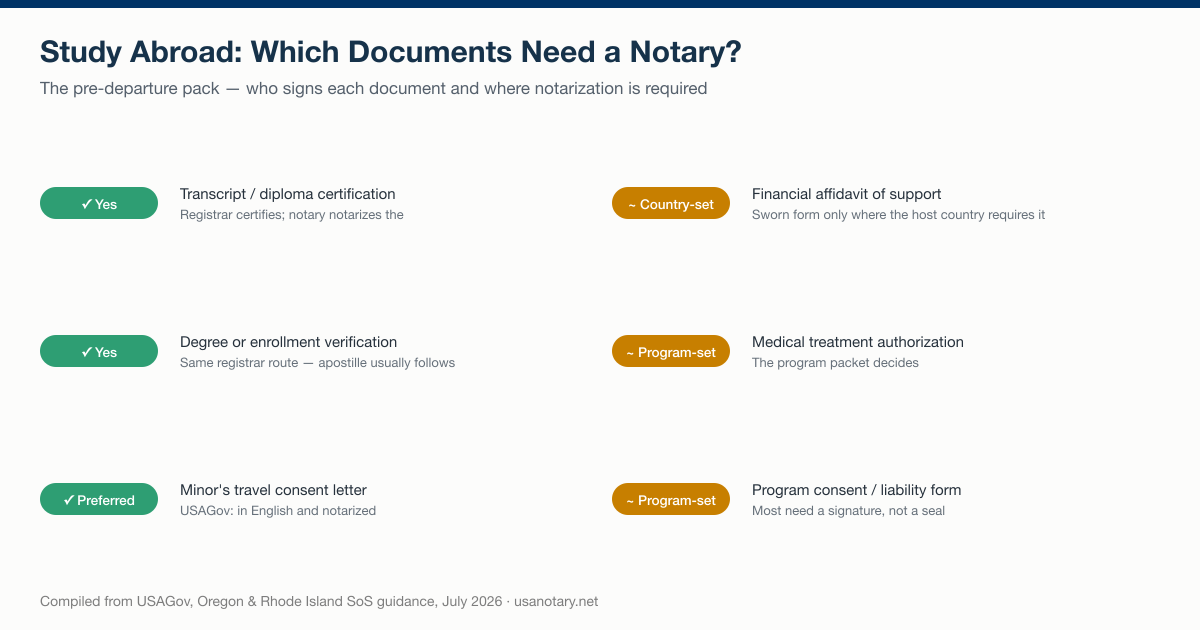
The pre-departure pack at a glance — which documents carry a notarization requirement and where it comes from, compiled from USAGov and state Secretary of State guidance, July 2026.
Two questions sort any document in the pile. First: who must sign — the school official, the student, or a parent? Second: does the receiving side want the document sworn or certified, or merely signed? When the answer is “sworn or certified,” notarization is required. When the destination is a foreign ministry, university admissions office, or immigration authority, plan for the apostille layer on top.
Just as important is what stays out of the notarize pile. The passport application runs on the State Department’s own process, the student visa application is filed with the destination country’s consulate under that consulate’s procedures, and airline, housing, and course-registration forms are ordinary signatures. Adding a notary’s certificate to a document nobody asked to have sworn wastes money and time — and a packet held up waiting for an unneeded appointment misses deadlines just as thoroughly as a missing document does.
How do transcripts and degree verifications get notarized?
The registrar certifies the record, and the notary notarizes the registrar’s signature — that is the entire mechanism, and getting it backwards is the most common reason academic documents bounce. A notary cannot vouch for your grades or your degree. Oregon’s Secretary of State spells out the sequence for schools in three steps: “the school records office certifies to the record in the presence of the notary,” “the notary public notarizes that statement,” and the notarized transcript or diploma then goes to the Secretary of State for authentication or apostille.
What the registrar’s certification statement contains
Oregon’s guidance lists the elements the notarized document carries: the jurisdiction where the document was notarized, a statement by the school official — principal or registrar — as to the authenticity and type of document, that official’s signature given in the notary’s presence, the notary’s statement indicating who signed and the date, and the notary’s signature and seal with commission details. A study-abroad office that pre-builds this certification block as a template turns a bounced-document problem into a five-minute task each time a host university asks for certified records.
The second route: notary copy certification
Rhode Island’s Department of State accepts either of two methods for school records headed to an apostille. The school registrar, principal, or other authorized representative certifies that the record is true and accurate and signs before a notary — or, where a document already bears an original school-official signature, a notary performs a copy certification. Which route works, and which state’s notary you need before the apostille office will act, differs by state — the state-by-state detail lives in our full guide to how a notarized transcript actually works.
The timing trap
Campus notary desks are the slow link in the chain. UCLA’s registrar — one of the largest in the country — notarizes only the documents it issues and states that processing takes up to one week, not including delivery time, with a special handling fee on top. A host university deadline that lands mid-summer, when registrar offices run reduced hours, is exactly the scenario the rest of this guide plans around: start the academic-records request first, because every other document in the pack can be notarized faster than this one.
Practices vary widely between institutions — some records offices keep notary access in-house, others expect the student to arrange the notary, and summer staffing shrinks either way. Ask the records office two questions up front: does it certify records for use abroad, and does the certifying official have a notary available — or is that the student’s job to solve?
When does the packet also need an apostille?
An apostille authenticates the signature, seal, and capacity of the official who signed a public document so a foreign authority will accept it — it is the international layer on top of the notarization, not a substitute for it. Whether your packet needs one depends on a single fact: is the destination country a party to the 1961 Hague Apostille Convention? HCCH, the intergovernmental body that administers the Convention, reports 130 Contracting Parties, and describes the apostille as replacing “the often long and costly legalisation process” with a single certificate.
Hague vs. non-Hague destinations
USAGov’s rule of thumb decides who issues the certificate:
| Destination | Certificate needed | Issued by |
|---|---|---|
| Hague Convention member (130 contracting parties) | Apostille | The state’s secretary of state for state-issued and notarized documents; the U.S. Department of State for federal documents |
| Non-member country | Authentication certificate | The U.S. Department of State route, followed by whatever additional legalization steps the destination country’s own instructions require |
For a study-abroad packet, the practical translation: the notarized transcript certification, the notarized affidavit of support, and any other state-notarized document go to the secretary of state of the state where the notarization happened. Federal documents — an FBI background check, for instance, if the host country’s visa checklist includes one — go to the U.S. Department of State instead. What an apostille is, what it costs, and how long state offices take is covered in our explainer on what an apostille is and when you need one.
Sequence matters here, because the apostille legs run on separate clocks. A registrar’s certification notarized in Oregon and a parent’s affidavit notarized in Texas route to two different apostille offices, each with its own fees and turnaround. Coordinators assembling one packet from documents notarized in multiple states should launch every apostille leg in parallel the day its document is notarized — waiting to mail everything in one envelope just chains the slowest office’s delay onto every document in the pack.
Remote notarization and the apostille office
State apostille offices publish execution rules of their own, and they control acceptance. Rhode Island’s school-records guidance, for example, instructs that the certifying school official “must physically sign the document in the presence of a RI notary public.” Before booking any notarization session for an apostille-bound academic record, confirm the destination state office’s current instructions — a ten-minute check that prevents a re-do with a hard departure date looming.
Who signs consents, medical authorizations, and affidavits of support?
The adult student signs for themselves. College study-abroad packets are built on the participant’s own signature once the participant is 18 — the consents, liability acknowledgments, and medical authorization forms all carry the student’s name, and whether any of them is notarized is a program policy decision: the packet tells you. Programs that operate in multiple countries often notarize the medical authorization because a hospital abroad is likelier to honor a sworn, sealed authorization than a bare signature — but that is the program’s call, not a general legal rule.
Financial affidavits of support
A financial affidavit of support is a sworn statement that a named person — the student, or the parent or sponsor funding the stay — holds or commits the funds for the program period. Host universities and student-visa checklists that want the statement sworn will say so explicitly, and the required wording, currency figures, and supporting bank evidence differ by country and institution — confirm the exact form with the host university or the destination country’s consulate before anything gets signed. Once the form is in hand, it behaves like any sworn document: the affiant swears before the notary, in one session. Our walkthrough of how to notarize an affidavit covers oath language, what to have ready, and the jurat certificate the notary completes.
Medical treatment authorizations
An adult participant authorizes the program to arrange care in their own name; for a participant under 18, a parent or guardian signs. Where the program packet calls for notarization, the signer and the notary complete it like any other acknowledgment or jurat — the only planning wrinkle is that the signing parent is frequently not in the same city as the student or the program office, which is the collection problem the workflow section below solves.
What about minors in study-abroad programs?
A participant under 18 adds one document the adult pack never carries: the travel consent letter. USAGov’s guidance is direct — a child traveling alone or with only one parent or legal guardian “may need a letter of consent,” it is “preferred that the letter of consent is in English and notarized,” and when the child travels with a guardian or alone, both parents should sign. For a high-school exchange or a summer language program with a group leader, that means both parents sign the consent before departure, and the notarized letter travels with the student.
Destination countries set their own entry rules for unaccompanied minors, and some are stricter than the U.S. baseline. The full treatment — what the letter says, who signs in split-custody situations, and how the notarization runs over video — is in our child travel consent notarization guide; this page’s job is simply to make sure the letter is on your checklist next to the transcripts.
How do coordinators collect notarized forms from scattered signers?
Deadline pressure, not difficulty, is what breaks the study-abroad document pack. By June, the signers are scattered: the registrar is on campus, the student went home for the summer, the sponsoring parent lives in another state, and the host university wants the complete packet weeks before orientation. Remote online notarization is built for exactly this shape of problem — the National Association of Secretaries of State reports that 47 states and the District of Columbia have a law allowing remote e-notarization, so nearly every signer in the pack can complete their document over live video from wherever they are.
Here is the collection workflow a program coordinator or registrar’s office runs:
- Split the packet into “signature” and “notarize” piles. Use the table above: most consents need only a signature; the registrar certification, any affidavit of support, and a minor’s travel consent letter go in the notarize pile.
- Check the apostille office’s rules first. For any academic record continuing on to an apostille, confirm the destination state’s execution instructions before booking — Rhode Island’s physical-signing rule is the kind of detail that decides how the registrar’s session runs.
- Send each signer a session link. Staff-initiated workflows let the program office start the request so students and parents receive a link instead of instructions — sessions run 24/7, so a parent three time zones away signs after work instead of during the registrar’s office hours.
- Run the session — together or separately. A session takes 15–30 minutes. Identity verification runs first — credential analysis on the signer’s ID plus knowledge-based authentication, handled by a third-party identity service — and multi-signer sessions let both parents complete a consent letter in one sitting even from two different states. Remote witnesses are supported where state law and the document’s rules permit.
- File the output the same day. Each completed document comes back as a tamper-evident PDF with a complete audit trail, and the audio-video recording and electronic journal entry are retained for 10 years or longer where state law requires — a stronger record than a stamped paper original if a host university ever questions the packet.
At $25 per document, with volume pricing for offices that handle whole cohorts each term, the notarize pile costs less than the courier fees the paper route racks up. Education teams — registrars, study-abroad offices, and district coordinators — can set up standing workflows through our online notarization service for schools and universities.
What if paperwork comes up mid-program?
Documents keep arriving after departure — a housing form the host city wants sworn, a financial-aid form from the home university, a renewal the consulate requests. A student already overseas has options that don’t involve hunting for a notary at the U.S. embassy, and the mechanics — time zones, ID requirements, and which documents work — are covered in our guide to notarizing documents from overseas. Coordinators who set up the pre-departure workflow above already have the harder half solved: the same staff-initiated process reaches a student in a host country the same way it reached them at home.
Finish the pack before the flight
The study-abroad document pack rewards sequencing: start the registrar’s certification first because it is the slowest, confirm the apostille office’s rules before any apostille-bound document is notarized, and batch the student and parent documents into remote sessions that close in minutes instead of mail cycles. Notarized documents for study abroad are a checklist problem, not a legal maze — four document groups, two questions per document, one workflow.
Questions about a specific packet, or a program that needs a standing workflow for every cohort? Call 804-767-7500 or get in touch — sessions run 24/7, and signers can join from all 50 states.