
Do you need a gift affidavit to give a car to a family member?
Sometimes, and the state’s own form decides. Texas, New Mexico and West Virginia publish a gift affidavit, Rhode Island publishes one for gifts from outside the immediate family, and Missouri’s general affidavit has a gift checkbox. Massachusetts publishes a tax-exemption affidavit for gifts and Tennessee an affidavit of non-dealer transfers, and both are signed under penalty of perjury. California handles a gift with a Statement of Facts (REG 256) plus the word “gift” on the title. This guide reads the form from each of those eight places.
Two of them show how much the answer varies. Texas requires the gift affidavit: the Comptroller says the donor and recipient “must complete a required joint notarized Form 14-317.” West Virginia does not for a West Virginia title passing between a parent and child or between spouses, though other relatives still file it: the DMV says “a gift affidavit is not required if a vehicle is titled in West Virginia and is being transferred strictly between parent and child, child and parent, or spouse and spouse.”
When the form you need carries a notary block, you can notarize your gift affidavit online instead of finding a notary near both of you. The sections below show which forms carry one and what each form says about who signs.
This guide covers gifts, meaning transfers where nothing is paid. If one family member is buying the car from another, the paperwork is a sale: read how to sign over a car title. For the notary rules on the title itself in all 50 states and DC, read which states notarize a vehicle title.
This guide is not legal or tax advice. It reports what each agency’s form and page said when we read them on October 1, 2026, and your state’s motor vehicle or tax office decides what it accepts.
Which states’ gift forms need a notary?
Five of the eight forms below carry a notary block, though Missouri’s Department of Revenue says its gift affidavit does not have to be notarized, and three are signed under penalty of perjury with no notary block. The table quotes the notary wording as printed on each form.
| State and form | Who signs | Notary wording on the form | Family and tax wording as printed |
|---|---|---|---|
| Texas: Form 14-317, Affidavit of Motor Vehicle Gift Transfer | Donor and recipient (“signatures of all principal parties”) | “SWORN TO and SUBSCRIBED before me”; the notary line reads “NOTARY PUBLIC FOR THE STATE OF ___ OR AUTHORIZED EMPLOYEE OF THE TAX ASSESSOR-COLLECTOR’S OFFICE” | $10 gift tax for eligible parties; a no-payment transfer to an ineligible party “is defined as a sale” |
| New Mexico: MVD-10018, Affidavit of Gift of Motor Vehicle or Vessel (Rev. 11/2025) | Donor on page 1, recipient on page 2 | Each page has a notary block; the MVD page says both “must sign … and have their signatures notarized” | Recipient states their relationship to the prior owner; no tax figure printed |
| West Virginia: DMV-5-TR, Affidavit of Transfer of Ownership Without Consideration | Current owner and new owner | Two blocks: one if both owners are present together, a second if they cannot sign before the same notary at the same time | Not required for parent-child or spouse-spouse transfers of a West Virginia title |
| Rhode Island: Sales and Use Tax Affidavit of Gift of Motor Vehicle | The recipient (“grantee”) | “NOTARY PUBLIC” block, with the commission expiration date marked mandatory; “A notarized gift letter … must accompany this affidavit” | Form says “To be used for non-immediate family only” |
| Missouri: Form 768, General Affidavit (Rev. 05-2020), gift checkbox | The owner (donor) | One block: “Subscribed and sworn before me.” ”(*Notarization required)” is printed beside two other checkboxes, not the gift one, and the Department of Revenue says “The General Affidavit or statement does not have to be notarized.” | None printed |
| Massachusetts: Form MVU-24 (Rev. 4/99) | Donor and donee | “I declare under the pains and penalties of perjury”; no notary block on the form | Claims an exemption from sales or use tax for a gift |
| Tennessee: Form RV-F1301201 (Rev. 5-22) | Seller or transferor and purchaser or transferee | “Under the penalties of perjury, I swear”; no notary block on the form | “Tax-exempt relatives include spouses, siblings, and lineal relatives” |
| California: REG 256, Statement of Facts | The applicant | “I certify (or declare) under penalty of perjury”; no notary block on the form | Section A has a “Gift” box for the use tax exemption |
This table covers eight jurisdictions: Texas, New Mexico, West Virginia, Rhode Island, Missouri, Massachusetts, Tennessee and California. It does not cover the other 42 states or DC. Each row was read from the agency’s own form on October 1, 2026. Forms change, so confirm the current version with your state’s motor vehicle or tax office before you sign.
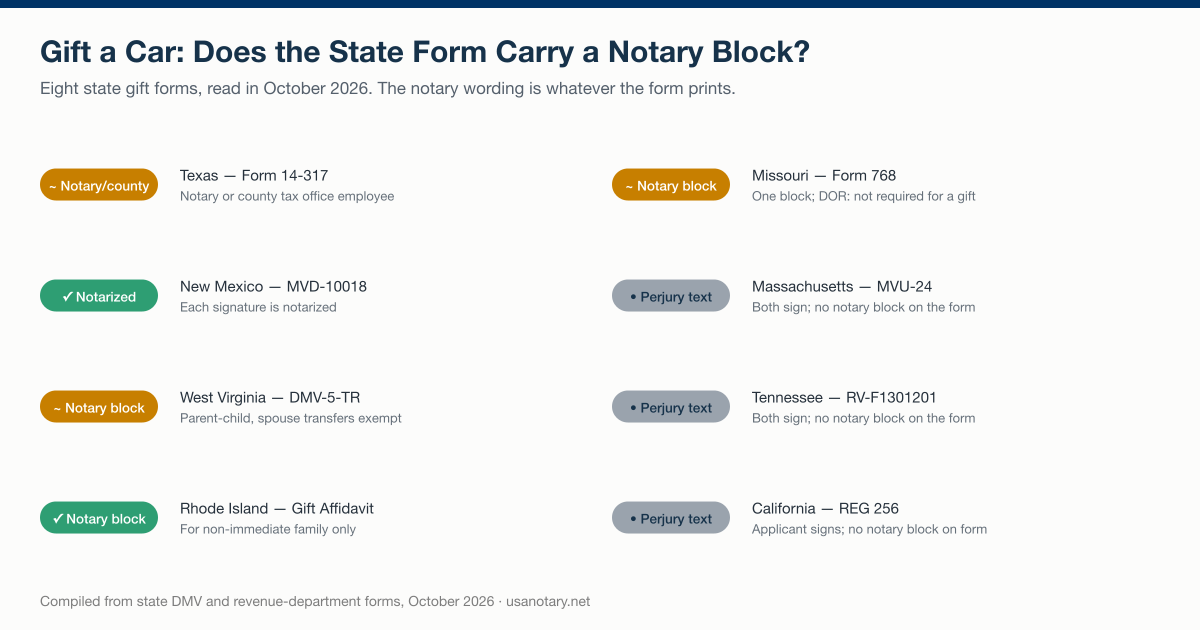
The notary wording on eight state vehicle gift forms, read from the forms in October 2026.
Three patterns show up in the table:
- A notary block on the form. Texas, New Mexico, West Virginia, Rhode Island and Missouri print one, although Missouri’s Department of Revenue says its form does not have to be notarized for a gift. Texas states the condition outright: “To be valid, this affidavit must be properly completed and contain the signatures of all principal parties to the transaction, sworn to and subscribed” before a notary or a county tax office employee.
- A perjury statement and no notary block. Massachusetts, Tennessee and California print only a signature under penalty of perjury. If your form looks like that, a notary has nothing to complete.
- A carve-out for close family. West Virginia drops the affidavit for parent-child and spouse transfers of a West Virginia title, Rhode Island uses its gift affidavit only for gifts from outside the immediate family, Tennessee lists tax-exempt relatives on its form, and Texas sets a $10 tax for eligible relatives.
Missouri needs a note. Form 768 is a general affidavit with several checkboxes and one notary block at the bottom, and ”(*Notarization required)” appears beside the first checkbox and the firefighter-plates checkbox, not the gift checkbox. The Department of Revenue’s page on selling a vehicle settles the gift case: “The General Affidavit or statement does not have to be notarized.” The same page tells the donor to write “GIFT” in the title’s sale price area and says “Do not use a sale price of $1.”
How does Texas Form 14-317 work?
Texas Form 14-317, the Affidavit of Motor Vehicle Gift Transfer, is the gift affidavit Texas requires for a gift to an eligible relative. It is the most detailed of the eight forms, so it is a good model for what a gift affidavit asks.
Who counts as an eligible relative. The form lists these eligible parties: a spouse (separate property only; “vehicles held as community property are not subject to the gift tax”), a parent or stepparent, a father- or mother-in-law or foster parent, a grandparent or great grandparent (including in-laws), a grandchild or great grandchild (including in-laws), a child or stepchild, a son- or daughter-in-law or foster child, a sibling or brother- or sister-in-law, and a guardian. Qualifying revocable trusts and 501(c)(3) nonprofits also qualify. Aunts, uncles, nieces and nephews are not on the list: the Comptroller says transfers between them for no consideration are “taxed as a sale and SPV procedures may apply.”
How to complete and file it:
- Confirm the relationship. Check the box on the form for the eligible relationship.
- Complete the certification. Each donor certifies that “This motor vehicle is being transferred without consideration, including no assumption of debt.” Each recipient completes a matching certification.
- Have both signatures sworn. The form says the affidavit must contain “the signatures of all principal parties to the transaction, sworn to and subscribed in front of” a notary public of Texas “or the equivalent from another state or jurisdiction,” or a county tax assessor-collector (CTAC) or a CTAC employee. A “sworn to and subscribed” statement is a jurat; our guide to jurats and acknowledgments explains what the notary does.
- File it in person. The form says it “must be submitted in person by either the donor, recipient or authorized agent, with valid photo identification, to the county tax assessor-collector,” in the county where the title application, Form 130-U, is submitted. The statute, Tax Code 152.062(b-2), says a gift from a spouse, parent or stepparent, grandparent or grandchild, child or stepchild, sibling or guardian “must be filed in person by the recipient of the gift or, as applicable, the person from whom the gift is received” and that a licensed motor vehicle title service “may not be used.”
- Pay the $10 gift tax. The Comptroller says the gift tax “is the responsibility of the eligible person receiving the motor vehicle,” paid to the CTAC when that person titles and registers the vehicle. A vehicle received as a gift from an eligible donor located out of state is also subject to the $10 tax when it is brought into Texas.
Signing the form carries a penalty. The form warns that Tax Code Section 152.101 “provides a penalty to a person who signs a false statement. An offense under this section is a felony of the third degree.”
What makes a transfer a “gift,” and when does it become a sale?
A transfer is a gift when the recipient pays nothing, and every form defines “nothing” broadly. Texas lists what counts as consideration: “cash, the assumption of a lien or other debt, payment for providing services or labor, or an exchange of real or tangible personal property.” Missouri’s form says “there is no money or other valuable consideration involved.” West Virginia’s says the transfer “does not involve any exchange of goods, service or money in return for the vehicle.” Rhode Island’s says “no monies, services, barter arrangements, or other articles or things of value” were paid or given.
Massachusetts asks four yes-or-no questions of both parties: whether either party made or received payment in any form, whether either made a promise of payment or expects payment in the future, whether either assumed any debt, and whether the donor intended to make a gift. Tennessee’s form lists the considerations to check: money, a loan assumption or payoff, services or labor, and a trade-in.
A loan on the car can turn a gift into a taxable transfer. West Virginia says that if a lien is recorded on the new owner’s title, “the transfer is not exempt from sales tax; tax will be calculated at 6% of the recorded lien amount.” Texas handles a separate case: if an eligible recipient takes a new loan on the vehicle for an unrelated purpose, the Comptroller says the gift tax is still the right tax and the tax office may ask for “reasonable documentation, such as a statement from the lender, that the loan was unrelated to the motor vehicle transfer.”
Is it better to gift a car or sell it for $1?
The forms do not rank the two. They describe what each choice triggers, and the facts below are limited to what the agencies print.
- Texas: “A motor vehicle transfer made without payment or consideration to an ineligible party is defined as a sale and subject to Standard Presumptive Value (SPV) procedures.” A gift needs an eligible relationship; paying even a dollar means the transfer is not a gift under the form’s definition.
- West Virginia: “Applications containing a designated purchase price on the title sheet paired with a conflicting ‘Gift Affidavit’ will be rejected.” Do not write a price on the title and also file a gift affidavit.
- Missouri: the Department of Revenue tells a donor to write “GIFT” in the title’s sale price area and adds: “Do not use a sale price of $1.”
- Tennessee: the form has a separate checkbox for a “Gift transfer or low selling price to person other than tax-exempt relatives,” and defines a low selling price as “75% or less of the fair market value.”
- California: REG 256 has a use-tax exemption box for a “Family transfer sold between a parent, child, grandparent, grandchild, spouse, domestic partner, or siblings (if both are minors related by blood or adoption),” separate from its “Gift” box.
So the choice is a tax-office question as much as a family one. If a sale price goes on the paperwork, the sale path is covered in how to sign over a car title. Federal tax reporting is outside the scope of this guide; ask a tax professional.
What if the donor or recipient cannot be there?
Several forms plan for an absent party, and they plan differently.
- Texas accepts “a reproduced copy of the non-appearing party’s notarized signature.” The instructions add that the absent party’s notarized signature “may be reproduced (scanned or printed) or faxed,” and that an agent may file in person “accompanied by a completed Power of Attorney form.” The Comptroller adds that the affidavit “may be notarized by a notary from another state.”
- West Virginia gives the new owner a separate notary block “ONLY IF THE CURRENT AND NEW OWNERS CANNOT SIGN UNDER WITNESS OF THE SAME NOTARY AT THE SAME LOCATION AND TIME.”
- New Mexico puts the donor’s affidavit and notary block on page 1 and the recipient’s on page 2, so each signature is notarized on its own page.
- Massachusetts, Tennessee and California ask for signatures under penalty of perjury and print no notary block, so there is no notarial act to arrange.
The Texas form and the Comptroller’s guide let an agent act under a power of attorney, and our guide to a vehicle power of attorney for an absent owner explains the document and its notary rules.
How to notarize a gift affidavit online
You can use online notarization when your form has a notary block and the office that accepts it takes an online notarization. Two checks come before the session.
First, check the form. If it is a Massachusetts, Tennessee or California form with no notary block, the form itself calls for signatures only, so confirm with your office before you pay for a notary. If it has a block, use the exact form your state publishes and do not alter it.
Second, check acceptance. Texas shows why. The Government Code defines online notarization as “a notarial act performed by means of two-way video and audio conference technology” and lets an online notary public perform one “regardless of whether the principal is physically located in this state.” Form 14-317’s instructions name “an online notary public who has been authorized by the Secretary of State to perform online notarization under Government Code, Chapter 406” in a bulleted list under the paragraph about signatures acknowledged by the CTAC. That bullet’s grammar does not make clear which party it applies to, so ask the county tax office whether it will take an affidavit notarized online. For other states, the forms we read do not mention online notarization at all. A remote notarization can be valid in another state, but the motor vehicle office decides what it accepts.
Then the session runs in four steps:
- Upload the form your state published, with the notary block blank.
- Verify your identity with the platform’s identity checks before the session.
- Meet a commissioned notary on live video and sign. The notary completes the notarial certificate electronically.
- File the notarized form the way your state requires. Texas requires in-person filing at the county tax office, and the reproduced-signature rule lets the other party’s notarized copy travel with the filer.
Where the donor and recipient live in different places, they can sign in separate sessions if the form allows it. Texas accepts a reproduced notarized signature from the non-appearing party, and West Virginia’s second notary block exists for owners who cannot sign before the same notary. Online notarization with USA Notary is $25 per document for consumers. Businesses that handle title paperwork for customers can read about online notarization for auto businesses.
What else will the DMV or tax office ask for?
The gift affidavit is one document in a title packet, and every office keeps its own checklist. In Texas, the affidavit goes in with the title application: the form says it is filed with the county tax assessor-collector where Form 130-U is submitted, and the Comptroller says the 14-317 “should also be included with the title packet.” The title itself, photo identification and any lien paperwork vary by office and by vehicle.
Two of our other guides cover the rest. For the title assignment, see how to sign over a car title. For the notary rules on the title itself, see which states notarize a vehicle title. Call your state’s office or read its page before you go.