
What is an affidavit of survivorship (affidavit of death of joint tenant)?
An affidavit of survivorship is an affidavit, recorded in the county land records, that documents a co-owner’s death so the survivor’s title can be shown. The name changes by source. Los Angeles County’s recorder titles its form Affidavit of Death of Joint Tenant. Nevada’s statute is headed “Recording affidavit of death of joint tenant or spouse holding community property with right of survivorship creates disputable presumption title vested in survivor” (the heading continues with the life-tenant provision). Ohio’s statute speaks of “an affidavit accompanied by a certified copy of a death certificate” when a “survivorship tenant” dies. This guide uses affidavit of survivorship for all three.
The instrument has a narrow scope. It covers real property that co-owners hold in joint tenancy or with a right of survivorship. It does not cover insurance “survivorship” claim forms, which are a different instrument, and it is not legal advice. The county recorder and your attorney or title company decide what to record.
If the affidavit is part of a title or escrow file, our online notarization for title and escrow teams covers the notarial step.
Who signs it, and who must appear before the notary?
The affiant signs it: one person with knowledge of the facts. Nevada’s statute asks for an affidavit “subscribed and sworn to by a person who has knowledge of the facts,” and California’s Probate Code 210 describes “an affidavit of death executed by a person having knowledge of the facts.” Both texts speak of a single affiant. Ohio’s text lists what the affidavit must recite but does not say who signs, and the Los Angeles County recorder’s page says “the survivor may file” the form.
Nevada adds a requirement that matters at the signing table: the affidavit must set forth “the family relationship, if any, of the affiant to each deceased joint tenant or the deceased spouse.”
In the Nevada and California texts the affiant is the only signer, so the affiant is the one who appears before the notary. The affiant swears to the statements, and the notary administers the oath and completes the certificate (see what an affiant does). The Los Angeles County form’s jurat reads “SUBSCRIBED AND SWORN TO (or affirmed) before me” and names the person who “appeared before me.” Where the form names one affiant, the notarial session can be a single-signer session.
What has to go with it when you record it?
A death record goes with it. For Nevada’s presumption to apply, the recorded affidavit must be “accompanied by a certified copy of the death certificate of each deceased joint tenant or deceased spouse.” California’s affidavit must include “an attested or certified copy of a record of the death” plus “a particular description of the real property.” Ohio lets the transfer be recorded with either a certificate of transfer or “an affidavit accompanied by a certified copy of a death certificate.”
The contents differ by state:
- Nevada (NRS 111.365(1)): the affiant’s family relationship to each deceased owner; a description of the instrument or conveyance that created the joint tenancy or right of survivorship; a description of the property; and the date and place of death.
- California (Probate Code 210(a)): a particular description of the real property, plus the death record. The Los Angeles County form also asks for the recording reference of the deed that created the joint tenancy and a dollar figure for “the value of all real and personal property owned by said decedent at date of death.”
- Ohio (ORC 5302.17): the names and the address of the other survivorship tenant or tenants, the date of death of the decedent, and a description of the real property.
Los Angeles County adds one more document. Its recorder says: “At the time of recording, present the completed affidavit (see below), a certified copy of the death certificate and a Preliminary Change of Ownership Report.”
Does the affidavit have to be notarized?
Nevada’s text requires an oath: the affidavit must be “subscribed and sworn to,” and a notary administers oaths through a jurat. California’s answer takes two sources. Probate Code 210 does not mention a notary. The general recording rule in Government Code 27287 says “before an instrument can be recorded its execution shall be acknowledged by the person executing it,” with the exceptions the section lists. The Los Angeles County recorder’s own form, however, prints a jurat block, not an acknowledgment. Which certificate a given county recorder accepts is the recorder’s call. Ask first.
Ohio’s section is silent on the notary. ORC 5302.17 requires an affidavit and a certified death certificate and says the county recorder “shall record any certificate or affidavit so filed,” but it names no notary step. Ohio’s general definition still applies to the word: “An affidavit is a written declaration under oath” (ORC 2319.02). A blank in this part of the table means the statute text we read does not say. It does not mean no notary is needed. In Ohio, ask the county auditor and the county recorder what they need before signing.
In practice, follow the certificate printed on the form your county recorder accepts. If it prints a “sworn to” or jurat block, the affiant takes the oath and the notary completes that block. If you are unsure which certificate the county wants, ask the recorder before the session.
Where and how is it recorded?
The affidavit is recorded in the county where the property is. California’s Probate Code 210 says “in the county in which the property is located.” Nevada’s statute names “the office of the recorder of the county or counties in which the real property is situated.” Ohio’s statute has the affidavit presented “to the county auditor” and filed “with the county recorder,” and for registered land it points to a separate procedure in section 5309.081 of the Ohio Revised Code.
Recording puts the affidavit in the county’s official records. In Nevada, a county recorder must also each month send “all the information contained in each affidavit” received to the Department of Human Services.
Remote notarization changes how the affidavit gets signed, not where it is recorded. The National Association of Secretaries of State reports that 47 states and the District of Columbia have a law that allows remote e-notarization. We did not find a primary source stating how the California, Nevada or Ohio recorders treat a remotely notarized survivorship affidavit, so this page makes no acceptance claim for any of them. How a recorder takes a remotely notarized instrument (electronic recording, or a certified paper copy) varies by county, and whether an out-of-state online notarization is accepted is a separate question from the recorder’s own rules. Call the county recorder before the session.
State snapshot: what do California, Nevada and Ohio say?
All three states pair the affidavit with an official death record (certified in Nevada and Ohio, “attested or certified” in California). They differ on the notary wording, on who may sign, and on what recording does. California appears here through two statutes and the Los Angeles County recorder’s form.
| State | Who signs or records | Notary wording in the source | What goes with it | What the source says recording does |
|---|---|---|---|---|
| Nevada (NRS 111.365) | Affidavit “subscribed and sworn to by a person who has knowledge of the facts" | "Subscribed and sworn to” | Certified copy of each death certificate; family relationship, instrument description, property description, date and place of death | “It is presumed” title has terminated and “vested solely in the surviving joint tenant or spouse or vested jointly in the surviving joint tenants” (the heading calls it a disputable presumption) |
| California (Prob. Code 210; Gov. Code 27287; LA County form) | “Any person may record”; affidavit “executed by a person having knowledge of the facts” | Prob. Code 210: none stated. Gov. Code 27287: “execution shall be acknowledged.” LA County form: prints a “SUBSCRIBED AND SWORN TO (or affirmed)” jurat. Ask the recorder which certificate it accepts | Particular description of the real property plus an attested or certified record of the death. LA County: certified death certificate and a Preliminary Change of Ownership Report | The documents are recorded as “establishing the fact of the death.” The section states no title presumption |
| Ohio (ORC 5302.17) | Presented to the county auditor and filed with the county recorder; the text does not say who signs | Not stated in ORC 5302.17; ORC 2319.02 defines an affidavit as “a written declaration under oath” | Certified copy of a death certificate; names and address of the other survivorship tenant or tenants, date of death, property description | “The county recorder shall record any certificate or affidavit so filed” (a certificate of transfer under section 2113.61 is the alternative) |
Table covers California (statutes plus the Los Angeles County recorder’s form), Nevada and Ohio only. Last verified November 4, 2026. A blank or “not stated” cell means the text we read does not say; confirm with the county recorder.
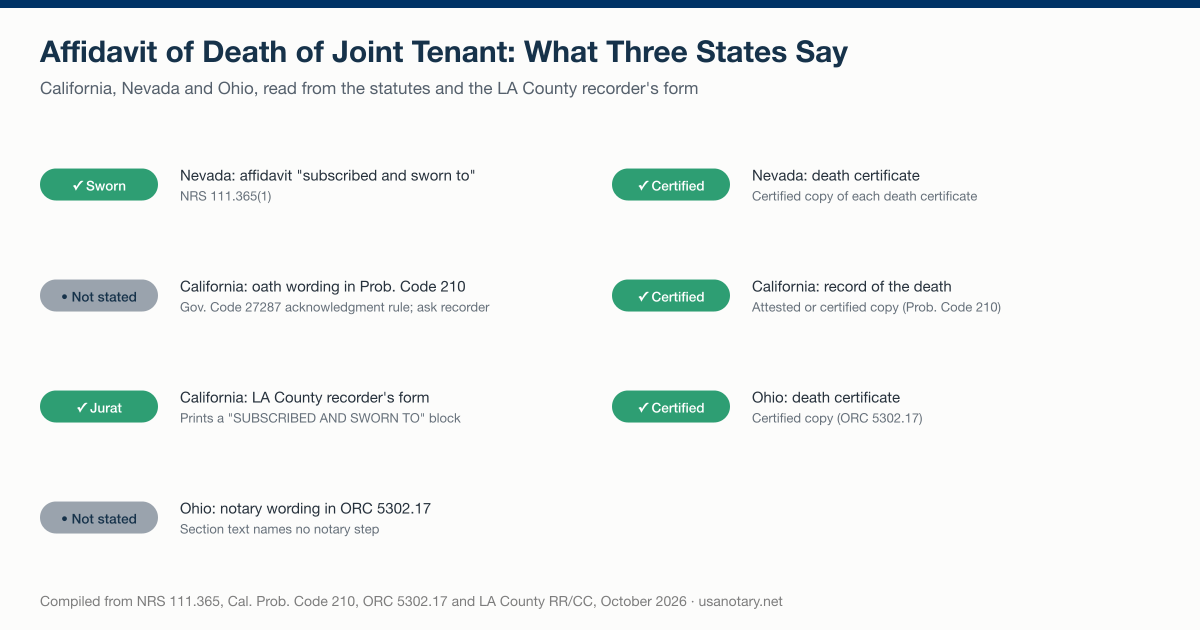
Two readings of the California row deserve emphasis. First, the statute establishing “the fact of the death” stops short of Nevada’s presumption: Probate Code 210 lets any person record the documents, and it does not say what title consequence follows. Second, the Los Angeles County recorder’s own page says the survivor “may file” the form and adds that “it may be advisable to consult an attorney due to the legal aspects involving a change in ownership of real property.” Nevada’s statute has a sibling for life tenants (NRS 111.365(2)), which this guide does not cover.
Survivorship, heirship or small estate: which one applies?
The texts above reach only co-owned property with survivorship. Nevada speaks of “real property owned by two or more persons as joint tenants or as community property with right of survivorship,” Ohio of a “survivorship tenant,” and Los Angeles County of parties who “hold title as joint tenants.” Property the decedent owned alone is outside what these sections address. An heirship affidavit and a small-estate affidavit are different instruments, and this guide does not cover them.
Los Angeles County’s page also lists separate forms for the death of a trustee and for a surviving spouse, so the instrument follows how title was held. A decedent’s brokerage or fund accounts use a different sworn form, covered in our guide to the affidavit of domicile for a decedent’s securities. If a deed created the survivorship tenancy, how deed notarization works covers that signing. For which instrument fits your title, ask an attorney or the title company.
How do you get the affidavit notarized online?
The signing can run over live video, with one affiant in the session. The steps:
- Confirm the form with the county recorder. Ask which form it accepts, whether it takes a remotely notarized affidavit, and in what format. Los Angeles County publishes its own form and notes that such forms are also sold at office supply stores.
- Fill in the facts, but do not sign. The affiant swears and signs in front of the notary, so leave the signature and date lines blank.
- Get the death record (a certified copy; California also accepts an attested copy). It is a separate document issued by the public office that holds the death record. It travels with the affidavit at recording; the notary session covers only the affidavit.
- Start a session on USA Notary. Upload the affidavit, verify identity, swear the contents on camera and sign. The notary administers the oath and completes the certificate. Online notarization costs $25 per document.
- Send the signed affidavit and the death record to the recorder by the route the recorder named in step 1.
For recurring estate or title files, our title and escrow page describes the business-initiated workflow. Questions about a specific file? Call 804-767-7500.