
What does a dealer reassignment form do?
A dealer reassignment form transfers ownership of a vehicle a licensed dealer holds in inventory to the next buyer — another dealer or a retail customer — without a new certificate of title being issued in the dealership’s name. The certificate of title carries a limited number of assignment spaces on its back; the reassignment form is the state-issued supplement that continues the ownership chain when those spaces are exhausted, when the title is electronic, or when the title’s format doesn’t conform to federal odometer rules.
Two of the biggest titling states show the pattern. Texas issues Form VTR-41-A, the Dealer’s Reassignment of Title for a Motor Vehicle, which the Texas DMV’s Registration and Title Bulletin #011-15 governs. Florida issues HSMV 82994, the Motor Vehicle Title Reassignment Supplement — dealers call it the “rainbow” for its security paper — which Pasco County’s dealer training describes as the form “used to reassign a Certificate of Title and make odometer disclosures between licensed dealers or between dealers and their retail buyers.”
Every reassignment, whether on the title’s back or on a supplement, does two jobs at once: it assigns ownership to the named transferee, and it records the federal odometer disclosure for that transfer. The two are inseparable by design — which is why the forms are regulated the way they are.
The dealer reassignment form is everyday paper for anyone moving inventory: a wholesale buyer flipping a unit to another store, an auction reassigning a consigned vehicle to the winning bidder, a franchise dealer passing a trade-in to its used-car affiliate. Each hop in that chain consumes a reassignment — and each hop is a place where a missing signature, a skipped odometer box, or the wrong form stalls the deal at the county window.
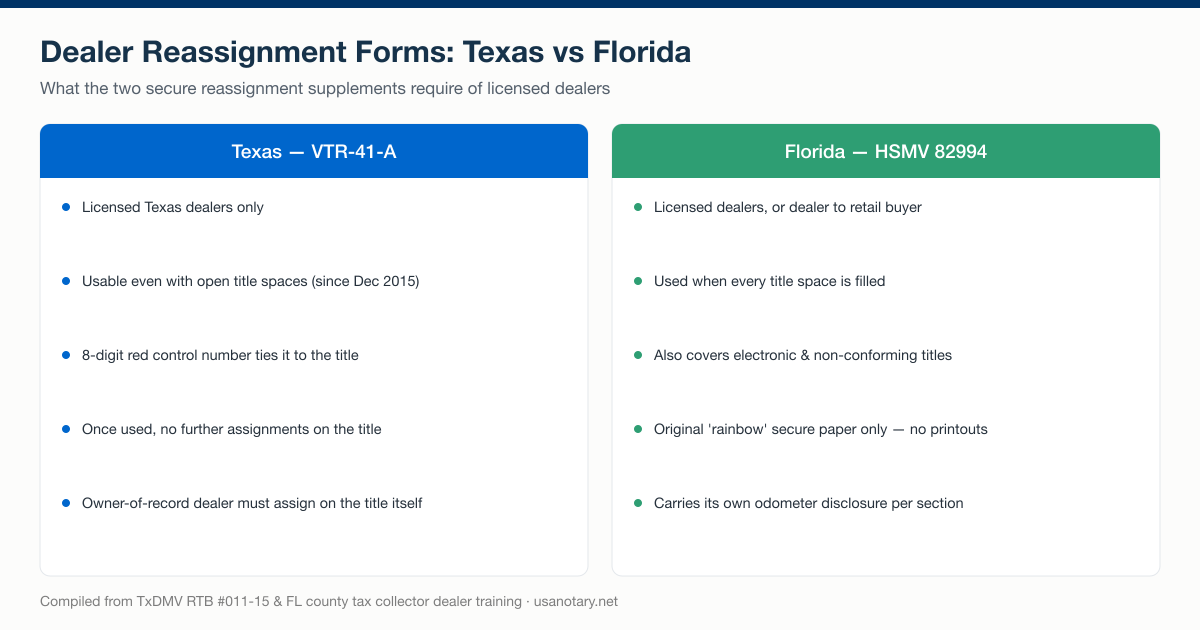
Texas VTR-41-A vs Florida HSMV 82994 — the two rule sets side by side, compiled from TxDMV RTB #011-15 and Florida county tax collector dealer training, July 2026.
Why reassignment forms are “secure” documents
Federal law is the reason a reassignment form cannot be a printout. Under 49 CFR § 580.4, physical documents “which are used to reassign the title, shall be issued by the jurisdiction and shall be set forth by a secure printing process or other secure process” — the same standard the rule applies to titles themselves. Florida enforces it bluntly: Pasco County’s training warns that HSMV 82994 “must be the original form HSMV 82994 on secure paper. We cannot accept printed, copy paper versions.” Texas prints a control number on each VTR-41-A — per the TxDMV bulletin, “printed in red ink, eight digits, and located in the lower left corner” — so every supplement can be tied back to a specific title chain.
The odometer disclosure inside every reassignment
The odometer disclosure is required on the reassignment document itself. 49 CFR § 580.5 directs the transferor to disclose the mileage on the title or “on the physical document being used to reassign the title,” signed by the transferor and acknowledged by the transferee’s own signature. Each reassignment section on a VTR-41-A or 82994 therefore contains its own mileage certification — actual, in excess of mechanical limits, or not actual. Our odometer guide sets out who signs the mileage statement on a reassignment and what each of the three certifications means; here the point is structural: a reassignment form without a completed odometer section is an incomplete transfer.
Why can only licensed dealers use a reassignment form?
Reassignment rights attach to the dealer license, not to the document. A private owner who sells a vehicle must assign the title directly to the buyer — the process in our walkthrough of how a private owner signs over a car title — and the buyer must apply for a new title in their own name. A licensed dealer is the one party states allow to stand in the middle of that chain without retitling, because the dealer is a regulated, auditable counterparty the state can trace through its license number.
The states enforce the wall from both directions:
- Florida builds the license into the form. The Pinellas County Tax Collector’s Form 82994 training materials show fields for “Dealer/Auction License” and the dealership’s federal employer ID — a supplement with no valid license number behind it fails at the tax collector’s window.
- Texas frames the entire process around the licensee. TxDMV’s bulletin opens with the baseline rule: “a licensed Texas dealer must take assignment on the back of the certificate of title” before any reassignment happens at all.
- Ohio routes non-dealers onto entirely different paperwork. Form BMV 3770, the Ownership Assignment and Title Application for Casual Sale, may be used only when the title is held electronically and “neither the seller nor the buyer is a licensed Ohio dealer” — the state’s own form text walls the casual-sale path off from the dealer path.
The privilege has edges even for licensees. In Texas, a dealer whose name appears on the face of the certificate — as the recorded owner, not as an assignee in the chain — may not use Form VTR-41-A at all. The TxDMV bulletin explains why: federal odometer regulations require the owner named on the face of the title to make the initial assignment on the certificate itself (or on the state’s secure power of attorney form), so a titled dealer assigns on the title like any other owner, and only subsequent dealers reassign on the supplement.
Which states issue a separate dealer reassignment supplement?
Not every state handles overflow the same way, and the differences are exactly where deals stall. Here is the picture from the source documents fetched for this guide:
| State | Reassignment supplement | Who may use it | What the state’s own materials say |
|---|---|---|---|
| Texas | VTR-41-A — Dealer’s Reassignment of Title for a Motor Vehicle | Licensed Texas dealers | Usable “even when all of the reassignments on the back of the title are not complete” (RTB #011-15, eff. Dec. 2015); carries an eight-digit red control number; once used, “no further assignments may be made on the certificate of title” |
| Florida | HSMV 82994 — Motor Vehicle Title Reassignment Supplement (“rainbow”) | Licensed dealers, or dealer to retail buyer | Used when the title is electronic, when the title is non-conforming, or “when all the dealer reassignments have been used on the title”; original secure paper only — no printed copies |
| California | REG 262 — Vehicle/Vessel Transfer and Reassignment Form | Per DMV’s Vehicle Industry Registration Procedures Manual §5.075 | The manual dedicates section 5.075 (Odometer Mileage Reporting chapter) to the REG 262 |
| Ohio | No downloadable dealer supplement in the sources reviewed | Dealers reassign within the title chain | The state’s published assignment form, BMV 3770, is reserved for casual (non-dealer) sales of electronically held titles — and is sworn to before a notary |
Two practical notes on reading that table. First, the federal secure-printing rule in 49 CFR § 580.4 sits underneath all of it: whatever a state calls its supplement, the document is jurisdiction-issued security paper, not a PDF. Second, out-of-state titles change the math — Texas, for example, allows the VTR-41-A on “any out of state certificate of title even if all reassignments are not completed,” which is why wholesale cars crossing state lines so often arrive with a supplement stapled to the title.
What happens when a title runs out of reassignment spaces?
The chain moves to the supplement — and the order of operations matters more than most title clerks expect. States limit the spaces on a title and control the supplements that extend them for the same reason: every additional reassignment is another link an examiner must be able to audit, so the overflow paperwork is deliberately traceable rather than open-ended. Florida’s trigger list is the clean version: per Pinellas County’s training, the 82994 comes out when the title is electronic, when the odometer must be carried over on a non-conforming title, or when all the dealer reassignments on the title have been used.
Texas is looser since December 2015 but more procedural. RTB #011-15 lets a dealer use the VTR-41-A even while open spaces remain on the title — provided the cross-referencing is done exactly right. The workflow the bulletin prescribes:
- Confirm the dealership holds assignment first. The form “may only be used after the dealer has obtained assignment of the vehicle from the owner listed on the certificate of title.” No assignment in, no reassignment out.
- Complete the reassignment on the VTR-41-A — transferee, odometer disclosure, signatures.
- Cross-reference the title. If open spaces remain on the certificate, the dealer “must write in the next open reassignment ‘REASSIGNMENT ON ########’” using the supplement’s eight-digit control number, so no reassignment space is left dangling.
- Keep the certificate with the deal. A dealer holding the assigned title “must make the certificate of title available to the transferee even if the reassignment to the transferee is made on Form VTR-41-A.”
- Stop assigning on the certificate. Once a VTR-41-A assignment is completed, “no further assignments may be made on the certificate of title or certified copy of title” — later dealers continue on supplements.
The failure mode is step 3. A title surrendered with an open reassignment space and no control-number cross-reference invites rejection at the county window, because the examiner cannot tell whether the chain ran through the supplement or around it. County tax offices in Texas are instructed to check exactly that: the bulletin’s county-action section tells examiners to “ensure the ownership evidence or prior secure dealer reassignment contains the control number of the Form VTR-41-A.”
Does a dealer reassignment form need to be notarized?
Notarization is not required on the Texas or Florida dealer reassignment forms themselves — signatures are. The federal odometer rule the forms implement, 49 CFR § 580.5, requires the disclosure to be signed by the transferor and signed again by the transferee; it does not mention notarization anywhere. Florida’s county training walks through every field of the HSMV 82994 — title number, dealership license, price and tax, purchaser, odometer status — and ends at two signature blocks: seller and purchaser. No notary appears in the sequence.
Where notarization does enter a dealer’s title packet
Notarization is required at specific points around the reassignment, and that is where title desks get caught:
- Owner-assignment states. Some states require the notary at the step where the owner assigns the title into or out of the chain. Ohio’s BMV 3770 is explicit: the buyer’s and additional-seller signature lines read “Must sign in front of Notary/Authorized Officer,” and the form’s jurat blocks — “Sworn to and subscribed in my presence” — are completed by a notary public or authorized officer. The buyer’s title application on the same form is sworn the same way. That form is for private-party casual sales: it may be used only when neither the seller nor the buyer is a licensed Ohio dealer, and under Ohio Revised Code 4505.063 (effective April 6, 2023) no notarization is required on titling documents when a licensed dealer is a party to the transfer. In Ohio the notary step therefore applies to transfers with no licensed dealer on either side, not to the dealer’s own purchase or resale. Our state-by-state guide to which states require notarized vehicle titles maps where that rule applies.
- Powers of attorney. When a customer can’t appear to sign the title — a lost-title trade-in, an out-of-state seller, an auction consignment — the fix is usually a vehicle power of attorney, and POAs are the most commonly notarized document on an automotive title desk. Texas even issues a secure POA (Form VTR-271-A, named throughout RTB #011-15) specifically for transfer-of-ownership use.
- Affidavits and duplicate-title applications. Repossession affidavits, correction affidavits, and several states’ duplicate-title applications carry notary blocks of their own.
Can the reassignment form itself be completed online?
Generally no — and the reason is the same federal rule that makes the form secure. A physical reassignment supplement is jurisdiction-issued security paper under 49 CFR § 580.4, so the dealer completes it in ink on the original document; Florida’s refusal of printed, copy-paper versions is that principle in practice. What moves online is everything around the supplement: the notarized owner assignment in a notary state, the title power of attorney that lets an agent execute the physical paperwork, and the sworn affidavits in the packet. Remote online notarization handles those documents — the secure form itself stays physical.
The practical summary for a title clerk: the reassignment form is signature paperwork; the documents feeding it — owner assignments in notary states, POAs, affidavits — are where notarization is required. Budget the notary step there, before the vehicle ships.
Dealer reassignment vs title jumping: where is the legal line?
The dealer license is the line. A dealer reassignment and a jumped title describe the same physical act — selling a vehicle without retitling it in your own name — but one is a regulated privilege and the other is a violation. The reassignment version runs on jurisdiction-issued secure forms, carries a fresh odometer disclosure at every hop, ties each supplement to the title by control number, and stays traceable to a license number the state can audit. Title jumping is that same skip performed by an unlicensed flipper — no reassignment rights, no secure form, a gap in the ownership chain, and consequences that land on whoever buys the car at the end of it.
That contrast is worth internalizing because it answers a question dealers hear from nervous retail buyers: “why isn’t your name on this title?” The honest answer is that the state built a lane for exactly this — and the paperwork in the buyer’s hand, secure supplement included, is the proof the dealership stayed in it.
How do title desks notarize the rest of the packet online?
The notarized documents around a reassignment — title POAs, owner assignments in notary states, affidavits — no longer require a trip to find a stamp. The National Association of Secretaries of State reports that 47 states and the District of Columbia have a law that allows for remote e-notarization, which means the signer meets a commissioned notary over live video and signs electronically instead of at a counter.
For a dealership or auction title desk, the workflow looks like this: staff upload the document and initiate the session — customers never need to create accounts — the signer’s identity is verified through credential analysis and knowledge-based authentication run by a third-party identity-verification service, and a commissioned notary completes the notarization on live video. Sessions run 24/7, take 15–30 minutes, and support multiple signers in one session, so a co-signed POA or a seller-plus-spouse assignment closes in a single sitting. Every session produces a tamper-evident PDF backed by a complete audit trail, with the audio-video recording and electronic journal retained for 10 years or longer where state law requires — a stronger evidentiary record than a stamp in a paper journal if a seller later disputes a signature.
Pricing is flat: $25 per document, with volume pricing for business accounts that run title paperwork every week. Signers can connect from all 50 states, which matters when the out-of-state seller on a wholesale unit is the one holding up the packet. Dealerships, auctions, and lenders can set up staff-initiated workflows through our online notarization service for automotive businesses.
A reassignment chain is only as strong as the documents feeding it. Keep the secure supplement rules straight, cross-reference every control number, and put the notarized pieces of the packet on video instead of on the road. Questions about a recurring title-desk workflow? Call 804-767-7500 or reach out through our contact page.