
What is title jumping?
Title jumping is buying a vehicle and reselling it without ever titling it in your own name. The certificate of title — the state-issued document that proves who owns a vehicle — is designed to pass through every owner in sequence: the seller assigns it, the buyer applies for a title, the state issues a new certificate, and the chain of ownership stays unbroken. A title jumper takes the seller’s signed assignment, leaves the buyer line blank or incomplete, and hands the same certificate to the next purchaser. On paper, the middleman never existed. You’ll also hear the practice called a jumped title, a floated title, or skipping title.
The motive is almost always speed and money. Applying for a title costs a fee, usually triggers sales tax, and takes a trip to the county title office — in Texas, the dealer side of that same filing includes a duty to “remit any required motor vehicle sales tax” along with the title paperwork (Tex. Transp. Code § 501.0234). A flipper who buys on Saturday and resells on Tuesday skips the fee, skips the tax, and skips the record that they ever owned the car. The person left holding the problem is the final buyer, whose paperwork now shows a seller the state has never heard of. The correct hand-off — every field of the assignment completed, no blanks — is covered in our walkthrough of how to sign over a car title; title jumping is the crime of skipping the step that comes after it.
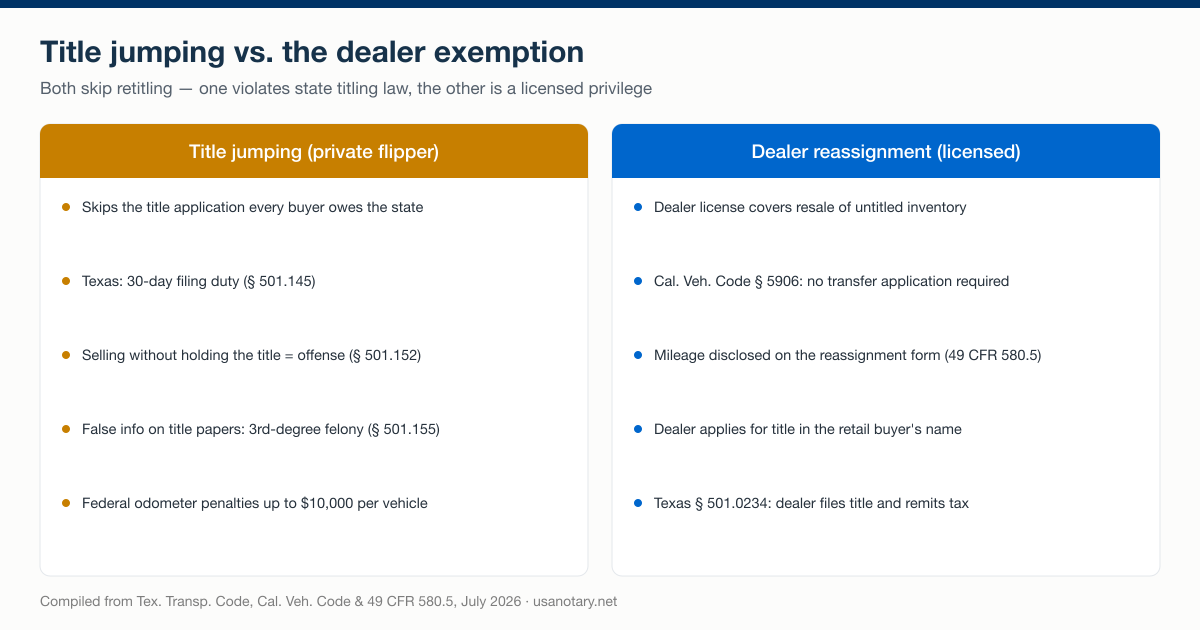
Both paths skip retitling — the statutes fetched for this article draw the legal line between them, re-verified October 2026.
Why is title jumping illegal?
Title jumping is illegal because state titling law puts a filing duty on every purchaser in the chain, and the jump is a refusal of that duty. The deadlines are short and explicit. Texas gives a used-vehicle purchaser until “the 30th day after the date of assignment” to file for title with the county assessor-collector (Tex. Transp. Code § 501.145). California gives a transferee 10 days to forward the endorsed certificate and transfer fee to the DMV (Cal. Veh. Code § 5902). Arizona gives 15 days (Ariz. Rev. Stat. § 28-2058). A flipper who resells before filing has, by definition, blown through the deadline — there is no legal window in which an unlicensed middleman can resell a vehicle they never applied to title.
| State | Buyer’s deadline to apply for a title | Statute (fetched October 2026) | Related offense provisions |
|---|---|---|---|
| Texas | 30 days after the date of assignment (60 for qualifying military) | Tex. Transp. Code § 501.145 | Selling a Texas-registered vehicle without possessing the title or title receipt is an offense (§ 501.152); false or incorrect info on a title application or assignment is a third-degree felony (§ 501.155) |
| California | 10 days after receiving the endorsed certificate | Cal. Veh. Code § 5902 | Acting as a dealer without a license is prohibited (§ 11700) |
| Arizona | 15 days after the transfer | Ariz. Rev. Stat. § 28-2058 | Selling seven or more used vehicles in twelve months makes you a “used motor vehicle dealer” subject to licensing (§ 28-4301(34)) |
| All states (federal) | Odometer disclosure due at every transfer of ownership, for most vehicles | 49 CFR § 580.5 | Civil penalty up to $13,676 per violation (the statute’s $10,000, inflation-adjusted under 49 CFR § 578.6(f)); knowing and willful violations up to 3 years imprisonment (49 U.S.C. § 32709) |
The federal layer: a broken odometer-disclosure chain
Title jumping also collides with federal law, and this is the part most articles miss. Under 49 CFR § 580.5, “in connection with the transfer of ownership of a motor vehicle, the transferor shall disclose the mileage to the transferee” — and a transferor “in whose name the vehicle is titled” must make that disclosure on the title itself, “not on a reassignment document.” A jumped-title flipper is never the titled owner, so they cannot execute the disclosure the regulation demands; the mileage statement the final buyer receives is signed by someone with no place in the record. Congress wrote the underlying statute because “buyers of motor vehicles rely heavily on the odometer reading as an index of the condition and value of a vehicle” (49 U.S.C. § 32701). The penalties are not decorative: 49 U.S.C. § 32709 sets a civil penalty of up to $10,000 per violation — “a separate violation occurs for each motor vehicle” — with a $1,000,000 cap for a related series, and a knowing, willful violation is a criminal offense punishable by up to 3 years. Those civil figures are adjusted for inflation: 49 CFR § 578.6(f)(1) currently reads “not more than $13,676 for each violation,” with a related-series maximum of $1,364,624. (Older vehicles are exempt from the disclosure rule — Arizona’s statute, mirroring the federal scheme, exempts model year 2010 and older vehicles at ten model years of age, and 2011-and-newer vehicles at twenty.) If the car in front of you is not exempt, the disclosure the seller still owes is the document to ask for by name — a transfer that cannot produce one, signed by the person whose name is on the title, is the fastest tell that a hop is missing from the chain.
Is title jumping a felony?
Sometimes — it depends on how the conduct is charged, because titling statutes rarely name the practice. Texas is a clean example of the ladder. The default penalty for an offense under the Certificate of Title Act is modest: a misdemeanor fine of $1 to $100 for a first offense (§ 501.157). Selling a Texas-registered vehicle without possessing the title or title receipt is its own offense (§ 501.152). But the moment a jumper writes a false date, fakes a price, or signs another person’s name on an assignment, the charge becomes knowingly providing “false or incorrect information” on a title document — a felony of the third degree under § 501.155. Stack the federal odometer exposure on top and a habitual flipper is running real criminal risk on every car.
How do licensed dealers legally skip retitling?
Licensed dealers skip retitling through a mechanism called dealer reassignment, and the exemption attaches to the dealer license — not to the practice of flipping. California states it plainly: when the transferee of a vehicle “is a dealer who holds the same for resale,” the dealer “is not required to make application for transfer” (Cal. Veh. Code § 5906). A dealership that takes a trade-in on Monday and wholesales it on Thursday does exactly what a title jumper does — resells without retitling — and does it legally, because the legislature carved out inventory held for resale.
This is the distinction every consumer article garbles, so it is worth being precise about what the exemption does and does not do:
- The exemption defers the paper trail; it does not delete it. Section 5906’s own closing words require that “upon transferring his title or interest to another person he shall comply with this division.” In Texas, a dealer holding a general distinguishing number (GDN) who sells at retail must “apply, in the name of the purchaser of the vehicle,” for title and registration, and remit the motor vehicle sales tax with the same filing (§ 501.0234). The state still ends the transaction with a titled owner and collected tax — the dealer’s name simply never occupies a link in the chain.
- Federal odometer law builds the reassignment path in. 49 CFR § 580.5(b) requires that “any physical documents which are used to reassign a title shall contain a space” for the mileage disclosure. The regulation assumes dealers will move vehicles on reassignment documents and forces the odometer statement onto each hop — the disclosure chain stays intact even though the title chain shows one assignment.
- The reassignment document is a dealer-only instrument. It travels with the title, records each dealer-to-dealer hop, and carries the odometer disclosure for every hop. A private individual filling out a dealer reassignment space is not using a loophole; they are documenting their own title jump.
- No license, no exemption. Texas closes the circle at the licensing end: “a person may not engage in business as a dealer, directly or indirectly, including by consignment,” without a GDN (§ 503.021). The words including by consignment matter — handing your flips to a friend’s “consignment lot” does not launder the license requirement away.
Why does the carve-out exist at all? Licensed dealers operate from an established place of business, under state oversight, with license numbers stamped on every reassignment they execute. The state can audit a dealer’s chain of hops after the fact; it cannot audit a stranger who was never in the record. The exemption is a regulated substitute for retitling — which is exactly why extending it to unregulated sellers defeats the point.
You bought a jumped-title car: how do you fix it?
A jumped title is fixable in most cases, but the fix runs through your state title office, and the burden of proof sits with you. Here is the sequence that title offices generally expect, with the two statutory tools that do the heavy lifting:
- Go back to the seller first. The cleanest cure is the titled owner completing a proper assignment to you directly. If your flipper is reachable and the titled owner is cooperative, a corrected assignment — every field completed, as our guide to signing over a car title lays out — resolves the gap without bonds or hearings.
- Assemble your ownership evidence. Payment records, messages with the seller, the assigned title you were handed, and a bill of sale. If you’re papering the purchase after the fact, a notarized bill of sale is stronger evidence than a signature nobody can attribute — the notarization pins the seller’s identity to the document.
- Ask your title office which cure it offers. Processes differ by state, and the office that will issue your title is the only authority whose answer matters. Texas, for instance, pairs a formal hearing procedure (§ 501.052) with a faster bond alternative.
- Post a bonded title where available. Texas lets an applicant “obtain a title by filing a bond” when the vehicle is in their possession and lien conditions are met — the bond must equal “one and one-half times the value of the vehicle as determined by the department” and indemnifies prior owners, lienholders, and subsequent purchasers (Tex. Transp. Code § 501.053). California’s version lets the DMV accept “an undertaking or bond” in the absence of the regularly required ownership evidence (Cal. Veh. Code § 4157). Not every state offers a bonded title, and eligibility conditions vary — step 3 tells you whether yours does.
Budget for the tax and fees the jumper skipped, too: the title office will collect what is due on your transfer regardless of what happened upstream.
How do notarized-title states catch a jumped title?
A cluster of states requires the title assignment itself to be notarized, and that requirement functions as a fraud checkpoint no other state paperwork provides. Kentucky’s Transportation Cabinet instructs that “the seller must sign the back of the title in the presence of a notary.” Louisiana’s OMV requires the certificate of title “assigned before a notary by seller to purchaser.” Oklahoma requires “a properly assigned and notarized Oklahoma certificate of title” to transfer ownership.
| State | Notarization rule on the title assignment | Source (fetched October 2026) |
|---|---|---|
| Kentucky | “The seller must sign the back of the title in the presence of a notary” | Kentucky Transportation Cabinet |
| Louisiana | Title “assigned before a notary by seller to purchaser” | Louisiana OMV |
| Oklahoma | “A properly assigned and notarized Oklahoma certificate of title”; for an electronic title, the Form 718 Electronic Title Bill of Sale “needs to be notarized” | Service Oklahoma, electronic titles FAQ |
The mechanism is identity, not detective work. A notary’s core duty is verifying the signer’s identity against government ID before completing the notarization. Title jumping depends on a seller signature that nobody scrutinizes — and in a notarized-title state, the person signing the seller’s assignment must produce ID, in front of a commissioned officer, matching the identity they claim. When the “seller” is a flipper whose name appears nowhere on the certificate, the transfer stalls at the notary’s desk instead of at the DMV counter weeks later. Our 50-state review of which states require a notary for a car title documents seven states with the requirement, plus five conditional ones.
Remote online notarization keeps the checkpoint and removes the trip: the National Association of Secretaries of State reports that 47 states and the District of Columbia have a law allowing remote e-notarization. One caveat carries over from every title workflow — the notary can be remote, but your state’s titling rules govern the document, so confirm the receiving title office accepts a remotely notarized transfer before completing one.
What is curbstoning — and how is it different from title jumping?
Curbstoning is unlicensed car dealing disguised as private selling — a flipper who runs a dealership’s sales volume from curbs, parking lots, and marketplace listings without the license state law requires. The Autopian’s reporting on the practice describes curbstoners as people who “buy and sell vehicles without a dealer’s license, proper permits or an established place of business.” The name comes from where the inventory sits: parked at the curb, one “private” sale at a time.
The two practices are different violations that usually travel together. Title jumping is a document problem — a gap in the chain of ownership. Curbstoning is a licensing problem — dealer-scale selling without dealer-scale accountability. A curbstoner who titled every flip in their own name would hand the state a neat record of unlicensed dealing, so curbstoners jump titles almost by necessity; the jumped title is the curbstoner’s camouflage.
The licensing line is written into state code, and it is lower than most flippers assume:
- Arizona defines a “used motor vehicle dealer” as anyone “engaged in the business of selling, seven or more used motor vehicles in a continuous twelve month period” (Ariz. Rev. Stat. § 28-4301(34)). Seven sales in a year is a hobbyist’s pace — and it is dealer territory in Arizona.
- California prohibits acting as a dealer at all without first being issued a license (Cal. Veh. Code § 11700).
- Texas bars engaging in business as a dealer “directly or indirectly, including by consignment,” without a general distinguishing number (Tex. Transp. Code § 503.021).
For buyers, the tells overlap with jumped-title tells: a seller whose name doesn’t match the title, a “friend’s car” being sold on someone’s behalf, the same phone number behind multiple listings, and a strong preference for parking-lot meetups over any venue — a notary, a title office — where ID gets checked.
How do dealerships and auctions screen out jumped titles?
Automotive businesses sit on the receiving end of this fraud: a curbstoned trade-in or a consigned vehicle with a jumped title becomes the dealership’s problem the moment it enters inventory. The screening principle that works is the same one notarized-title states baked into their statutes — put a verified identity on the seller’s paperwork before the vehicle is accepted.
That is a workflow remote online notarization handles without slowing the deal. A title clerk sends the consignor’s paperwork — seller’s affidavit, title power of attorney, odometer statement — into a staff-initiated session; the signer completes identity verification through credential analysis of their government ID plus knowledge-based authentication, then signs on camera before a commissioned notary. Sessions run 24/7, take 15–30 minutes, support multiple signers, and work for signers in all 50 states. Every session produces a tamper-evident PDF and a complete audit trail, with the audio-video recording and electronic journal retained for 10 years or longer where state law requires — so if a “seller” later claims they never signed, the record answers. At $25 per document with volume pricing for recurring title-desk work, the screen costs less than one hour of unwinding a bad consignment. Our online notarization service for automotive businesses covers the dealership, lender, and auction workflows end to end.
The rule that protects everyone in the chain is the one title jumping exists to dodge: every owner applies for a title, every assignment carries a real identity, and the paper matches the person. Questions about a title-desk workflow? Call 804-767-7500 or contact us.