
This guide describes what the statutes and one court form say. It is not legal advice, and your state’s probate court or an attorney decides whether an estate qualifies. If your state’s form calls for an oath and the office receiving it accepts remote notarization, you can notarize it online for $25 per document; the sections below show which states call for one.
What is a small estate affidavit, and what can’t it do?
A small estate affidavit is a sworn or declared statement that lets a decedent’s successors collect or transfer the decedent’s personal property without a court-appointed representative. Texas Estates Code § 205.001 puts it as entitlement to the estate “without waiting for the appointment of a personal representative.” California Probate Code § 13100 lets the successor act “without procuring letters of administration or awaiting probate of the will.”
The affidavit has limits that the statutes spell out:
- It does not erase debts. Texas allows it only “to the extent the estate assets … exceed the known liabilities of the estate.” Illinois says the affiant “is obligated to pay all valid claims against the decedent’s estate before any distribution is made to any heir or legatee.”
- It does not make the affiant safe if the facts are wrong. The signers carry the risk; the liability language is covered below.
- It generally does not move real estate. Texas § 205.008(b): “Except as provided by Section 205.006, this chapter does not transfer title to real property.” Section 205.006 covers only a homestead that is the decedent’s only real property, and that affidavit “must be recorded in the deed records.” Arizona uses a separate real-property affidavit, filed in court.
- It does not change a will. Texas § 205.008(a): the chapter “does not affect the disposition of property under a will or other testamentary document.”
Who can use a small estate affidavit?
The statutes read here set three kinds of test: a waiting period since the death (the Illinois text states none), no personal representative administering the estate, and a value under the state’s dollar limit. Each state words and measures these differently, and two allow exceptions to the representative test: California’s affidavit can state that the personal representative “has consented in writing,” and Arizona’s can be used once “the personal representative has been discharged or more than one year has elapsed since a closing statement has been filed.”
Waiting period. The clock starts at the date of death: 30 days in Texas and Arizona, 40 in California and Washington, 60 in Virginia. Washington adds a notice step: the claiming successor must give written notice to the other successors and “at least ten days have elapsed since the service or mailing of such notice.” California ties the 40 days to an attached “certified copy of the decedent’s death certificate.”
No administration under way. Texas: “no petition for the appointment of a personal representative is pending or has been granted.” Illinois asks that “no letters of office are outstanding” and no petition for letters is “contemplated or pending in this State or in any other jurisdiction.” Washington and Virginia use similar language (“in any jurisdiction”).
Will or no will. Texas chapter 205 applies to “the distributees of the estate of a decedent who dies intestate.” Illinois counts personal estate “passing to any party either by intestacy or under a will.” Virginia’s affidavit states that “the decedent’s will, if any, was duly probated.”
Dollar limit. The number and what it counts differ by state; the table below puts them side by side. Two examples show the gap: Texas excludes “homestead and exempt property,” while California counts “the gross value of the decedent’s real and personal property in this state” (less property described in section 13050 and any property in a section 13151 petition).
Who signs a small estate affidavit, and does it need a notary?
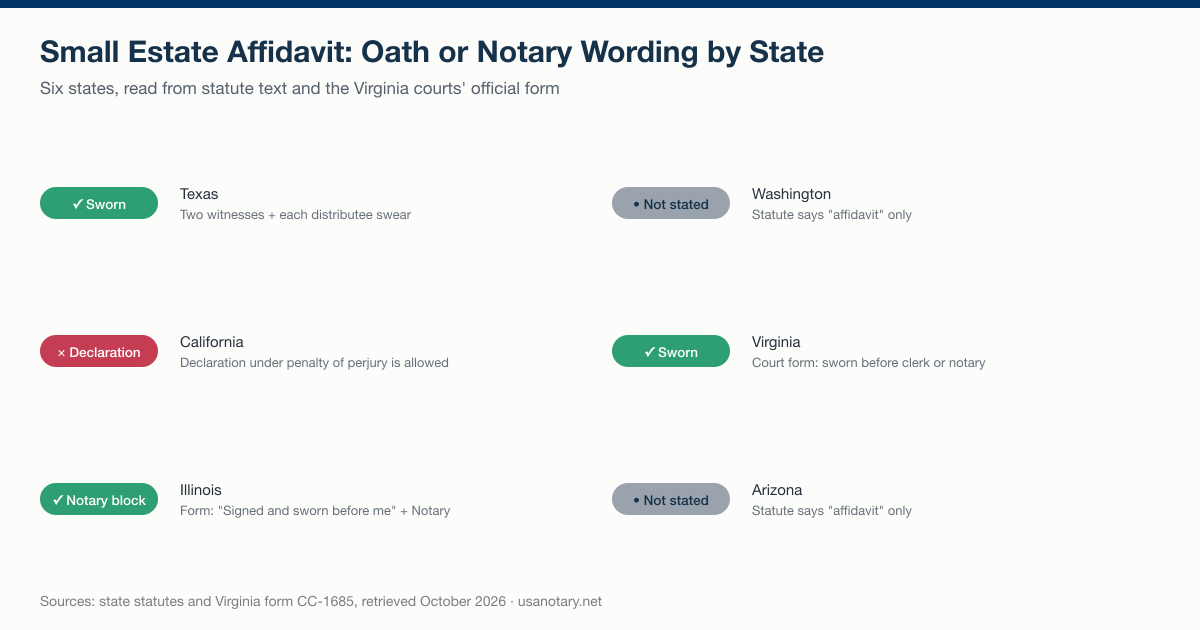
The signer list and the notary rule both depend on the state, and the two do not always travel together. The statutes read for this page fall into four groups.
The statute or form names an oath before a notary. Illinois’s statutory form opens “I, (name of affiant), on oath state” and closes with “Signed and sworn before me on (insert date)” above a “Notary Public” line. Virginia’s statute says only “affidavit,” but the Virginia courts’ form CC-1685 closes with “Subscribed and sworn to/affirmed before me,” with boxes for clerk, deputy clerk or notary public.
The statute says “sworn” without naming a notary. Texas § 205.002(a)(1) requires the affidavit to be “sworn to by” two disinterested witnesses and each distributee with legal capacity. A notary has “the same authority as the county clerk to … administer oaths” under Texas Government Code § 406.016, so a notary can take the oath the statute requires. The difference between swearing and merely acknowledging a signature is covered in jurat versus acknowledgment.
The statute accepts a declaration. California § 13101(a) requires “an affidavit or a declaration under penalty of perjury under the laws of this state” and prescribes the closing statement, “The affiant or declarant affirms or declares under penalty of perjury under the laws of the State of California that the foregoing is true and correct.” A declaration under penalty of perjury is not sworn before a notary, so § 13101 itself does not call for one. If the asset is a debt secured by a recorded lien on real property, § 13101(c) adds the requirements of § 13106.5, which this page does not cover. Check whether the bank or transfer agent holding the asset asks for its own notarized version before you sign.
The statute is silent. Washington’s RCW 11.62.010 and Arizona’s A.R.S. 14-3971 say “affidavit” and set no notary wording in the text read. Arizona’s real-property affidavit adds that signers acknowledge “that any false statement in the affidavit may subject the person or persons to penalties relating to perjury and subornation of perjury.” Silence in a statute does not settle what a given court, bank or DMV accepts. Ask the receiving office.
Who is the affiant. The person who swears the facts is the affiant; what an affiant does covers the role. Several states ask for more than one signer. Texas needs the two witnesses plus every distributee with capacity (and, “if warranted by the facts,” a guardian or next of kin for a minor or incapacitated distributee). Virginia’s affidavit is “made by all of the known successors.” Illinois’s form has a single affiant who names the heirs and distribution.
Why the signers should care. Texas § 205.007(c): “Each person who executed the affidavit is liable for any damage or loss to any person that arises from a payment, delivery, transfer, or issuance made in reliance on the affidavit.” Illinois § 25-1(e): the affiant “shall indemnify and hold harmless all creditors, heirs, and legatees of the decedent and other persons, corporations, or financial institutions relying upon the affidavit who incur loss because of such reliance,” up to the amount lost because of the affiant’s act or omission.
Small estate affidavit limits, waiting periods and notary wording by state
This table covers six jurisdictions only: Texas, California, Illinois, Washington, Virginia and Arizona. Each row was read from the legislature’s own text (or, for Virginia’s notary wording, the Virginia courts’ form) on 2026-10-01. It is not a 50-state table, and a state missing from it has not been checked.
| State | Dollar limit and what it counts | Wait | Who swears or signs | Oath or notary wording in the source |
|---|---|---|---|---|
| Texas (Est. Code 205.001-.004) | $75,000 in estate assets on the date of the affidavit, “excluding homestead and exempt property.” Decedent must have died intestate. | 30 days | Two disinterested witnesses, each distributee with legal capacity, and a guardian or next of kin for a minor or incapacitated distributee if the facts warrant | “sworn to by” those signers. The statute does not use the word notary. |
| California (Prob. Code 13100-13101) | $208,850 for deaths on or after April 1, 2025 ($184,500 for deaths from April 1, 2022 to March 31, 2025; $166,250 before). Counts gross value of real and personal property in California, with listed exclusions. | 40 days, shown by an attached certified death certificate | The successor (the “affiant or declarant”), or a person authorized to act for the successor | “an affidavit or a declaration under penalty of perjury.” No notary named. |
| Illinois (755 ILCS 5/25-1) | $150,000 in personal property for deaths on or after August 15, 2025, not counting motor vehicles registered with the Secretary of State, which are listed separately. For earlier deaths the form’s limit was $100,000 for the gross value of the entire personal estate. | None stated in the text read | The affiant | Statutory form: “on oath state” … “Signed and sworn before me on (insert date)” … “Notary Public” |
| Washington (RCW 11.62.010) | $100,000 for the entire estate subject to probate, less liens and encumbrances, not counting a surviving spouse’s or domestic partner’s community property interest. Decedent must have been a Washington resident. | 40 days, plus 10 days after written notice to the other successors | The claiming successor | Statute says “affidavit.” No notary wording in the text read. |
| Virginia (Va. Code 64.2-601; form CC-1685) | $75,000 in the decedent’s entire personal probate estate, wherever located | 60 days | All of the known successors | Statute: “affidavit,” on a form prepared by the Supreme Court’s Office of the Executive Secretary. Form CC-1685: “Subscribed and sworn to/affirmed before me,” clerk, deputy clerk or notary public. |
| Arizona (A.R.S. 14-3971) | $200,000 in personal property, less liens and encumbrances, “as valued as of the date of death.” Real property is a separate court-filed affidavit with a $300,000 limit. | 30 days (personal property); 6 months (real property) | The successor, or a person acting on the successor’s behalf | Statute says “affidavit.” The real-property affidavit carries a perjury acknowledgment. No notary wording in the text read. |
A “not stated” or “none stated” cell means the text we read says nothing on that point. It does not mean the point is optional. Banks, transfer agents, courts and motor vehicle offices set their own acceptance rules, so confirm with the receiving office.
What do the limits actually count?
The same dollar figure measures different things in different states. Texas counts estate assets minus homestead and exempt property. California counts gross value of real and personal property in the state, with exclusions. Illinois, for deaths on or after August 15, 2025, counts personal estate except registered motor vehicles. Washington counts the whole probate estate less liens. Virginia and Arizona count personal property wherever located (Arizona less liens and encumbrances). An estate that fits under one state’s measure can miss another’s.
Which dates change the numbers?
- California: the $208,850 figure is date-of-death specific. The Judicial Council table says “Unless otherwise provided by statute, these amounts will next be adjusted on April 1, 2028.” For deaths on or after April 1, 2022, § 13101(f) says the list of adjusted amounts “shall be attached” to the affidavit or declaration.
- Illinois: the $150,000 limit and the separate listing of registered motor vehicles came from P.A. 104-346, effective August 15, 2025, and § 25-1(j) applies those changes to “a decedent whose date of death is on or after the effective date.” Before that, the form read $100,000 for “the gross value of the decedent’s entire personal estate.” P.A. 104-624 takes effect January 1, 2027. The $150,000 limit stays, but the text then says that motor vehicles used as living quarters; motor homes, mini motor homes and van campers; non-self-propelled vehicles; commercial vehicles; implements of husbandry; and buses or commuter vans “shall not be considered an excluded motor vehicle” when valuing the estate. For a death near either date, confirm with the circuit court clerk or an attorney which version applies.
- Virginia: county websites may host older affidavit forms. The King George County “Virginia Small Estate Act Affidavit” we fetched, a county-hosted form rather than CC-1685, lists $50,000; the statute and form CC-1685 (revision 07/26) say $75,000. The statute now says “The affidavit shall be on a form prepared by the Office of the Executive Secretary of the Supreme Court of Virginia,” so use form CC-1685 from the courts’ site.
Where does a small estate affidavit go: court, bank, DMV or recorder?
Texas files it with the court; in the other five states, the personal-property procedure has the successor present it to the holder of the property. The recipient differs by state:
- Texas: the affidavit is “filed with the clerk of the court that has jurisdiction and venue of the estate,” and “the judge approves the affidavit” under § 205.003. Distributees then give a clerk-certified copy to each person who owes money to the estate, holds estate property, or acts as registrar, fiduciary or transfer agent (§ 205.004). A homestead affidavit is recorded in the deed records.
- California: the affidavit or declaration “shall be furnished to the holder of the decedent’s property,” with a certified copy of the death certificate attached.
- Illinois: a person, corporation or financial institution holding the decedent’s personal estate that “is furnished with a small estate affidavit in substantially the form hereinafter set forth” is directed to pay or deliver. The form attaches a copy of the death certificate. The statute also lets the affidavit be used for a title transaction with the Secretary of State for the decedent’s vehicles.
- Washington: to a person who owes a debt or holds property, to a transfer agent of a security, or to a government agency that issues ownership certificates, with proof of death. A copy, “including the decedent’s social security number,” is mailed to the Department of Social and Health Services’ Office of Financial Recovery.
- Virginia: to “any person having possession of a small asset,” and to a transfer agent of a security.
- Arizona: to the person holding the property or debt, a transfer agent, or the motor vehicle division for a vehicle; the real-property affidavit is filed in court, and a certified copy is recorded with the county recorder.
Financial institutions are the most common holders. Online notarization for banks and credit unions covers how institutions receive remotely notarized documents; whether a particular branch accepts a remotely notarized small estate affidavit is that institution’s call. For vehicles after a death, see how title transfers treat notarization state by state, including the Texas heirship affidavit row.
How do you notarize a small estate affidavit online when several people must sign?
Online notarization can let each signer swear before a notary over two-way audio and video from a different location, which suits families spread across states. Texas defines the term: “a notarial act performed by means of two-way video and audio conference technology that meets the standards adopted under Section 406.104.” The National Association of Secretaries of State reports that 47 states and the District of Columbia have a law allowing remote e-notarization. The statutes read here do not say whether a given Texas clerk, bank or DMV accepts a remotely notarized small estate affidavit, so the first step is to ask.
- Read the form your state uses. Find out who must swear (Texas: two witnesses and each distributee; Virginia: all known successors) and whether the form calls for a notary or accepts a declaration (California).
- Ask the receiving office. Confirm that the court clerk, bank or transfer agent accepts a remotely notarized affidavit, and ask whether it wants its own form.
- Gather the attachments. California and Illinois call for a certified or attached copy of the death certificate. California also requires the adjusted-amounts list for deaths on or after April 1, 2022. Illinois’s form lists each asset and debt.
- Fill in everything except the signatures. The Illinois and Virginia notary blocks read “Signed and sworn before me” and “Subscribed and sworn to/affirmed before me,” which describe signing and swearing in front of the officer. Leave signature lines blank until the session.
- Line up every signer. Illinois’s form has an out-of-state affiant submit to the jurisdiction of Illinois courts and name an agent for service of process. Texas directs its online notarization standards to cover “credential analysis and identity proofing,” so expect each signer to prove identity to the notary.
- Hold the session. Each signer takes the oath, signs when the notary directs, and the notary completes the certificate. A notary administers the oath; the signer swears to the facts.
- Deliver the signed affidavit. File it with the court (Texas) or present it to the holder, with attachments.
Online notarization on USA Notary costs $25 per document. Questions about your documents or number of signers? Call 804-767-7500. For the general mechanics of a sworn document, see how to notarize an affidavit.
Small estate affidavit vs. heirship affidavit vs. probate: which applies?
They answer different questions. A small estate affidavit gets personal property to successors without a representative. An heirship affidavit records who the heirs are. Probate appoints a representative. The table uses Texas chapters 203 and 205 as the worked example.
| Instrument | What it does, per the statute | Notary or oath wording in the source |
|---|---|---|
| Small estate affidavit (Texas ch. 205) | Entitles distributees to the estate “without waiting for the appointment of a personal representative,” up to $75,000, with a judge’s approval | “sworn to by” two disinterested witnesses and each distributee |
| Heirship affidavit (Texas ch. 203) | A statement of facts about family history and identity of heirs, received by a court “as prima facie evidence” in a heirship proceeding or title suit if it was legally executed as described in the next column and has been of record five years or more in the deed records | “legally executed and acknowledged or sworn to before, and certified by, an officer authorized to take acknowledgments or oaths”; the sample form ends with a “signature of notarial officer” line |
| Probate (appointment of a personal representative) | Appoints a personal representative to administer the estate. The Texas small estate route requires that “no petition for the appointment of a personal representative is pending or has been granted” | Not covered by this page |
If the estate is over your state’s limit, the small estate affidavit is generally not the instrument. If a personal representative has been appointed, most of the statutes read here rule it out; California (with the representative’s written consent) and Arizona (after discharge, or a year after a closing statement) are exceptions, so ask the probate court clerk or an attorney. Survivorship (joint tenancy) transfers are a separate topic and outside this page. For a brokerage account, the institution’s own paperwork may ask for an affidavit of domicile, and for a deceased owner’s unclaimed funds, see claiming a deceased owner’s unclaimed property. When you are unsure which applies, ask the probate court clerk or an attorney.